VOA Courtesy: VOA
2 October 2025

Time to re-burnish Global South credentials

The year 2025 is often compared to the Bandung moment of 1955, and for good reason. With the U.S. reordering traditional relationships, the opportunity for greater emphasis on the Global South is now. It is therefore time for India, Africa and ASEAN among others to re-burnish their Global South credentials and use that identity as a platform to engage each other more deeply.

U.S. Tariffs on Brics+ countries Courtesy: Gateway House
25 September 2025

U.S. Reciprocal Tariffs on BRICS+ countries

Under U.S. President Donald Trump’s reciprocal trade policy, the original five BRICS member countries account for the highest U.S. tariffs globally. India and Brazil are facing the highest tariffs of 50%, while China follows with a tariff of 34%, down from 145% earlier in the year. This infographic details the U.S. reciprocal tariff rates for each BRICS+ member and the sectors that are impacted.

Gateway House (4) Courtesy: Gateway House
18 September 2025

A new momentum for middle powers

The world is undergoing a profound transformation - not driven by the U.S., China, or Russia, but by small and medium states carving out their rightful space in the emerging order. With UN reform stalled, middle-power cooperation must organise effectively to push for a responsive multilateral system that works for all, ensuring institutions are reformed and made fit for today’s world.

ANI Courtesy: ANI
11 September 2025

India and Indonesia reconnect 

India and Indonesia are two Asian leaders and democracies which are reconnecting after decades, even centuries – in a world rife with new volatility and uncertainty. Both countries can collaborate and learn: Indonesia is an adept trading nation and India is a powerful tech player. The two governments are on a mission to deepen and diversify their relationship, stepping out of their past, and bringing fresh thinking.

X  narendramodi Courtesy: X / Narendra Modi
22 August 2025

India-China risky boundary early harvest

Chinese Foreign Minister Wang Yi's two-day visit to India achieved a significant goal: to resolve the bilateral border dispute and ensure Prime Minister Narendra Modi’s presence at the Shanghai Cooperation Organisation summit. It’s not a reaction to the U.S.-India tariff tensions, but a realistic policy compulsion felt by India.

PM 5 nation visit (1) Courtesy: Gateway House
7 August 2025

India becomes strategic with Latin America

India’s engagement with Latin America is gaining momentum, marked by PM Modi’s recent visits to Brazil, Argentina, and Trinidad & Tobago. Amid rising Chinese influence, sustained political engagement and targeted investments are key to unlocking Latin America’s potential for India’s benefit. India needs a multifaceted strategy that blends economic engagement with public diplomacy and more official visits at higher political levels.

PM 5 nation visit Courtesy: X / PMOIndia
14 July 2025

PM Modi’s five-nation tour

PM Modi's five-nation tour highlights that despite geopolitical conflicts, New Delhi remains confident in its ability to balance relationships with the North and South.

Ricardo Moraes  Reuters Courtesy: Ricardo Moraes / Reuters
9 July 2025

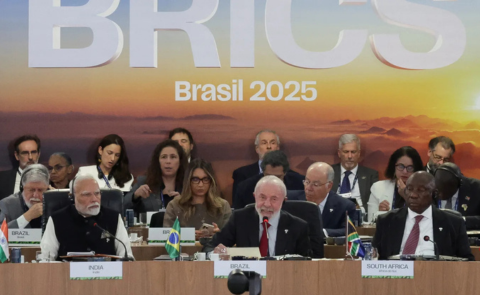
BRICS Summit: strengthening cooperation

While BRICS does have a wise agenda, backed by considerable unity, it is not in a strong position to garner the world’s support for it. The fissures within the G7, the tensions between the U.S. and Europe, and the unilateralism of Washington leave little room for BRICS to develop an international consensus on the issues agreed at the recent Rio Summit.

X  @narendramodi Courtesy: X / narendramodi
4 July 2025

Shaping the future of BRICS

BRICS is undergoing a major transformation—expanding its membership, redefining its global role, and navigating geopolitical tensions. As the group prepares for the Rio Summit in July 2025, key challenges include integrating new members, reforming multilateral institutions, and balancing economic ambitions with strategic unity. With India set to chair in 2026, the bloc’s evolving identity will shape its global influence.

Getty (1) Courtesy: Gateway House
15 May 2025

The New Geopolitics and South Asia’s Trade Architecture – What Next?

Geopolitics is increasingly intertwined with the economic destiny of South Asia. Even before the U.S. tariffs were rolled out, growing polycrises had hit the global economy, which has been struggling since the pandemic. South Asia seems a relatively bright spark of regional trade and growth. This paper analyses South Asia’s trade architecture in the backdrop of a sluggish world economy in the 2020s, and makes recommendations for closer regional economic integration.