


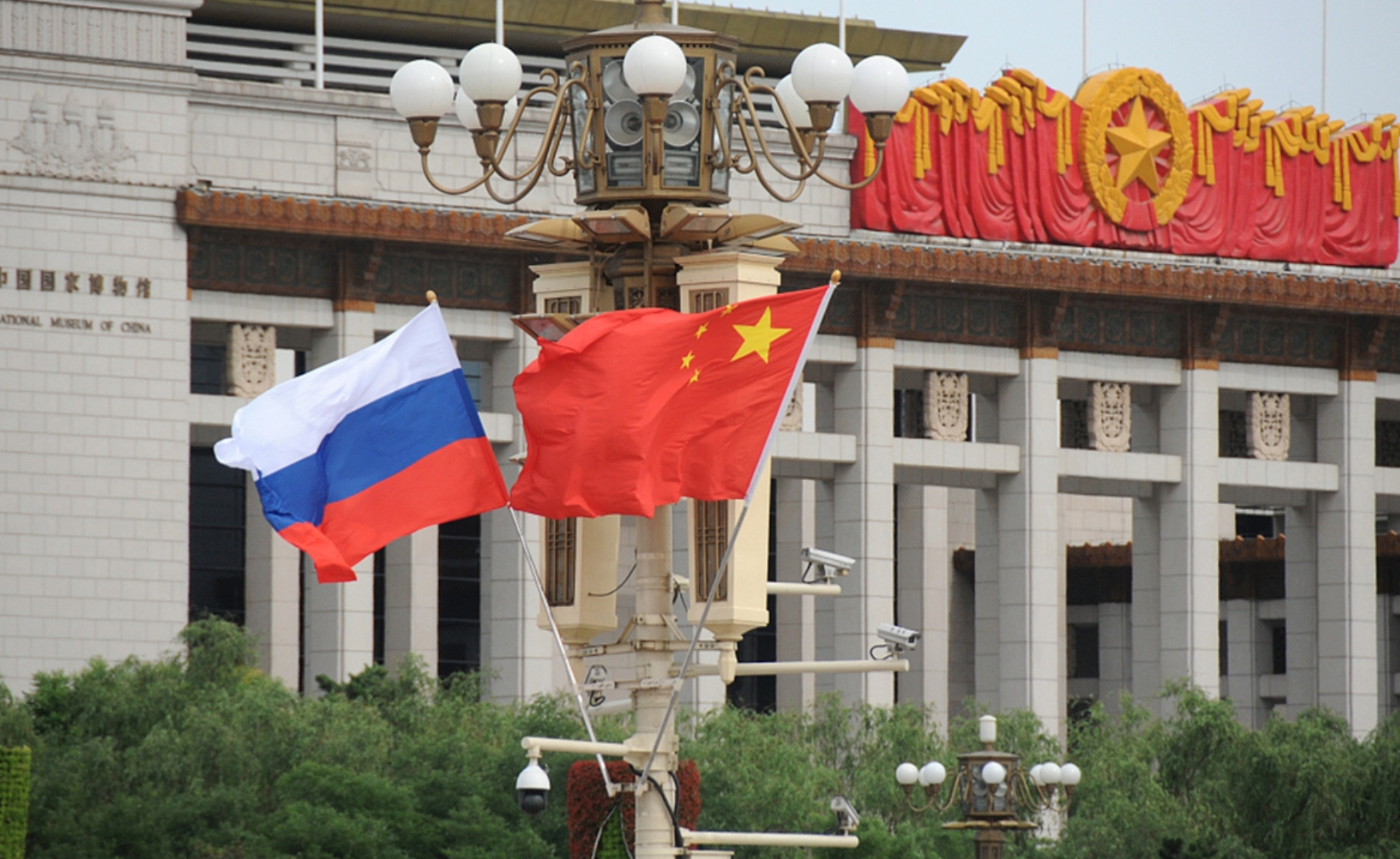
At the Sept. 1-4 annual Eastern Economic Forum in the Russian Pacific port of Vladivostok, Russia’s First Deputy Prime Minister Denis Manturov announced[1] that Russia-China bilateral trade grew by 22% in the first half of 2026 and exceeded $135 billion[2]. Bilateral trade had fallen by 6.9% in 2025 after a record high of $245 billion a year earlier, on account of a reduction in the value of Chinese crude imports from Russia and a fall in Russian imports of Chinese cars. Judging by the latest numbers, bilateral trade between Moscow and Beijing in 2026 is set to touch an all-time high. The trendline has been climbing over the last 25 years, with bilateral trade between the countries having grown more than thirty-fold.
The trade relationship between the two countries mirrors the diplomatic one, which deepened after the signing of the Treaty[3] of Good-Neighbourliness, Friendship and Cooperation in July 2001. The 20-year treaty, which was extended for five years in 2021 and for another five in May 2026, identified trade, military know-how, science and technology, energy resources, transport, nuclear energy, finance, aerospace and aviation, and information technology as major areas of cooperation between the countries.
At the beginning of the 20th century, China’s share in Russia’s foreign trade stood at less than 5%; now the Asian powerhouse is Moscow’s largest trading partner, accounting for 27% of its total exports and 36% of total imports,[4] according to the Geidar Institute for Economic Policy. The economic relationship has been fortified since the Ukraine war began in February 2022.
In a report[5] published in August 2026, the U.S.-China Economic and Security Review Commission, which was set up by the U.S. Congress to monitor and investigate the national security implications of the U.S.-China economic relationship, said China has become “indispensable” for Russia. “China and Russia have built an increasingly sanctions-resistant financial and economic relationship that has reduced but not eliminated Western leverage,” said the commission’s report. It added that China’s “layered sanctions-evasion networks” have reduced Russia’s isolation and increased Moscow’s dependence on Beijing.
One of the key factors in evading sanctions and reducing Western leverage has been the use of the ruble and renminbi in bilateral trade. Addressing the Russia-China Energy Business Forum in Vladivostok, Rosneft Chief Executive Igor Sechin said[6] mutual settlements between the countries were “handled almost entirely” in national currencies, bypassing the U.S. dollar altogether. “To consolidate the use of national currencies, it is required to fine-tune the relevant infrastructure and instruments supporting clearing operations and open the correspondent accounts,” he added.
While this payment arrangement entirely suits Russia, which faces over 30,000 active international sanctions, Chinese banks are being increasingly cautious in their dealings with Russian entities in order to avoid secondary sanctions from the U.S.
Speaking ahead of the St Petersburg International Economic Forum in June 2026, Alexander Vedyakhin, first deputy chairman of the executive board of Sberbank, said[7] there were “persistent gaps within the payment infrastructure” when it came to settlements in rubles and yuan. “Payment routes become significantly more complex, requiring the inclusion of additional intermediary banks – which often reject payments without providing detailed explanations,” he added.
The threat of secondary sanctions continues to loom for China. The Lindsey O. Graham Sanctioning Russia and Iran Act of 2026, which has been passed by the U.S. Congress, threatens Beijing with up to 100% tariffs for importing Russian oil.[8] China imported 67 million tonnes of Russian oil in the first seven months of 2026, Rosneft’s Sechin said[9] in Vladivostok in September.
China is heavily dependent on Russia to power its economy. In 2025, Beijing imported[10] 38.8 billion cubic metres of natural gas from Russia through the Gazprom-operated 3,000-km Power of Siberia pipeline. The countries are holding negotiations for the construction of the 2,600-km Power of Siberia-2 pipeline that will deliver 50 billion cubic metres of gas from the Yamal fields in the Russian Arctic to China via Mongolia.
Russia is China’s leading supplier of enriched uranium, accounting for 90% of China’s purchases in 2025.[11] Moscow also supplied 90 million tonnes of coal to China, about 20% of its imports. Rosneft CEO Sechin said the share of coal in China’s power generation is expected to stay at 40% over the next ten years.
With Russian natural resources playing a key role in firing the Chinese economy, it is unlikely that Beijing will allow U.S. sanctions to interrupt its energy trade with Moscow.
However, Russia accounts for just 4% of China’s total foreign trade, and the question of Moscow’s overall economic dependence on Beijing once again arises. Despite their global geopolitical rivalry, the U.S. remains China’s top trade partner, with bilateral trade[12] between the countries standing at $494.6 billion in 2025.
The U.S.-China Economic and Security Review Commission’s August 2026 report claimed that Beijing is “converting Moscow’s dependence into lasting military, technological, economic and geopolitical advantages, while avoiding the obligations of a formal alliance.”
Such criticism that comes from the West and some in India has been shrugged off by Moscow. In an August 2026 article for the Kommersant newspaper, Russian Foreign Minister Sergey Lavrov said[13] the 2001 treaty offered both countries “necessary flexibility and, consequently, clear advantages over ‘classical alliances’.” He added that the economies of the two countries were “intrinsically complementary,” and that the “relations between Russia and China are built on an equal footing, are free from ideological dogma, are not directed against third countries, and remain resilient to the influence of external circumstances.”
Apart from cars, China has captured a substantial share in Russia’s electrical and electronic equipment market. The value of smartphone exports from China increased by 14.7% to $943.4 million in the first seven months of 2026, according to TASS data.[14]
Polling organisations like Levada do not specifically conduct research on economic and trade policies, so it is difficult to understand how ordinary Russians feel about the growing economic dependence of their country on China. Anecdotal evidence does suggest that there is discontent with the withdrawal of Western products and brands from the country and their replacement with Chinese substitutes. This, however, has little to no impact on government policy.
Policymakers in Moscow are clearly aware of the dangers of too much dependency on China and have, since 2022, expanded their so-called pivot to Asia by increasing engagement with partners like India and African countries. Setting a $100 billion trade target with India, Innoprom, a large-scale industrial exhibition that is held in Yekaterinburg, held its inaugural India edition [15] in New Delhi just before the 2026 BRICS summit. Over 200 exhibitors took part in the exhibition at the Bharat Mandapam.
Russia continues to increase its engagement with other major economies of the Global South, but those will be unable to replace its trade relationship with China, which is only set to grow. Foreign Minister Lavrov’s views on intrinsic complementarity are echoed in the corridors of power in Beijing – a mutually beneficial arrangement.
Ajay Kamalakaran is a writer with a special interest in Russia and the former Soviet Union.
This article was exclusively written for Gateway House: Indian Council on Global Relations. You can read more exclusive content here.
For permission to republish, please contact outreach@gatewayhouse.in
©Copyright 2026 Gateway House: Indian Council on Global Relations. All rights reserved. Any unauthorised copying or reproduction is strictly prohibited.
References:
[1] Ministry of Foreign Affairs of the Russian Federation (@MIDRussia), “Government of the Russian Federation: On September 3, Russia’s First Deputy Prime Minister Denis Manturov…,” Facebook, September 2026, https://www.facebook.com/MIDRussia/posts/government-of-the-russian-federation-on-september-3-russias-first-deputy-prime-m/1428702176119505/.
[2] In 2022, China had a trade deficit of $38 billion. This narrowed to less than $1 billion in 2025. The growth in exports has been mainly powered by heavy machinery and automobiles. Since 2022, there has been a massive increase in automobile exports from China to Russia. According to Russian research firm Autostat, automobile exports from China to Russia rose by 21% in the first seven months of 2026 to 161,200 units. There is a visible increase in Haval (Great Wall), Chery, and JAC models on Russian roads. Imports fell in 2025 as Russia increased recycling fees (meant for end-of-life disposal) for cars by 85%. Chinese manufacturers are now increasingly looking at production in Russia. There is also a thriving grey market where European car brands are finding their way to Russia through China.
[3] “Treaty of Good-Neighborliness and Friendly Cooperation Between the People’s Republic of China and the Russian Federation,” signed July 16, 2001, Ministry of Foreign Affairs of the People’s Republic of China, July 24, 2001, https://www.mfa.gov.cn/mfa_eng./zy/gb/202405/t20240531_11367098.html.
[4] Aleksandr Knobel and Aleksandr Firanchuk, “Itogi vneshnei torgovli v 2025 godu” [Results of Foreign Trade in 2025], Monitoring ekonomicheskoi situatsii v Rossii (Moscow: Gaidar Institute for Economic Policy, March 2, 2026), https://www.iep.ru/ru/monitoring/itogi-vneshney-torgovli-v-2025-godu.html.
[5] Joseph Federici and Morgan Peirce, “China-Russia Fact Sheet: A Short Primer on the Relationship,” U.S.-China Economic and Security Review Commission, August 20, 2026, https://www.uscc.gov/research/china-russia-fact-sheet-short-primer-relationship.
[6] Rosneft, “Sechin: Settlements Between Russia and China Are Being Conducted in National Currencies; Central Bank Support Is Needed,” news release, September 4, 2026, https://www.rosneft.com/press/news/item/224681/.
[7] Sberbank, “Sber: RUB and CNY transactions between Russia and China are ongoing, but the infrastructure needs fine‑tuning,” June 2, 2026, https://www.sberbank.ru/en/press_center/all/article?newsID=e5a885af-fc9e-4205-8799-400d3eb262a7&blockID=1539®ionID=77&lang=en&type=N.
[8] Lindsey O. Graham Sanctioning Russia Act of 2026, S. 5025, 119th Cong. (2026), https://www.congress.gov/bill/119th-congress/senate-bill/5025?hl=Lindsey+o+graham&s=1&r=2.
[9] Rosneft, “Sechin: The Position of Russia and China in the Global Economy and Energy Sector Creates the Foundation for Synergy,” news release, September 4, 2026, https://www.rosneft.com/press/news/item/224680/.
[10] Gazprom, “In 2025, Gazprom supplied more gas to China than to Europe for the first time,” 13 January 2026, https://www.gazprom.ru/press/news/2026/january/article583408/
[11] Rosneft, “Sechin: China Is an ‘Electrostate’ That Has Surpassed the U.S. and the EU in Energy Consumption,” news release, September 4, 2026, https://www.rosneft.com/press/news/item/224676/.
[12] Office of the United States Trade Representative, “The People’s Republic of China,” https://ustr.gov/countries-regions/china-mongolia-taiwan/peoples-republic-china.
[13] Sergey Lavrov, “A Constant in an Era of Radical Change: On the 25th Anniversary of the Russian-Chinese Treaty of Good-Neighbourliness, Friendship, and Cooperation,” Kommersant, July 16, 2026, reproduced by Ministry of Foreign Affairs of the Russian Federation, https://mid.ru/en/foreign_policy/news/2126964/.
[14] TASS, “China increased its export of integrated circuits to Russia by 183.4%,” July 20, 2026, https://tass.ru/ekonomika/27932749.
[15] “INNOPROM. India 2026,” International Industrial Trade Fair, New Delhi, September 9–11, 2026, accessed September 17, 2026, https://india.biwexpo.com/en.