


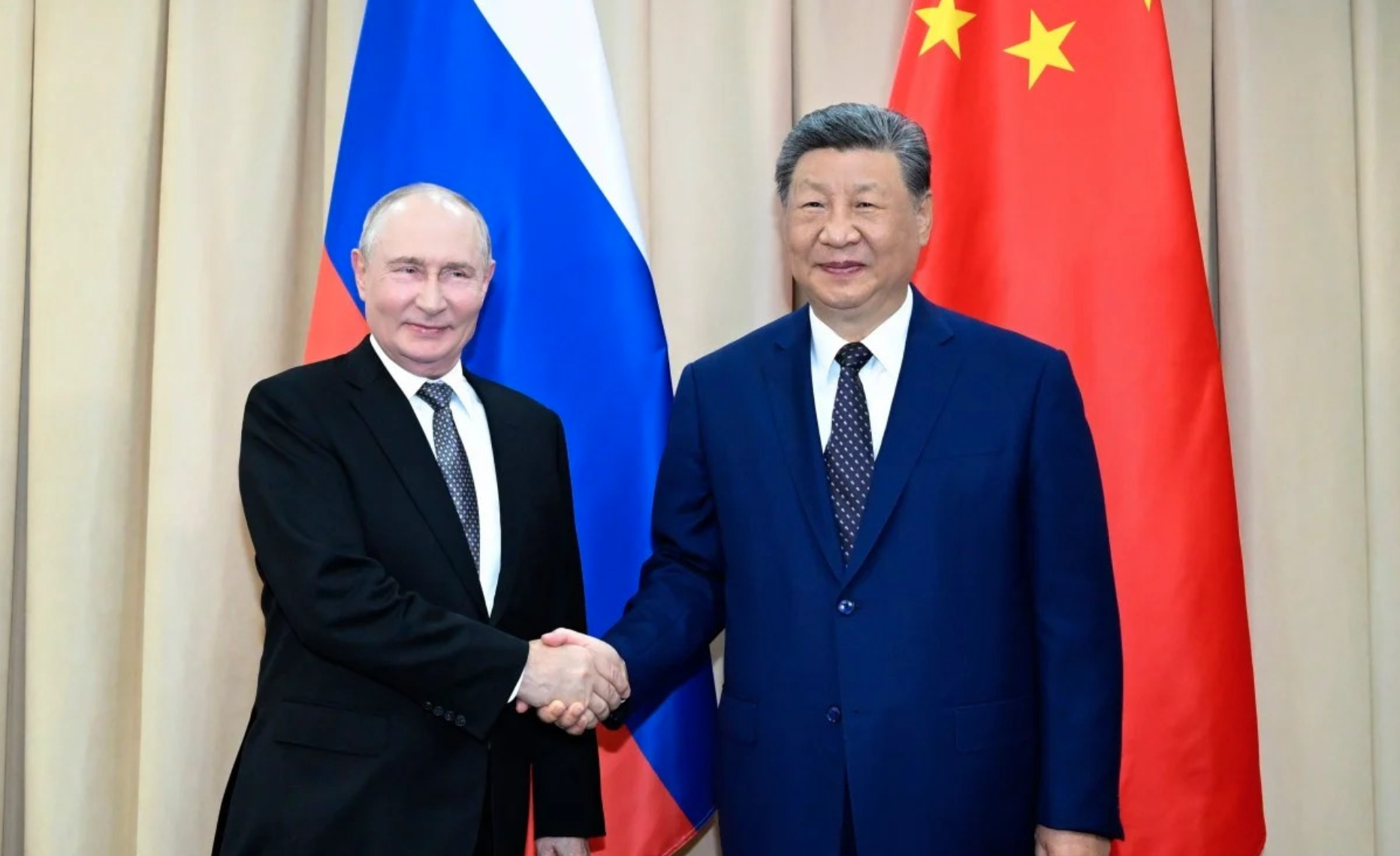
Russian President Vladimir Putin and his Chinese counterpart Xi Jinping held a bilateral meeting on August 31 on the sidelines of the Shanghai Cooperation Organization (SCO) heads of state summit in the Kyrgyz capital of Bishkek.
This was their second meeting this year: Putin made a state visit to China in May to mark 25 years of a friendship treaty between the two countries. In Bishkek the Russian President praised the “foundational bilateral Treaty of Good-Neighbourliness and Friendly Cooperation” and noted that the SCO was founded in 2001 at the initiative of Russia and China.
Official statements[1] from Moscow continue to praise the relationship, affirming its “unprecedented nature”. Russia-China ties have acquired a new dimension since the Russia-Ukraine war which imposed Western sanctions on Russia, compelling the country to further turn toward China for trade and political support.
The bilateral relationship has come a long way since the latter decades of the Cold War when the countries, though both communist, had tense relations. After the relationship began to deteriorate between Moscow and Beijing from the time of the Sino-Soviet split of the 1960s, it hit a low point during a brief border skirmish[2] in 1969 near the border along the Amur and Ussuri rivers. The relationship has been on a positive trajectory since the beginning of the 20th century.
The key factor was the resolution of the border dispute that dated back to the time of the Russian Empire and the Qing Dynasty. It took a series of agreements and treaties between Moscow and Beijing from 1991 till 2008 to fully demarcate and settle the 4,300-kilometre border (see map). In 2006, the countries signed a treaty[3] where they said they were “determined to transform the border between the Russian Federation and the People’s Republic of China into a border of eternal peace and friendship, passed down from generation to generation, and to make joint efforts to this end.”
The final result in 2008 was Russia handing Tarabarov Island (China calls it Yinlong) and half of Bolshoi Ussuriysky (Heixiazi in Chinese) on the Amur River to China. Territorial issues tend to evoke strong emotions in both countries. While the Chinese public was happy that territories that were seen as traditionally Chinese were returned to Russia, the treaty was billed as a compromise for better good. The Russian people were told that Beijing’s one-time claims to areas on the northwest of the Amur and cities like Vladivostok and Khabarovsk were rescinded.
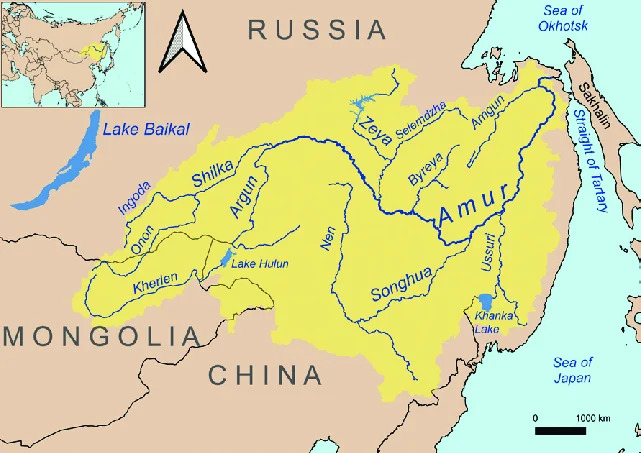
Source: Chaozhong Tan, CC-BY 4.0[4]
From the time that Russia’s relationship with the U.S. and EU started to deteriorate, beginning with the Russia-Georgia War in 2008, Beijing has been increasingly seen as a counterweight to the West. Russian state-run television began to regularly broadcast positive coverage about developments in China, as well as in bilateral ties. This was done in tandem with gradually loosening visa restrictions.
China and Russia now have a temporary visa-waver agreement for visitors, who want to travel to each other’s countries for a month or less. Media reports suggest that the countries are exploring the possibility of making it a permanent arrangement. Moscow’s largest international airport, Sheremetyevo, even has a separate immigration queue for Chinese group tourists.
Such scenarios would have been unthinkable in Russia in the early 2000s when there was still paranoia about Chinese illegal immigrants from the province of Heilongjiang (pop. 20 million) crossing over to the Russian Far East (pop. 7.85 million), which is one of the most sparsely populated places in the world. With China’s economic growth and the gap between the countries’ nominal per capita income narrowing to under $4,000[5] such scenarios are all but ruled out. The gap will be smaller between the Russian regions bordering China when compared to cities like Moscow.
With an increasing Chinese economic presence in Russia, airports, Aeroflot aircraft and many shops in cities like Moscow have signs in Mandarin. China accounted for 50.8% of international tourists in Russia in 2025, with 830,000[6] Chinese tourists travelling to the country. The numbers are likely to be higher since the visa-waiver came into place in December 2025. Chinese state-run media outlets[7] put the figure of annual Russian tourist arrivals in China at 2 million.
China is now the third largest source of international students to Russia. In 2025, 66,000 Chinese students were enrolled in Russian universities, a threefold increase[8] since 2016. A total of 21,000 Russian citizens study in China, according to the Russkiy Mir Foundation.
Beijing has kept a focused strategy to reach wider Russian audiences. In 2021, a television project titled China Today was established in Russia. The idea was to break down cultural barriers and dispel misconceptions about China. The joint Sino-Russian project has broadcast dubbed Chinese films and television shows, including children’s shows in Russian over the last five years.
Such initiatives and the overall good political ties have had a large impact on how ordinary Russians view China. A poll by the independent Levada Centre in January 2026[9] showed that 83% of Russians viewed China favourably. The sample consisted of 1,617 people over the age of 18 in 137 municipalities in 50 regions in the country. Levada’s polls showed that less than 50% of Russians viewed China positively in 1996. The changes over the last three decades broadly mirror movements in the diplomatic relationship.
Challenges remain for the two countries, especially if the war in Ukraine continues. China, like, India has refused to back Western sanctions on Russia and has called[10] for dialogue and negotiations to end the conflict.
Stronger sanctions like those proposed by the U.S. for countries buying Russian oil could affect China. The Lindsey O. Graham Sanctioning Russia and Iran Act of 2026, which was passed[11] by the U.S. Senate in August 2026, threatens China and India with 100% tariffs for importing Russian oil. Other potential measures that impact export market access for China in the West would also make Beijing face tough choices.
The countries also encounter a degree of strategic mistrust that is, to an extent, a remnant of another era. Until relations between Russia and the West began to rapidly deteriorate after the 2014 coup in Ukraine, a large section of the Russian political and economic elite had homes in countries like France and Spain and sent their children to study in Western Europe. The Ukraine War and the subsequent hostility towards the Russian elite in Europe have made this trend unsustainable. It is in this environment that Moscow has looked towards the Global South and countries like China and India to expand its economic footprint.
Some elements of the Moscow elite privately resent the growing clout that China enjoys in Russia and the latter’s increasing economic dependence on the giant southern neighbour. Bilateral trade grew by 22% in the first half of 2026 to over $135 billion. Beijing essentially views Moscow as both a reliable source of energy and a partner to counter Western expansion in Central Asia and the Global South, a role the Russians are comfortable with.
It is unlikely that even a long-term thaw with the West will mean Moscow changes course in its policy towards Beijing. This bilateral seems rock-solid and long-term.
Ajay Kamalakaran is a writer with a special interest in Russia and the former Soviet Union.
This article was exclusively written for Gateway House: Indian Council on Global Relations. You can read more exclusive content here.
For permission to republish, please contact outreach@gatewayhouse.in
©Copyright 2026 Gateway House: Indian Council on Global Relations. All rights reserved. Any unauthorised copying or reproduction is strictly prohibited.
References:
[1] Ministry of Foreign Affairs of the Russian Federation, “На полях Восточного экономического форума Президент России Владимир Путин встретился…” [“On the Sidelines of the Eastern Economic Forum, President of Russia Vladimir Putin Met…”], Facebook, September 3, 2026, https://www.facebook.com/MIDRussia/posts/1427952076194515/.
[2] “Военный конфликт СССР и Китая в районе о. Даманский” [“The Military Conflict between the USSR and China in the Damansky Island Area”], History.ru, https://history.ru/read/articles/voiennyi-konflikt-sssr-i-kitaia-v-raionie-o-damanskii-event.
[3] Ministry of Foreign Affairs of the Russian Federation, https://www.mid.ru/ru/foreign_policy/international_contracts/international_contracts/2_contract/45912/.
[4] Chaozhong Tan et al., “Amur-Heilong River — A Free-Flowing Transboundary River between Mongolia, China and Russia,” in River Culture: Life as a Dance to the Rhythm of the Waters, ed. Karl M. Wantzen (Paris: UNESCO Publishing, 2023), fig. 16.1. https://www.researchgate.net/figure/The-Amur-Heilong-River-between-Mongolia-China-and-Russia-Map-Chaozhong-Tan-CC-BY-40_fig1_366870626
[5] “China and Russian Federation,” World Bank Open Data, https://data.worldbank.org/?locations=CN-RU.
[6] “Российский выездной туризм держится на Китае, но растёт за счёт других рынков” [“Russian Outbound Tourism Rests on China but Is Growing on the Back of Other Markets”], Association of Tour Operators of Russia, September 10, 2026, https://www.atorus.ru/article/rossiyskiy-vezdnoy-turizm-derzhitsya-na-kitae-no-rastet-za-schet-drugikh-rynkov-66406.
[7] Xinhua, “Russian Tourists to Make over 2m Trips to China in 2025,” China Daily Hong Kong Edition, September 11, 2025, https://www.chinadailyhk.com/hk/article/619665.
[8] Russkiy Mir Foundation, https://russkiymir.ru/news/342704/.
[9] “Attitudes towards China, the United States, the EU, and Ukraine in January 2026,” Levada Center, February 16, 2026, https://www.levada.ru/en/2026/02/16/attitudes-towards-china-the-united-states-the-eu-and-ukraine-in-january-2026/.
[10] Minlu Zhang, “Envoy Calls for Dialogue to End Ukraine Conflict,” China Daily, September 3, 2026, https://global.chinadaily.com.cn/a/202609/03/WS6a98c6e5e4b06d4aa055c0f0.html.
[11] A Bill to Impose Sanctions and Other Measures with Respect to the Russian Federation, S. 5025, 119th Cong. (2026), https://www.congress.gov/bill/119th-congress/senate-bill/5025.