India in Central Asia: Time for a New Strategy
This paper introduces the dilemma of both India and Russia, whose state-owned energy companies are forced to operate in a region where Chinese government corporations have been dominant.

 Courtesy: Gateway House
This paper introduces the dilemma of both India and Russia, whose state-owned energy companies are forced to operate in a region where Chinese government corporations have been dominant.
 Courtesy: Michael Trolove/WikimediaCommons
Growing instability in the region make the planned Turkmenistan-Afghanistan-Pakistan-India (TAPI) gas pipeline seem more like a burden than a solution to India’s hunt for alternative energy sources. Is it wise for India to move ahead with the $7.6 billion project?
 Courtesy:
The completion of the Turkmenistan-Afghanistan-Pakistan-India (TAPI) pipeline is significant to secure a constant supply of natural gas to India. Since this pipeline passes through Afghanistan and Pakistan, both restive regions, security concerns have triggered wide debate on its viability.
Corruption has become a galling global phenomenon: structured, vertically-integrated networks, whose objective is the extraction of resources, are forming in countries around the globe. And strikingly, these structures are masquerading as democratically-elected, seemingly-open governments.
 Courtesy: PMO
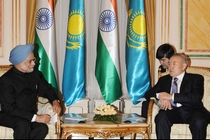
Indian Prime Minister Manmohan Singh met with Kazakh President Nazarbayev to strengthen ties and announced a Joint Action plan for 2011-14. Should the countries enhance their “arms-length transactional” relationship, a deeper alliance can be forged to include untapped sectors with immense potential
 Courtesy:
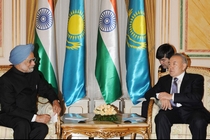
The India-Kazakhstan relationship is in need of a massive overhaul. Manmohan Singh’s visit to Astana is full of possibilities that can transform the relationship from a short-sighted association into a broad-based, strategic, long-term one focusing on energy, security, trade and technology.

