Strengthening India’s space reforms
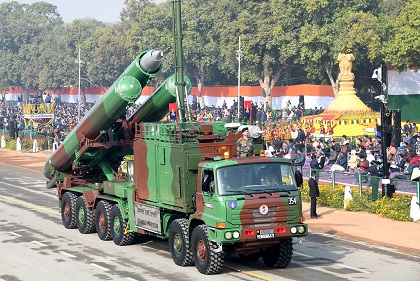
India needs a policy mix that nurtures the Space 2.0 industry, secures it from hostile takeovers and predatory investments from overseas investors, and does not suffocate it under excessive protectionism.
Courtesy: Getty images
India needs a policy mix that nurtures the Space 2.0 industry, secures it from hostile takeovers and predatory investments from overseas investors, and does not suffocate it under excessive protectionism.
Courtesy: Wikimedia Commons
As the daily numbers of COVID-19 cases remain high globally, examining Mahatma Gandhi's probable responses can be useful. Gandhi believed that political work shall go hand-in-hand with social reform, cleanliness and hygiene as its chief pillars.
Courtesy: Shutterstock
India's presence in the UNSC in 2021 provides a unique opportunity to bring India’s capacities and performance to global notice. It will be on the inside track for critical issues like the election of a new UN Secretary General, and defining global issues like the Corona pandemic and climate change, but must also use its position to prioritise counter terrorism and maritime security, especially with Chinese expansionism in the Indo-Pacific.
Courtesy: Shutterstock
As 2021 opens, the post-COVID world can expect some changes in the geopolitics of Asia. It will involve altering equations in the Indo-Pacific among major, middle and small powers. These will fluctuate with characteristic familiarity, creating instability, tensions and strife, but not leading to military conflict – barring an unforeseen accident. Post-COVID, the world will be uncertain and complex.
Courtesy: Twitter
The U.S. Navy Secretary, Kenneth Braithwaite, visited India on 17 Dec 2020. Will this year-end visit culminate in the reactivation of the First Fleet under the U.S. Indo-Pacific Command? The First Fleet, is likely to be an expeditionary fleet - one without a shore-based headquarters and assigned primary responsibility for the Indian Ocean and parts of Pacific Ocean bordering South Asia. Its reactivation will emphasise the strategic importance of this region. It will also relieve the burden of the U.S. Navy's 7th Fleet headquartered in Japan, that is deployed for operations in this vast oceanic space.
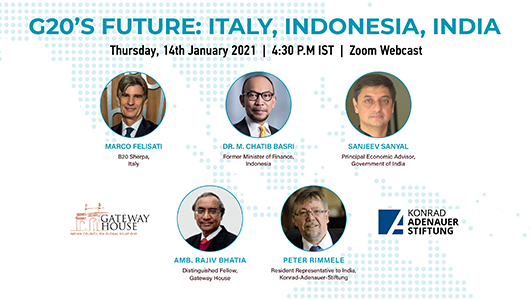
On December 15, 2020, Gateway House co-hosted a webinar with Konrad-Adenauer-Stiftung on Europe in the Indo-Pacific. The panel included: Rt Hon Sir Michael Fallon KCB, Member, Indo-Pacific Commission, Policy Exchange, UK, Former Secretary of State of Defence, UK; Karin Mössenlechner Director, Asia and Oceania Department, Ministry of Foreign Affairs, Netherlands; Dr. Axel Berkofsky, Co-Head of the Asia Center at Istituto per gli studi di politica internazionale (ISPI), Italy and Peter Max Rimmele, Resident Representative to India, Konrad-Adenauer-Stiftung.
Courtesy: Gateway House
Bharti Global’s stake in OneWeb has given India lateral entry into this lucrative and newly-competitive global satellite-based internet services market. India and the U.K., the two stakeholders in this company, can build and sustain this collaboration through a well-thought-out bilateral space diplomacy agenda.
Courtesy: Gateway House
India’s investments in energy thus far have concentrated on buying stakes in oilfields in developing countries often at the risk of political unpredictability. With oil prices, and therefore oil company values, falling – India should revise this strategy and aim for better value and lower risk by making investments in companies in the developed world. This paper recommends investing in oil and gas assets in energy-rich developed countries like the U.S., Canada and Australia, to reduce India's vulnerability to future increases in energy prices. These should be made via a sovereign wealth fund (SWF), not the national oil companies. The SWF will be best served by acting as a financial investor, acquiring, only minority stakes, rather than aiming for management control.
Courtesy: vicepresidentofindia.nic.in
India hosted the SCO summit on 30 November. Fueling its diplomatic drive is the region’s strategic importance and an enhancced focus on Central Asia with its strong civilizational, cultural and emotional bonds with India. Despite the daunting regional challenges, old and new, a seat at the SCO table strengthens India's hand in shaping the grouping’s - and region’s - future.
Courtesy: Shutterstock
With India now considering the creation of a policy to promote additive manufacturing, it is necessary to look at whether this new industry has a conducive regulatory environment, both at the domestic and global level. A key element of additive manufacturing is 3D, rapidly becoming a critical element in industrial and national security. Suitable regulation will ensure that countries that are heavily reliant on China for manufacturing, will have a chance to build their own industrial base