


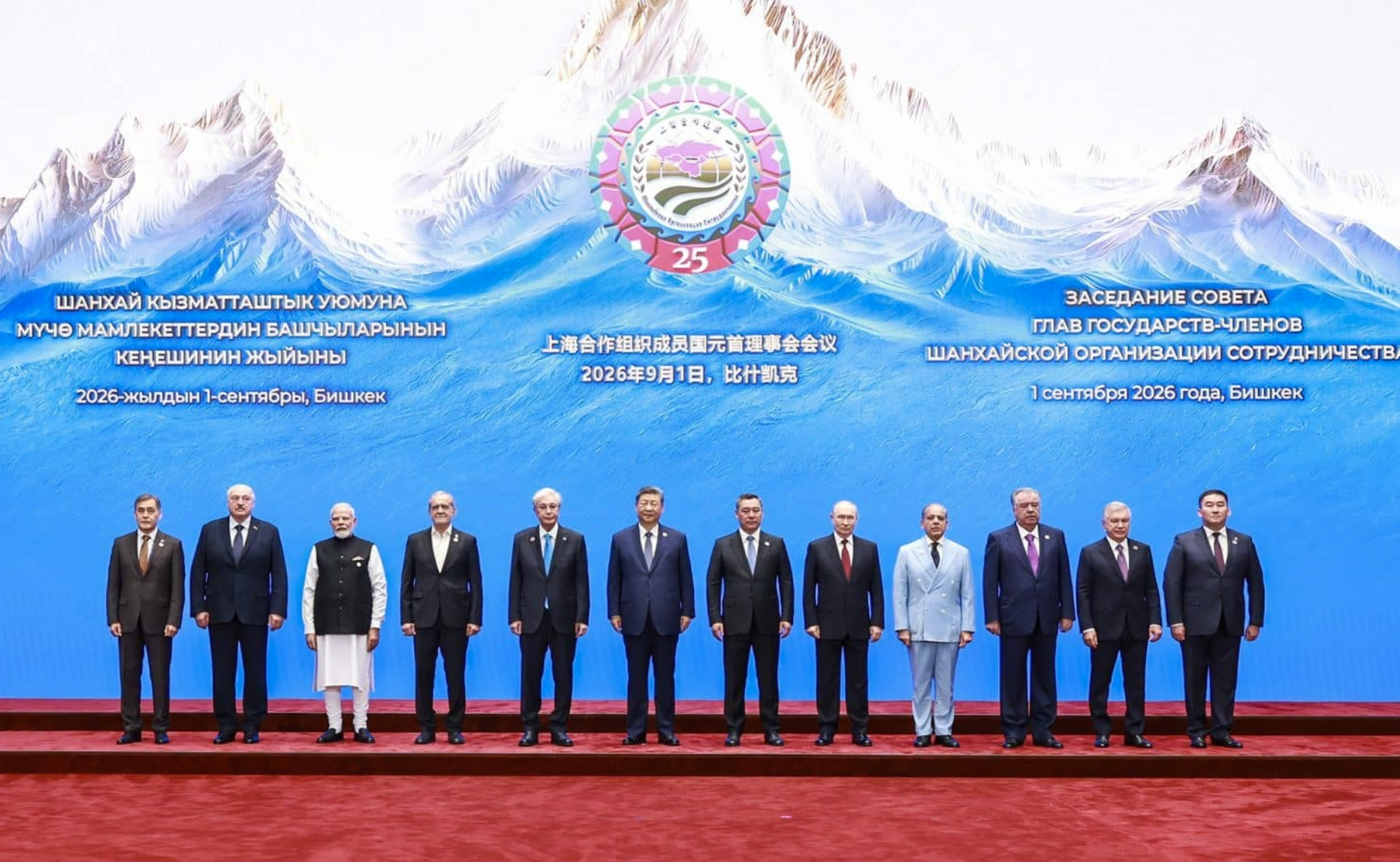
The 26th Summit of the Shanghai Cooperation Organisation (SCO) marked its silver jubilee in Bishkek, Kyrgyzstan, on 31 August and 1 September.[1] It was a timely marker because the SCO’s main strengths and its known challenges remain much the same. It brings together member countries that do not necessarily agree on what the global order should look like.
In its 25th year, the SCO has, however, moved beyond its original role as a meeting place for countries sharing post-Soviet frontiers and committed to dealing with terrorism and extremism, which were the main concerns of its original five members. Its membership has now expanded beyond Russia, China and Central Asia to include India, Pakistan and Iran, bringing a South Asian dimension to the SCO.
What the SCO wishes to become varies according to the different lenses that members wear. Some see it as a challenge to the Western liberal international order. Others see it as a channel for expanding Chinese and Russian influence. Some see in it the seeds of a Eurasian security organisation, while for others it could become a meaningful forum in which competing countries can overcome rivalries or at least deliberate with each other.
The Bishkek summit indicated that the SCO is a bit of all these things, but does not fully conform to any one of them. It is seen as a relevant cog in the emerging global order, but is not yet contributing to its architecture.
For both Russia and China, the SCO is a strategic option. Russia uses it to demonstrate the limitations of Western sanctions and efforts to isolate it. Russia feels that participating in the SCO indicates its inclusion in an organisation of several countries, bringing it greater acceptance in the Global South.
China sees the SCO as a political institution supporting its expanding economic engagement across the region.[2] The Belt and Road Initiative gives China considerable economic heft as the major economic player in the region, contributing to new transport corridors such as the China-Kyrgyzstan-Uzbekistan railway, and the SCO reiterates this aspect.
China is also pursuing a larger role for local currency trading, seeking to give the yuan a greater role while reducing the U.S. dollar’s influence in the region. These countries therefore see the SCO as an institutional framework for a better-integrated Eurasian economy.
However, while China seeks larger and deeper Eurasian integration, many members do not want it to become a vehicle for expanded Chinese domination. This is one reason why ideas for an SCO development bank and an SCO development fund have progressed slowly. Given the strength of its economy, China seeks to be the anchor of such institutions, while India and Russia are anxious that these should not become another Chinese-led institution where the weightage favours China over others.
This is perhaps the main contradiction within the SCO. Its members generally want the advantages of Chinese economic power, but do not want to accept Chinese hegemony.
India’s participation is critical since it prevents the SCO from becoming an explicitly anti-Western configuration. India’s idea of multipolarity is not a choice between the G7 and the Chinese idea of leading the world. India prefers a truly plural international system in which the Global South is heard more, rather than allowing big powers to dominate.
At the SCO summit, Prime Minister Modi emphasised that dealing with terrorism, connectivity, digital public infrastructure, cultural cooperation and economic stability were critical elements for the advancement of the SCO.[3] India’s support for regional connectivity is clear, but it also stresses that members’ sovereignty and territorial integrity must be respected. This refers to the China-Pakistan Economic Corridor, which China is building through Pakistan-occupied Jammu and Kashmir.
India’s role, therefore, is the biggest hurdle for those members of the SCO who want it to become an explicitly pro-Chinese and anti-Western institution. Without India, the SCO could become a China-Russia-led Eurasian institution. India brings strategic heft and pluralism to the SCO.
Despite its differences with some members, India continues to engage with the SCO and does not see this as incompatible with its relationships with the EU, the U.S., Japan, the Quad, or ASEAN. That is India’s view of strategic autonomy: not choosing a camp, but maintaining the autonomy to engage with different groups depending on the issue.
The SCO’s best achievement remains its security arrangements.
The Regional Anti-Terrorist Structure (RATS), located in Tashkent, has evolved into intelligence-sharing, watch lists and joint exercises.[4] It remains the SCO’s most functional institution. The Bishkek Summit aimed to build on this basis with new mechanisms addressing security, organised crime and narcotics. The SCO’s record includes decisions on counterterrorism, information security and other areas of security-related cooperation. This is where the SCO can certainly contribute to regional cooperation.
This has its limitations. Its members are not always in agreement on what constitutes terrorism or extremism. Mutual suspicion and rivalries challenge intelligence-sharing. The India-Pakistan rivalry complicates cooperation, but it should not be overlooked that before India and Pakistan joined in 2017, these kinds of problems already persisted among RATS members. Therefore, the structural divisions within the SCO predate India and Pakistan’s association and reflect deeper cleavages within Central Asia.
The SCO can attempt to manage security cooperation, but it seems difficult for it to eliminate the rivalries that often generate such insecurity.[5]
If the SCO aims to go beyond a security dialogue, then development and economics could be its determinant. The Bishkek Summit expanded the agenda to AI, digitalisation, energy, trade, investment and connectivity. It sought closer cooperation with other organisations, including the African Union Commission.[6]
This evolution matters because churn in the global order is no longer only the result of military power. Infrastructure, energy, critical minerals, technology, financial institutions and digital systems are now also instruments of power.
The SCO has potential in these areas. China’s factories, Russia’s energy and resources, India’s technology and services, and Central Asia’s geographic location and minerals, connected to Iran and Pakistan’s location on the Arabian Sea, could constitute a critical development. Together, this could become a formidable economic geography.
However, this requires an institution able to finance and implement projects, and the SCO has not yet reached that stage. The hiatus between its potential and its institutional capacity is huge.[7]
The African connection the SCO is trying to develop matters because it goes beyond diplomatic symbolism. Africa is recognised as an important pole in the emerging order because of its demographic dividend, markets, minerals, energy resources and number of countries. Cooperation between the SCO and the African Union could therefore become a major relationship among countries of the Global South.
In principle, India should welcome this. India already has major political and development partnerships across Africa and could perhaps use the SCO for trilateral engagements with Africa without giving up its own priorities.
Here again, implementation rather than declarations would be the determinant.
Is the SCO helping or hindering the global order? At this stage, the SCO can, if it chooses, help the global order or hinder it. As a forum where China, Russia, India, Pakistan, Iran and the Central Asian countries convene, it can at least create a dialogue where disagreements can be aired. It can also help by cooperating against terrorism and organised crime, promoting connectivity, and providing a greater voice to the Global South in shaping the rules of the emerging order.
It becomes a hurdle when it prioritises opposition to the Western order, provides a shield to sanctioned countries without offering solutions, or seeks to provide avenues for the domination of the organisation by one country.
The SCO’s best contribution is perhaps that, while it needs consensus on everything, declarations can pass with members clearly stating their opposition and a consensus on including such caveats. But this, of course, weakens the nature of the declaration. The SCO needs to make greater efforts to accommodate the views of all its members and create forward-looking documents that can become important in the evolving global order.
This is complicated because most SCO members are also members of overlapping plurilateral arrangements. India, for instance, is in the SCO, but also in BRICS, the Quad and the G20. It does not see any of them as an exclusive alliance, but as autonomous partnerships. This is the operating logic of multipolarity.
At its silver jubilee, the SCO has emerged as a durable Eurasian organisation. It has not yet become a vehicle for delivery.
Gurjit Singh is a former Indian Ambassador to Germany and author of The Durian Flavour: India, ASEAN and the Act East Policy. He is currently promoting the impact investment movement for implementing SDGs in Africa.
This article was exclusively written for Gateway House: Indian Council on Global Relations. You can read more exclusive content here.
Support our work here.
For permission to republish, please contact outreach@gatewayhouse.in
© Copyright 2026 Gateway House: Indian Council on Global Relations. All rights reserved. Any unauthorised copying or reproduction is strictly prohibited.
References:
[1] “The 26th Meeting of the Council of Heads of State of the SCO Member States and the ‘SCO Plus’ Meeting Held in Kyrgyzstan,” Shanghai Cooperation Organisation, September 1, 2026, https://eng.sectsco.org/20260901/2493609.html.
[2] “Expert Group on the Implementation of the Road Map of the SCO Member States for the Gradual Increase in the Share of National Currencies in Mutual Settlements Holds an Online Meeting,” Shanghai Cooperation Organisation, September 4, 2026, https://eng.sectsco.org/20260904/2500049.html.
[3] “English Translation of Prime Minister’s Statement at the 26th SCO Summit,” Ministry of External Affairs, Government of India, September 1, 2026, https://www.mea.gov.in/speeches-statements?dtl/41726/English_Translation_of_Prime_Ministers_Statement_at_the_26th_SCO_Summit_September_1_2026.
[4] “Regional Anti-Terrorist Structure of the SCO,” Shanghai Cooperation Organisation, March 24, 2026, https://eng.sectsco.org/20260324/2216764.html.
[5] Rajeswari Pillai Rajagopalan, “After 25 Years, the Shanghai Cooperation Organization Faces an Uncertain Future,” The Strategist, Australian Strategic Policy Institute (ASPI), August 31, 2026, https://www.aspistrategist.org.au/after-25-years-the-shanghai-cooperation-organization-faces-an-uncertain-future/.
[6] “Xi Calls for SCO to Strive for Higher Quality Development, Promote Better Global Governance,” State Council of the People’s Republic of China, September 1, 2026, https://english.www.gov.cn/news/202609/01/content_WS6a968278c6d00ca5f9a0cecc.html.
[7] Odil Gafarov, “Reimagining the Shanghai Cooperation Organization,” Institute for Advanced International Studies, accessed September 9, 2026, https://iais.uz/upload/outputnewfile/11-08-2024/Reimagining%20The%20Shanghai%20Cooperation%20Organization.pdf.