


Last month, on 15 to 16 June, Indian Prime Minister Narendra Modi was warmly welcomed to the eastern Mediterranean island of the Republic of Cyprus (ROC). Cyprus (ROC) comprises roughly the southern two-thirds of the island, while the remaining northern one-third is under the control of the Republic of Türkiye. PM Modi’s visit was for both sentimental and strategic reasons, as it aimed to reconnect with a country that has traditionally been a friend of India.[1]
The two nations’ bilateral is built on their shared post-colonial experience. Cyprus, like India, was a British colony; it won its independence in 1960. It soon joined the Non-Aligned Movement, of which India was one of five founding nations. Like most former British colonies, because of Britain’s insidious ‘divide and rule’ policies, Cyprus, like India, failed to stem the inter-communal conflicts between its Christian and Muslim populations. This resulted in the tiny island being partitioned in 1974, an event preceded by years of conflict that began in 1963. While India has consistently supported the UN Resolution for the reunification of Cyprus, Cyprus has also consistently supported India in the UN General Assembly, particularly her bid to become a permanent member of the UN Security Council.

(Photo courtesy: Katie Clerides)
This friendship has many prominent markers. New Delhi has a road named after the first president of independent Cyprus, Archbishop Makarios III. In 1972, a bust of Mahatma Gandhi, the Father of the Indian nation, was installed in the garden adjacent to the Cyprus Parliament House in the capital, Nicosia. The garden is located on an avenue named after India’s first Prime Minister, Jawaharlal Nehru, while the road on which the Indian High Commission (est. 10 February 1962) stands is named after his daughter, Prime Minister Indira Gandhi. Entirely overlooked in this friendship is the most enduring symbol of the ties the two countries share – and one that has had a marked influence on Cyprus itself – its former India-born first lady, Lilla Irene (Erulkar) Clerides, wife of former President Glafkos Clerides.
Lilla’s story, from her birth in Ahmedabad and childhood in Bombay to her becoming the first lady of Cyprus, is an extraordinary one.

(Photo courtesy: Katie Clerides)
She was born in 1921 to a Scottish mother, Kate Eccles Scott, and an Indian Jewish father, Dr. Abraham Solomon Erulkar. Her father and his brother, David, were active in India’s freedom struggle. Dr. Abraham was an MD from the Newcastle School of Medicine[2] in Scotland, and David Solomon Erulkar, a barrister from London. Both contributed in their professional capacities to help frontline freedom fighters in India. While David was the second counsel to Muhammad Ali Jinnah in the defense of the outspoken freedom fighter and editor of Kesari, Bal Gangadhar Tilak, in 1916, Dr. Abraham attended on Mahatma Gandhi during some of his hunger strikes.[3] Describing the home atmosphere Lilla grew up in, her daughter Katie, a lawyer and former member of parliament[4] in Cyprus, says her mother was inspired by India’s freedom struggle, especially the Salt Satyagraha, which culminated in so much police violence. “She idolised Mahatma Gandhi and Sarojini Naidu, whose poetry she was a great fan of,” Katie remembers.
Lilla had a privileged and sheltered upbringing in 6 Javeri Mansions, Little Gibbs Road, Malabar Hill, a building that once overlooked the quaint Anglican All Saints’ Church near Hanging Gardens. But she was so animated, even as a young child, by the events unfolding daily in India’s freedom struggle, that her parents sent her away to boarding school in England at the age of eleven, worried that their daughter “might go out and start participating in the demonstrations.” At the time, there were passionate ongoing rallies and bonfires of foreign cloth in Mumbai’s maidans and wholesale cloth markets.[5]
Lilla’s paternal side, the Erulkars, belong to the Marathi-speaking Indian Jewish community known as the Bene Israel (lit. Children of Israel), who have roots in India’s Konkan Coast dating back 2000 years. The Erulkars were a prominent family in the community. Lilla’s grandfather, Solomon, and great-grandfather, Abraham, were also doctors, a rarity in the 19th century, particularly at a time when most Bene Israel families were not highly educated and were migrating from their villages to the city for work.[6] Her grandfather, Solomon, is considered the founder of Ahmedabad’s only Jewish synagogue, Magen Abraham (est. 1934), which catered to the religious needs of his growing community in that city.[7]

(Photo courtesy: Katie Clerides)
“My mother always thought of herself as Indian, despite going through the English educational system and spending her most formative years in London,” reminisces Katie. Lilla was still studying in London when World War II broke out in 1939; she lived through the bombings of London and did not visit Bombay during the War. Unlike her older brother Joseph, who became a doctor in Manchester, Lilla studied the performing arts: theatre and music. She worked briefly with the renowned English author George Orwell at the BBC. While there, she worked at the India desk, scripting and anchoring programs. These kept her deeply engaged with the momentous events unfolding in India, leading to its independence and partition. It was also at the BBC that she met the young, blue-eyed, handsome Cypriot Glafkos Clerides, who had just been released from German incarceration as a prisoner of war after his Royal Air Force plane was shot down in 1942. The man who was to become the president of Cyprus from 1993 to 2003 had come to meet his sister Chrysanthe at the BBC studios, but serendipitously met her best friend, Lilla.
According to Katie, Lilla did not immediately assent to Glafkos’s proposal of marriage. When she did, he wrote a letter to Dr. Erulkar in Bombay, formally asking for her hand, and he received a telegram stating bluntly, “Advise: wait for a year.” They did wait. Glafkos and Lilla were married in a civil ceremony in London in July 1947.[8] They returned to Cyprus in 1951, after Glafkos completed his law degree and was called up to the bar at London’s Gray’s Inn.
The transition to life in Cyprus was difficult for the soft-spoken Lilla, as the spoken language on the island was Greek, something she could not master.[9] This, in a sense, restricted her socially to a small circle of friends; however, her fierce sense of self and her long-held beliefs about the evils of colonisation remained. This was reflected in her unyielding support of Glafcos’ role[10] in the Cypriot War of Independence from 1955 to 1959, as a secret member of EOKA, a Greek Cypriot militant group fighting for independence from Great Britain and reunion with Greece. In an interview,[11] Lilla draws a parallel between her interactions in India with a galaxy of Indian freedom fighters[12] and her involvement with India’s nationalist movement, saying that this exposure prepared her for the freedom struggle that later took place in Cyrus. To suppress EOKA, the British colonial administration used Turkish Cypriot policemen, thereby setting the stage for civil war and partition after Cyprus’s independence in 1960.[13]
(Photo courtesy: Katie Clerides)
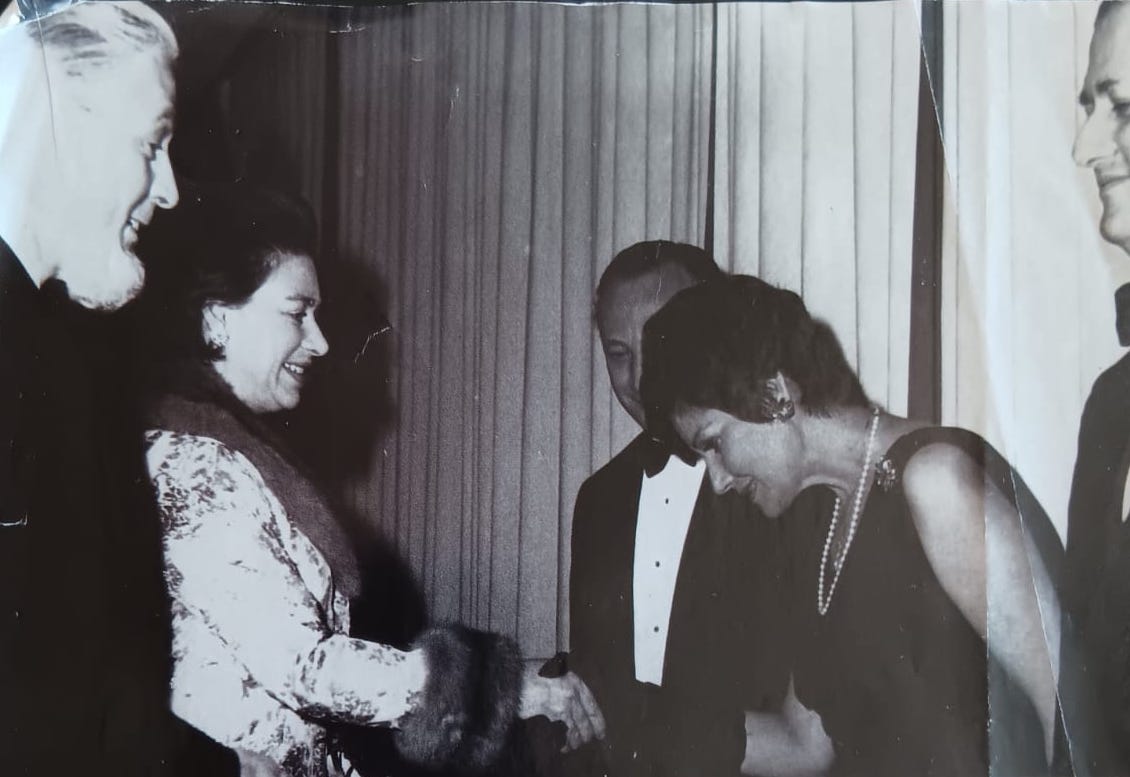
Ten years before the Island’s partition, in January 1964, Great Britain’s Princess Margaret was scheduled to make an official visit to Cyprus. As Archbishop Makarios III, the president of the Republic, did not have a spouse, he requested Lilla, the seniormost Parliamentarian’s wife (Glafcos was the Speaker of the House), to teach the ladies how to curtsey to Her Royal Highness. Lilla excused herself from this, saying that if she did not feel like curtseying to British royalty, how could she teach the ladies to do so? Eventually, this task was assigned to the foreign minister’s wife, and Lilla is photographed tilting her head slightly when introduced to Princess Margaret.
The coup d’état against President Makarios and his government in the summer of 1974 by EOKA B, instigated by the Junta in Greece, resulted in civil war and the invasion of Cyprus by Turkey. The Clerides held their ground during the war despite many ministers fleeing Nicosia. Glafcos took over as acting president, Lilla worked as a helper in the neurological ward of a hospital, and their daughter, Katie, volunteered with the Red Cross. By the time President Makarios returned in December 1974, after the United Nations Forces in Cyprus (UNFICYP) or Blue Berets had stabilised the security situation – Cyprus was partitioned.

(Photo courtesy: Rashtrapati Bhavan)
Ever since, the Clerides family has striven for the reunification of their beloved country. Glafcos launched a right-of-center party, the Democratic Rally, and since 1983 fought the presidential elections five times, winning twice in 1993 and 1998. His ten-year presidency resulted in the United Nations’ Annan Plan[14] for the reunification of Cyprus, which ultimately failed to materialise, as well as the preparation for his country’s induction into the European Union, which took place the year after his presidency ended in 2003. Being in the EU secured the Republic of Cyprus against incursions from the self-declared Turkish Republic of Northern Cyprus.
As First Lady, Lilla was able to bring her love for the performing arts into the public sphere. She opened the Presidential Palace gardens to the public by hosting free weekend musical and stage performances in its open-air amphitheatre.[15] Lilla’s connection with India was sustained through her and Glafcos’ close friendship with a few Indian High Commissioners’ families, like that of Paulomi and Amb. Rajendra Abhyankar, who fondly recall going sailing with the Clerides in the Katie 2 (yacht) in the blue waters of the Mediterranean.[16]
Lilla’s last visit to her beloved India was in 1997, when, as the First Lady of Cyprus, she accompanied her husband, President Clerides, on an official visit. It was a homecoming made even more special as the couple reconnected with their Indian friends.[17] Lilla died in Larnaca in 2007, with her family surrounding her.
It is this legacy of the self-effacing, and quietly confident Indian-origin First Lady of Cyprus that needs to be acknowledged, memorialised, and made part of the story of the India-Cyprus bilateral relationship.
Sifra Lentin is Fellow, Bombay History, Gateway House.
This article was exclusively written for Gateway House: Indian Council on Global Relations. You can read exclusive content here.
Support our work here.
For interview requests with the authors, or for permission to republish, please contact outreach@gatewayhouse.in.
© Copyright 2025 Gateway House: Indian Council on Global Relations. All rights reserved. Any unauthorised copying or reproduction is strictly prohibited.
References:
[1] Key points discussed during PM Modi’s visit were expanding cooperation in the maritime domain, increasing bilateral trade, and Cyprus’s joining the India-Middle East-Europe Economic Corridor. See: https://www.pib.gov.in/PressReleasePage.aspx?PRID=2136636
[2] The Newcastle School of Medicine (est.1871) is now part of the University of Newcastle.
[3] Dr. Abraham S. Erulkar helped many refugee European Jewish doctors fleeing fascism obtain a license to practice in India. He was the first elected president of the All India Medical Council in October 1945.
See Butt, A. H. “The Medical Council Of India.” The British Medical Journal, vol. 2, no. 4471, 1946, pp. 369–72. JSTOR, pp. 370. http://www.jstor.org/stable/20367438. (Accessed 25 July 2025)
[4] Katie (a short form for Katerina) Clerides, like her father, Glafkos, is a barrister from Gray’s Inn, London. She joined the right-of-center party, the Democratic Rally, which her father had founded in 1976. She won her seat in Parliament with a thumping majority.
[5] Chaudhury, K. K. “Greater Bombay District: Volume I” Maharashtra State Gazetteers (Bombay, Department of District Gazetteers, Government of Maharashtra, 1986) pp. 461, 463, 465-66, 474, 492, 494, 496-97.
[6] Migration from their Konkan villages into Bombay Island began in the 18th century. The early migrants were attracted by opportunities to enlist in the East India Company’s native regiments and its associated services.
[7] The Erulkar family were among the early Bene Israel families to settle in Ahmedabad. Lilla’s great-grandfather, Dr. Abraham Erulkar, set up a small prayer hall in his home. In 1906, her grandfather, Solomon Abraham Erulkar, donated a generous sum to establish a larger prayer hall in the Pankore Naka area of the walled city. As the new prayer hall soon proved too small, funds were collected to build a synagogue on Bawa Latif Street in central Ahmedabad. Once again, Dr. Solomon Erulkar was the largest donor to the Magen Abraham (lit. Shield of Abraham) Synagogue, completed in 1934.
Waronker, Jay A., the Synagogues of India: Architecture, History, Communities (Printed South Africa. A Friends of Indian Synagogues Publications, 2019), p. 24.
[8] Lilla and Glafcos had a Church wedding when she was 72 and Glafcos was 74 years old. This was after she converted to the Greek Orthodox Church.
[9] According to Katie, this was particularly so in her early years before Cyprus’s independence in 1960. After independence, many embassies and international institutions were established, and this attracted English-speaking personnel, many of whom became her friends. The Clerides were friendly with all the Indian High Commissioners and the UN Generals in charge of the UN Peacekeeping Forces, like General K.S. Thimayya, who died in Cyprus in 1965, and General Diwan Prem Chand.
[10] Glafkos was a secret member of the banned organisation EOKA (National Organisation of Cypriot Fighters) and defended its jailed fighters in court. Being a lawyer, he played a key role on the team representing Cyprus in negotiations in London and Zurich, which led to the London and Zurich Agreements that formed the basis for Cyprus’s independence from the United Kingdom.
[11] The Times of India article ‘She finds a home away from home in Cyprus’ by Namita Devidayal, dated 12 May 2000.
[12] Although this is not explicitly stated in the article, her remark indicates that she was often in Bombay during vacations.
[13] Cyprus, after 300 years of Ottoman rule, came under British colonial rule in 1878. The majority of Greek Cypriots were in favour of the removal of British rule and reunion with Greece, which they termed enosis. In 1955, they formed EOKA to achieve ‘enosis’. In 1958, the Turkish Cypriot population established the Turkish Resistance Organisation, also known as the TMT, with an opposing aim. Initially, it was the continuation of British rule but after Cyprus gained independence in 1960, the aim shifted to ‘taksim’ or partition.
[14] The Annan Plan of April 2002 was an UN-brokered constitutional arrangement whose aim was a federal, bicommunal, bizonal solution to what is known as the Cyprus Problem.
[15] She also oversaw the design of The Resistance Garden and playground in the presidential palace compound, as well as the cataloguing of the palace’s splendid art collection. Being the daughter of a doctor, she took a keen interest in health matters. She was involved in the Muscular Dystrophy Trust and the Cyprus Kidney Association. She was the honorary president of The Cyprus Association of Cancer Patients and Friends, The District Welfare Association of the Aged, The Cyprus Children’s Fund, and Apostolous Andreas. This association protects physically and mentally handicapped persons.
[16] This was sometime in the late 1980s before Glafcos became president.
[17] According to Amb. Abhyankar, the Embassy of Cyprus in New Delhi, reached out to many of the Clerides’ friends, inviting them to the official banquet.