


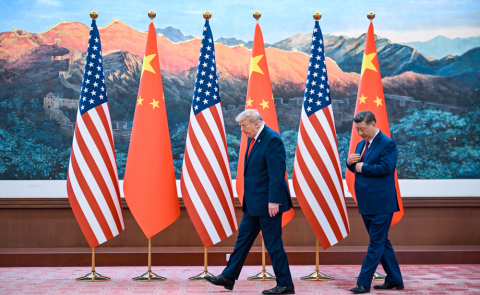
The whole world was looking at the results of one head of state – that was U.S. President Donald Trump’s visit to the Peoples Republic of China (PRC) from May 13-15, 2026. He was on the back foot when he went to China. This was due to his announcement that he would wind up the Iran war before going to China. His plans for a visit from March 31-April had to be postponed, and even in May during this trip, the Iran war was not over though a ceasefire was in effect. And, just prior to his May visit, China had instructed its companies sanctioned by the U.S., to ignore the sanctions – an open act of defiance by Beijing.
While the ceremonial programmes went as expected – the Chinese are masters at that – in substance the discussions did not go as expected for the U.S. There are several reasons why.
In the opening remarks which Trump was the first to make, he mentioned the bilateral aspects and praised Chinese President Xi Jinping and his friendship with Trump. Xi’s statement was more statesmanlike. An analysis of the readouts from China[1] and the U.S.[2] reveals that there was almost no meeting of the minds. The readout and the fact sheet[3] from the White House mentioned that the two sides discussed ways to enhance economic cooperation to include increasing Chinese investment in U.S. industries, $17 billion worth of agricultural purchases by China per year till 2028, purchase of 200 Boeing aircraft, restoring of market access for beef and sale of poultry from the U.S. The establishment of two boards, one for trade and another for investment, finds mention. Mentioned also were ending the flow of fentanyl precursors from China, which has been a problem for the U.S. for some time now, and the claim of Xi’s support for the Strait of Hormuz to remain open, with both countries agreeing that Iran cannot have a nuclear weapon. The U.S. Fact sheet mentioned that China will address the U.S.’s concerns on rare earths.
Xi spoke differently. He said China and the U.S. should not be rivals. He mentioned the Thucydides Trap[4] and cautioned the U.S. on its support for Taiwan. He went to the extent of saying that if the Taiwan issue is not handled properly, it could lead to clashes and conflicts between both the countries. Xi proposed a “Constructive Strategic Stability”. The explanation of this term was provided later by Mr. Wang Yi, Foreign Minister of China, during his press interaction[5] in Beijing after the completion of the visit. He said Constructive Strategic Stability meant providing strategic guidance for bilateral relations over the next three years and beyond and highlighted four connotations for the term.
One, positive stability where cooperation makes the relationship more resilient. Two, healthy stability in which the competition is kept within proper limits and does not become a zero-sum game. Third, constant stability that is achieved through policy continuity and China and the U.S. honouring their words and moving in the same direction. Lastly, achieving lasting stability where peace is expected and wars and conflicts are not acceptable. These are to be achieved by adhering to the three China-U.S. joint communiqués[6], respecting each other’s social systems, development paths, core interests, major concerns, and right to development.
The Chinese readout also stated that President Trump had agreed to work with President Xi to strengthen communication and cooperation, properly handle differences, make bilateral relations better than ever before and embrace a fantastic future and said Trump asked the business leaders in his delegation to present themselves to Xi.[7]
Wang Yi’s press interaction then proceeded along grand lines. He stated that achieving the great rejuvenation of the Chinese nation and making America great again can go hand in hand, and the two countries can help each other succeed and advance the well-being of the whole world. He confirmed that President Xi would pay a state visit to the U.S. this fall, likely to coincide with the UN General Assembly meeting.
President Xi Jinping announced an important initiative – to invite 50,000 young Americans to China on exchange and study programs over a period of five years. President Trump also said multiple times that he welcomes Chinese students to the U.S. The Chinese reiterated that China remained a hot destination for American businesses and investors.
China encouraged the U.S. and Iran to settle their differences and disputes through negotiation, including on the nuclear issue. China called for reopening the Strait of Hormuz as soon as possible on the basis of the continued ceasefire and believed that the only solution was achieving a permanent and comprehensive ceasefire. On the Ukraine crisis, both China and the U.S. want to see an early end to the conflict, and both have done a great deal to promote peace talks in their own ways.
A critical analysis of the visit reveals seven takeaways.
First, the Chinese have a practice of announcing important visits one week prior, simultaneously by both sides. By announcing the dates unilaterally, Trump made the Chinese uncomfortable.
Second, there was no joint statement issued at the end of the visit – an indication that there are issues with no consensus. In contrast, during the visit of Russian President Vladimir Putin to Beijing almost immediately after the Trump visit, China and Russia issued two joint statements including one joint statement[8] on “advocating a multipolar world and new type of international relations.”
Third, the read outs and the fact sheet indicate the varying level of importance given to the issues discussed. The U.S. read out and the fact sheet seem to address the audience in the U.S. and is mainly trade and investment-oriented. Barring the boards of trade and investment, there is no commonality in the statements of the two countries.
Fourth, the U.S. seems to have accepted Xi’s proposal for Constructive Strategic Stability as it figures in the U.S. fact sheet. This means the U.S. is accepting the terms set by China for the bilateral relationship. This is corroborated by the fact that U.S. is holding in abeyance $14 billion worth of weapons and equipment that is to be supplied to Taiwan.
Fifth, While China says it welcomes 50,000 students from the U.S. over the next five years and Trump says he welcomes it, in fact it runs contrary to the U.S.’ actions of targeting Chinese students in its country. Sixth, and in the same vein, if what China says is true, that American businesses find China an attractive place to do business with, it goes against the U.S.’ own decoupling strategy.
Lastly, on Iran, China clearly seemed to take the lead by saying that it encourages the U.S. and Iran to arrive at an amicable solution.
A comparison of this visit with Mr. Trump’s previous visit to China in November 2017, is revelatory. After that trip, there was a Joint Press statement[9] issued, the tone of which that indicated that China and the U.S. were comparable powers. This time around, it seems from the statements that China has the upper hand. In this tale of two visits, there are two different outcomes – and in the most recent one, China appears to trump the U.S.
Lt Gen S L Narasimhan is the Adjunct Distinguished Fellow for China and National Security Studies at Gateway House.
This article was exclusively written for Gateway House: Indian Council on Global Relations. You can read more exclusive content here.
For permission to republish, please contact outreach@gatewayhouse.in.
Support our work here.
© Copyright 2026 Gateway House: Indian Council on Global Relations. All rights reserved. Any unauthorised copying or reproduction is strictly prohibited.
References:
[1] Ministry of Foreign Affairs of the People’s Republic of China. 2026. “President Xi Jinping Holds Talks with U.S. President Donald J. Trump” May 14, 2026. https://www.fmprc.gov.cn/eng/xw/zyxw/202605/t20260514_11910330.html
[2] The White House. 2026. “Readout of President Trump’s Meeting with Chinese President Xi Jinping.” U.S. Embassy & Consulates in China. May 2026. https://china.usembassy-china.org.cn/readout-of-president-trumps-meeting-with-chinese-president-xi-jinping/
[3] The White House. 2026. “Fact Sheet: President Donald J. Trump Secures Historic Deals with China, Delivering for American Workers, Farmers, and Industry.” May 17, 2026. https://www.whitehouse.gov/fact-sheets/2026/05/fact-sheet-president-donald-j-trump-secures-historic-deals-with-china-delivering-for-american-workers-farmers-and-industry/
[4] Allison, Graham. 2017. Destined for War: Can America and China Escape Thucydides’s Trap? Boston: Houghton Mifflin Harcourt. Accessed June 4, 2026. https://www.hks.harvard.edu/publications/destined-war-can-america-and-china-escape-thucydidess-trap
[5] Ministry of Foreign Affairs of the People’s Republic of China. 2026. “Briefing by Foreign Minister Wang Yi on China-U.S. Summit and Common Understandings.” May 16, 2026 https://www.fmprc.gov.cn/eng/wjbzhd/202605/t20260516_11911719.html
[6] Embassy of the People’s Republic of China in the United States of America. 2026. “China-U.S. Relations: Important Documents.” Accessed June 4, 2026. https://us.china-embassy.gov.cn/eng/zmgx/zywj/lhgb/
[7] In olden days the Chinese expected the foreigners to present themselves before the emperor. Depicts a sense of superiority.
[8] Ministry of Foreign Affairs of the Russian Federation. 2022. “Joint Statement of the Russian Federation and the People’s Republic of China on the International Relations Entering a New Era and the Global Sustainable Development.” Facebook post. February 4, 2022. https://www.facebook.com/MIDRussia/posts/-joint-statement-of-the-russian-federation-and-the-peoples-republic-of-china-on-/1331321295857594
[9] The White House. 2017. “Remarks by President Trump and President Xi of China in Joint Press Statement | Beijing, China.” November 9, 2017. https://trumpwhitehouse.archives.gov/briefings-statements/remarks-president-trump-president-xi-china-joint-press-statement-beijing-china/