Rajni Bakshi was the Gandhi Peace Fellow at Gateway House from 2011 till 2017. A Mumbai-based author, she published a Research paper in October 2012 titled Civilizational Gandhi. Rajni has a BA from George Washington University and an MA from the University of Rajasthan. She is the author of Bazaars, Conversations and Freedom: for a market culture beyond greed and fear (Penguin, 2009), which won two Vodafone-Crossword Awards. Her earlier book, Bapu Kuti: Journeys in Rediscovery of Gandhi (Penguin, 1998) inspired the Hindi film Swades starring Shah Rukh Khan. Her other books include: Long Haul: the Bombay Textile Workers Strike 1982-83 (1986), A Warning and an Opportunity: the Dispute over Swami Vivekananda’s Legacy (1994), Lets Make it Happen: a backgrounder on New Economics (2003) and An Economics for Well-Being (2007).
Rajni serves on the Boards of Child Rights and You (CRY) and Citizens for Peace. She is also a member of the Executive Committee of the Gandhi Smriti and Darshan Samiti, an autonomous body under the Ministry of Culture and a long term associate of Centre of Education and Documentation (Mumbai & Bangalore). Download high-res bio image
Expertise
Peace, Economic democracy, electoral politics, social protests, climate change and sustainable development
India America Today published Gateway House, Senior Gandhi Fellow, Rajni Bakshi's Article. She discusses that ramifications of the Village councils in the Niyamgiri Hills of Odisha vote against mining in their area which decided the fate of billions of dollars in investment.
While the rejection by Odisha’s Gram Sabhas of mining projects in the state indicates the triumph of direct democracy, concerns that international investors will shun India due to the fear of unfavourable conditions are rife. How can we work towards both greater democracy and mining projects necessary for growth?
Modi’s popularity within the business community has been based on the perception of his ability for good governance. However, instead of engaging in the complexity of identity politics, business leaders can undertake actions that build immunity against communal tensions
Livemint published Gateway House's Fellow Rajni Bakshi's article on Narendra Modi and the issue of prime ministership. She argues that business leaders should build immunity against communal tensions instead of engaging in the complexity of identity politics.
The leaderless protests are upending traditional definitions of leadership and forms of hierarchy. Instead, the protestors are seeking some form of direct democracy and dignity.
Often, many vital inventions are left incomplete or do not reach the market as information is locked up by numerous patent holders. How does this hamper innovation, and why is it necessary to overcome the attitude of ‘anti-commons’ and foster cross-fertilization of knowledge?
There is much global discussion on creating new metrics of ‘valuation’ to make markets respond to burgeoning crises such as the widening income gap, ecological imbalance and social instability. Can Mahatma Gandhi’s concept of Trusteeship enable the creation of a broader, more wholesome definition of value?
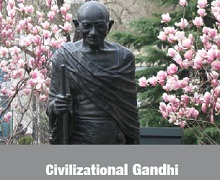
Gateway House's Rajni Bakshi analyses the Mahatma's civilizational vision and explains how it can guide us through contemporary economic and identity-related conflicts.
Gandhi’s little-known work on what it means to be truly civilized may be crucial to the future of our species. There seems to be an absence of a moral framework that serves as the basis of our pursuit of wealth & pleasure. Can such a framework guide us through contemporary economic and identity-related conflicts?
Many artists, thinkers and politicians are increasingly threatened, not just in India but in every corner of the world, by those who disagree with them. So what is the implication of Gandhi’s legacy for those of us who oppose such an assertion of ‘might’ over the ‘right’ of free expression and open exchange?