

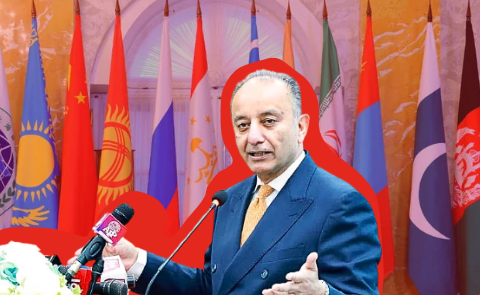
Pakistan’s Federal Minister for Climate Change and Environmental Coordination, Musadik Masood Malik, led Pakistan’s delegation to the inaugural SCO Civilisational Dialogue Forum in New Delhi, held November 20-22, 2026, at the historic Purana Qila. There were questions within India’s government about why Malik was sent to India and not the Culture Minister Aurangzeb Khan Khichi, as since this was the first ever SCO dialogue on culture and civilisation, organised jointly by the Ministry of Culture and Ministry of External Affairs (MEA). Malik was already known in India, having received some unwanted attention months before his visit. He had warned that Pakistan would “cut off those hands” that would take away control of its share of water under the Indus Waters Treaty, in abeyance due to Pahalgam attacks. He explains the logic of the Shehbaz Sharif government dispatching him to India, as it believes climate change is part of the civilisational talks, says Malik to Nayanima Basu of Gateway House in this exclusive interaction.
Nayanima Basu (NB): Why did you decide to come to India? Was it perceived as risky for you to visit India after Operation Sindoor?
Masudik Malik (MM): I honestly do not see this as a risk. I look at this as the responsible thing to do. The region is in a lot of flux. The geopolitics is in a lot of flux. If you look at the countries that are participating (in the SCO), you will find that each one of them has major issues that can only be resolved if we put our heads together. And these issues most adversely affect the most vulnerable. Therefore, it is a leadership challenge and a leadership responsibility for all of us to together find a forum where we can share our concerns and solve our problems.
So for me, it was a responsibility, particularly when framed in the context of cultures which, by definition, have no boundaries, which, over the burden of history or over the course of history, each one of us has been affected by someone else at some point in time. And therefore, to have that discourse, to have that discussion about how our identities are informed by our unique and diverse identities and how our perspectives are useful. We are all sharing that responsibility, and I’m very happy and glad to be here in India.
What risk can there be in trying to take care of your future in the wake of your past and present?
NB: Why was your name nominated for the Shanghai Cooperation Organisation (SCO) Civilisational Dialogue Forum and not that of Culture and National Heritage Minister Aurangzeb Khan Khichi?
MM: Climate is linked with culture and civilisations. Even in my speech, I gave a very clear example of how our oldest culture – Mohenjodaro – how the walls of Mohenjodaro, about a dozen of them, fell to the 2020 devastation caused by the floods and rainfalls. All of this is related to climate change. One of the most important learnings of our times is that it’s not one civilisation which is adversely affecting another civilisation. It is climate change, or the environment, which is adversely affecting all of us.
So from the cultural and civilisational perspective, what stood the test of history over 4,500 years began to fall apart because of the climate change. And at a certain level, climate change by definition is what we as people, as humans, are doing to the climate.
NB: But how do you connect climate change with civilisation?
MM: This sensitivity of what we are doing and how it affects the climate, and as a consequence of that, how it affects civilisations and cultures, is very important. And perhaps that’s the reason why our prime minister decided to send me so that we can talk about these matters.
You might also consider noting that most of the countries which are a part of SCO are glacier countries. These are mountain countries. They have issues and challenges of glaciers, of flooding, and of river flows, and therefore, it is critically important that we become sensitive in the way of the carbon emissions that we are making in our neighbourhood and how those carbon emissions are leading to rising temperatures and how those rising temperatures are making the glaciers melt and how melting of the glaciers is leading to glacial lake outburst floods (GLOFs).
These glaciers and GLOFs are completely blind. They don’t know which side of the mountain they’re going to fall. So when they fall, they affect and can potentially affect and cause devastation in either of these countries. Given the fact that a large number of the countries in SCO are glacier countries, mountain countries, and flood-ridden countries, it is critically important to make this linkage between climate change and civilisational impacts of climate change.
NB: Did you have any brief or mandate from your government to speak with the Indian government at some level on the abeyance of the Indus Water Treaty?
MM: My mandate and my obligation were very clear. My personal thinking is also perfectly in line with that. I’m here, and I was. First of all, as a token of respect, I was invited to SCO, and therefore my obligation is to SCO. I am not denying any opportunity for a bilateral conversation (with India). We have issues to resolve with multiple countries (in SCO). These issues are not necessarily adversarial. There are also a lot of opportunities that need to be explored in terms of bilateral relationships. I’m completely open to exploring opportunities as well as challenges bilaterally. But that would only happen when we are invited to a bilateral forum.
The invitation was not for a bilateral forum or a bilateral meeting. So as a token of respect, I think we should stick to the matter for which the invitation was sent and accepted.
NB: But has that move impacted Pakistan?
MM: I would say the same thing, I think, as a token of respect. When I’m invited to talk about the Indus Water Treaty and when, basically, we are having that discussion, I would be willing to talk about it. But muddling SCO conversations with bilateral issues, first of all, is slightly reductionist. If we were to talk about bilateral relationships, then I’ll have to talk about all of the challenges and opportunities. It would be appropriate to talk about it in the context of the bilateral relationships when the time is right.
NB: What memories will you be taking back with you from India?
MM: It’s beautiful. It’s been fantastic. The warmth that has been extended has been very impressive. And I’ll take that warmth back to Pakistan with me.
Nayanima Basu is an Adjunct Fellow, Gateway House.
This interview was conducted exclusively for Gateway House: Indian Council on Global Relations. You can read more exclusive content here.
For permission to republish, please contact outreach@gatewayhouse.in
©Copyright 2026 Gateway House: Indian Council on Global Relations. All rights reserved. Any unauthorised copying or reproduction is strictly prohibited.