

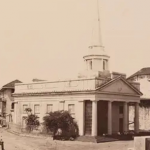
On Sunday, November 30, the 210-year-old Scot’s Kirk (lit. church), recently rechristened St. Andrew’s Cathedral celebrated the feast of Scotland’s patron saint, St. Andrew, just as it has done for two centuries. There are no Scots living in Mumbai except for a few expats of Scottish descent,[1] but the Presbyterian Church, which built this Kirk[2] opposite Lion’s Gate on Apollo Street (today’s Shahid Bhagat Singh Marg), continues this tradition for its congregation. It does this by hoisting the St. Andrew’s Saltire flag,[3] which features a diagonal cross, and keeps it flying at both Scots Kirks for one week.
The celebrations today are far more muted than they were a 100 years ago, when many Scots lived in Bombay. Then, exuberant festivities commenced after Church service, with pegs of Scotch whisky like Glenlivet, Scotland’s national dishes of Cock-a-Leekie soup[4] and Haggis,[5] tunes from the Highlander’s bagpipes, and renditions by guests of Robert Burns and Walter Scott’s poetry on the Land o’ Cakes and Brither Scots. These were large festive occasions, earmarked on the city’s expat social calendar and were held in the city’s Town Hall (today’s Asiatic & Central Library) or Masonic Lodge or Grant’s buildings in Colaba. On occasion, the events were hosted by a redoubtable Parsi merchant with “Scottish interests”, an euphemism for his business dealings with Scottish agency houses.

Image credits: Wikiwand

Image credits: Sifra Lentin
The importance of the Feast of St. Andrew on Bombay’s social calendar reflects the strength of the Scottish presence in the city from the early 1700s to India’s independence in 1947. This was true for other presidency cities like Calcutta and Madras as well. Every one in six men in the English East India Company (EEIC) was Scottish, a number disproportionately high for Scotland’s small population in the 18th century. It was the Scottish network within the EEIC itself, such as its president, Henry Dundas,[6] and a coterie of influential MPs in Westminster targeting the Scottish vote, which enabled many Scots to emigrate to the East during the 18th century.
These enterprising men worked as factors (merchants) and writers (bureaucrats) in the Company. At the same time, Scottish trading houses (free traders), which the Company permitted to trade in India,[7] too, brought out fellow Scots to staff and take over overseas businesses when senior merchants returned home.[8] At one point, there were so many Scottish doctors onboard the East Indiamen and other merchant ships in the India trade, that EEIC director John Drummond wrote to his brother William, in 1731, not to recommend any more Scots for Company ships “till some of them die, nor will, look out for no more, for I am made the jest of mankind, plaguing all the Societys of England with Scots Surgeons.”[9]
The Scots penchant for overseas work was serendipitous. Scotland became part of Great Britain under the Act of Union (1707), and the union worked mainly because the adventurous, hardy Scottish spirit that might otherwise have risen in revolt against England, could be channeled into the colonies. Even the most ardent Jacobite, a Scot who believed in the restoration of a Scottish Stuart King to the throne of Great Britain and resented the Union of 1707 as a raw deal for his small nation, subsumed his beliefs at the prospect of making money in India. This made Scots motivated Empire-builders, but they almost always returned home as Scotsmen, walking a thin line between loyalty to Great Britain and their Scottish homeland. A “divided loyalty” that continues to manifest itself, as it did in the 2014 independence referendum on whether Scotland should secede from the UK (It didn’t.).
So, who are these early Scottish sojourners to Bombay? What are the milestones they left behind?


Image credits: Sifra Lentin
The earliest legacy of the city’s Scottish past is the Cathedral of St. Andrew’s (its original name was Church of St. Andrew’s), the first Scottish Presbyterian Kirk to be built in Bombay. The church’s first Padre, Rev. James Clow, arrived in the city in 1815 on a petition to the EEIC by Scottish soldiers, sailors, traders, and company men – and stayed for two decades. Dr. D.P.N. Prasad, chairman of this church’s governing board, who is researching the archives of his Kirk, says they continue to diligently follow the Scots’ preferred Presbyterian service rather than the Anglican one observed in St. Thomas’ Cathedral.
The first Presbyterian Sunday services were held in 1815, first in the mess room of the Town Barracks and then in the old Court premises, today’s Great Western building, located a plot away from the Kirk.[10] “The Scots are famously frugal people,” says Prasad, “and do not like spending a penny more than what is necessary.” The evidence is in the Kirk’s archives, which are full of letters of remonstrance written at the time the church was being built, calling for restraint on extravagant spending. The result is a neo-classical building, who’s exterior and interior reflect the Presbyterian ethos of simplicity.[11]
When the Scot’s Kirk was built, there was pushback from Calcutta’s Anglican Bishop against its tall spire, which likely competed with St. Thomas’s Cathedral’s bell tower for attention.[12] This order was passed by the colonial government in Bombay. The reason given was that it overshadowed the Brab tree in Bombay Castle, as a guide to ships entering the Harbour – but was clearly a Presbyterian-Anglican tussle for supremacy in the city. The order was appealed in the Company’s court in London, and the EEIC’s objection was overturned. The spire was finally built in 1823.[13] A commentator of the time cattily remarked this would never have happened if it had occurred after 1843, when Queen Victoria first attended service at Crathie Kirk, a Scottish church close to the British Royal family’s Scottish estate, Balmoral Castle.[14]
The early 19th century was also a time when many Scotsmen who influenced the political, economic, educational, and cultural life in Bombay were part of Rev Clow’s congregation.

Image credits: National galleries of Scotland

Image credits: Wikimedia
Foremost was the Scottish governor of Bombay from 1819 to 1827, Lord Mountstuart Elphinstone, who actively supported The Bombay Native Education Society (BNES), established in 1820 as the Elphinstone Native Education Institute.[15] This new Society intended to popularise modern education in the local and Indian languages amongst Indians.[16] The BNES schools marked the beginning of state education for Indians in the Bombay Presidency. Elphinstone’s support was key to this initiative, which was also backed by merchant philanthropist Jagannath (Nana) Shankarsett. By the time Elphinstone left Bombay, a BNES central school had been established, which was later bifurcated into a high school and, later, a college, both named after him. The high school is today the Elphinstone Technical High School in Dhobi Talao, and the college, which was originally located in Byculla, is in the Kala Ghoda precinct.
In addition to Presbyterian priests-missionaries – the most famous being Rev. John Wilson, after whom the city’s Wilson College is named – and Company servants like Elphinstone, Scottish free traders played a critical role in facilitating overseas trade from Bombay. Like native merchants, they “oiled” the wheels of trade and commerce in the city by providing banking services (credit to the company and cash advances to Indian farmers), ship insurance, and filling the gaps in the EEIC’s ability[17] to participate in the hinterland and coasting trade.
Just one among many is Wallace & Co. whose Bombay Burmah Trading Corporation Ltd, established in 1863, is the oldest company still actively traded on the Bombay Stock Exchange (BSE).[18]

Image credits: Chiang Mai a la Carte Tour

Image credits: Ben Squires photos
Lewis Alexander Wallace had six sons, and the oldest, William, travelled to Burma to take delivery of 1,500 tons of teakwood, which his firm was supplying to the British Indian railways, then embarking on an infrastructure buildout across India to connect hinterland markets with ports like Bombay. Wallace & Co. floated Bombay Burmah in 1863 in order to monetise the risky investments William had made in buying teakwood concessions in the forests of the Kingdom of North Burma, a monarchy. The timing was propitious for selling shares in this risky venture, as a nascent Bombay stock market was in the grip of a bull run, driven by the high demand for Indian raw cotton amid global shortages caused by the American Civil War. The market crashed in mid-1865[19] on news that the War had ended; however, Bombay Burmah was among the few companies that survived. It is today a Nusli Wadia company that has diversified into plantations, manufacturing, healthcare and horticulture, and is still going strong, almost 200 years later, on the BSE and the National Stock Exchange.
Like Bombay Burmah, many Scottish businesses and institutions are today under Indian management, and their Scottish roots are little known. There is one obvious exception: Scotch whisky. Early newspaper reports on the Feast of St. Andrew’s a 125 to 150 years ago refer to revelries made even more raucous with the free flow of Scotch. It is little wonder that India is today the largest consumer of Scotch whisky in the world, a taste of which was first acquired by Indian elites due to their Scottish interests.
So, though the music of the bagpipes can no longer be heard, and the poetry of Burns and Scott is confined to classrooms rather than late-night drunken revelries, what does endure are the institutions and businesses the Scots built, and the Mumbaikar’s favourite whisky peg – Scotch!
Sifra Lentin is Fellow, Bombay History, Gateway House.
This article was exclusively written for Gateway House: Indian Council on Global Relations. You can read exclusive content here.
Support our work here.
For interview requests with the authors, or for permission to republish, please contact outreach@gatewayhouse.in.
©Copyright 2025 Gateway House: Indian Council on Global Relations. All rights reserved. Any unauthorised copying or reproduction is strictly prohibited.
References:
[1] The Cathedral of St. Andrew occasionally has visitors of Scottish descent who attend service. A few years ago, Dr Prasad recounted that there was a young American from the US Consulate General who played the Scottish bagpipes on the steps of the Church.
Interview with Dr D.P.N. Prasad, chairman of the Board, Scot’s Kirk, by this author, on 7 December 2025.
[2] Construction of the Church of St. Andrew, designed by Captain Sam Goodfellow, and known as Scot’s Kirk, began in 1815 and was completed in 1818. The first service in this Church was held on Sunday, 25 April 1819, and was conducted by Rev. James Clow. He was Bombay’s first Presbyterian Chaplain. The 200th anniversary of this Kirk was celebrated in 2015, taking the year of commencement of construction as the year of this Kirk’s establishment.
[3] St. Andrew, one of the Twelve Apostles of Jesus Christ, and the patron saint of Scotland, is believed to have been crucified on an angled cross. The angled cross on the Union Jack represents Scotland.
[4] This soup is believed to have its roots in the French chicken and onion soup, but instead of onion, it uses leek, which is abundantly available in Scotland. Traditionally, a mature fowl, preferably a rooster, is used in the preparation of this rich broth, which is the national soup of Scotland.
[5] Haggis is the national dish of Scotland. It is prepared as a mixture of sheep’s heart, liver, lungs; chopped onion, oatmeal and suet, all seasoned with salt, pepper, spice, nutmeg, and allspice. This mixture is filled into a cleaned sheep’s stomach and boiled for hours before being served with Neeps (turnips), Tatties (mashed potatoes) and a Wee Dram of Scotch Whisky.
[6] Henry Dundas or the First Lord Melville was the president of the Board of Control for the East India Company from 1793 to 1801.
[7] The EEIC’s Charter of 1600 gave it a monopoly on the India trade. However, the Company permitted a few merchants to trade in India; these were known as free traders, as opposed to those who breached this monopoly, who were known as interlopers. This monopoly on the India trade was taken away from the Company in 1813.
[8] The heads of agency houses, whether Scots or others, retired only after they had made enough wealth to invest in landed estates and actively participate in Westminster politics. Most continued in overseas trade but managed the London or Glasgow, or Manchester end of it.
[9] One reason for most posts such as doctors, captains, accountants, being dominated by Scots was the practical and quality higher education that they received in colleges in Scotland’s cities like Edinburgh and Glasgow.
See Mackenzie, John M., ‘Essay and Reflection: On Scotland and the Empire”, The International History Review, 15:4, p.715.
[10] Sheppard, Samuel T., The Gazetteer of Bombay City and Island Volume iii (Bombay, The Times of India Press, 1909) p. 247
[11] Captain Sam Goodfellow designed the Cathedral of St. Andrew.
[12] Interview with Dr Prasad on 7 December 2025. According to Dr Prasad, this was the real reason why the objection was raised.
[13] The original spire was destroyed by lightning and was rebuilt in 1826.
[14] It is a tradition that continues to this day when the British royal family is in residence at Balmoral.
[15] The Elphinstone Native Education Institution was from 1820 to 1822 a branch of the Bombay Education Society, established for the education of European and Anglo-Indian children, , after which it became an independent body named The Bombay Native School Book and School Society Lord Elphinstone was the first president of the Society heading a board that was a mix of Company men and eminent locals. In 1827, it became The Bombay Native Education Society.
See: Sheppard, Samuel T., The Gazetteer of Bombay City and Island (1909) Vol. 3 (Bombay, The Times of India Press, Reprint 1982), p. 101.
[16] The Society was initially named the Bombay Native School and School Book Association. From 1827, it was known as the Bombay Native Education Society. See https://gazetteers.maharashtra.gov.in/cultural.maharashtra.gov.in/english/gazetteer/greater_bombay/education.html#:~:text=The%20honour%20of%20having%20made,modern%20education%20among%20Indian%20people.
[17] This was the result of the Company’s Charter, which forbade the Company from participating in the coasting trade, unlike the Dutch East India Company.
[18] The EEIC employees established Bombay’s earliest agency houses. The advantage they had over local merchants was that they could trade with London, Manchester and Glasgow, at a time when Indian merchants could not. Most early agency houses, such as Alexander Adamson, Forbes Smith & Co., and Bruce Fawcett & Co., were founded by Scots and helped Company servants to remit their earnings home. They also provided silver to the Company to buy tea in China, thereby facilitating the triangular trade between India, China, and Great Britain.
The role of agency houses is covered extensively in Lentin, Sifra, Mercantile Bombay: A journey of trade, finance and enterprise (New Delhi, Taylor & Francis, 2023)
[19] This agency house originated in Frith & Co. (a partnership between Scotsman J.G. Frith and a Parsi Framji Nusservanji Patel) before the Scottish Wallace family bought it over and renamed it.