

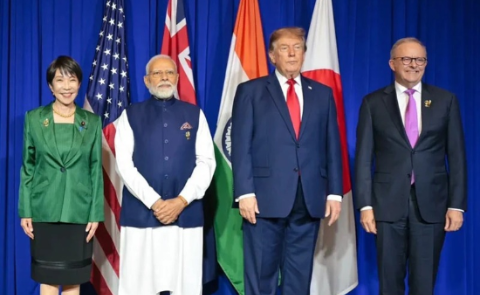
On November 17, 2026, the 7th leaders’ summit of the Quad countries, viz. the U.S., India, Japan and Australia, took place in Manila. It was the first summit attended by President Donald Trump, who hosted and chaired it, as the last summit was held in Wilmington in September 2024 when Joe Biden was the U.S. president. This was also the first summit held in a non-Quad country, but Manila holds significance in this very forum’s development. The first meeting of officials that launched the Quad took place in Manila in 2007, as did the meeting that revived it in 2017, after a decade-long hiatus.
The context of the 2026 Quad Leaders’ meeting is particularly important. It was framed by two wars – Ukraine and Iran – and a decisive defeat of Trump’s Republican Party in the U.S. midterm elections. The summit was preceded by the 49th ASEAN summit and the 21st East Asia Summit (EAS).
The meeting was not initially confirmed. Uncertainty prevailed until the last minute over whether the leaders would meet in Manila, as officials awaited confirmation of President Trump’s participation. That came only just before his departure from Washington. Even then, U.S. officials sought to portray it as “a multilateral meeting” rather than a full-fledged Quad summit (even though the official statements thereafter in all countries refer to it as a summit).
Three reasons explain the U.S. decision to participate. One, the Washington establishment needed a strong diplomatic show in Asia to divert attention from the Republican Party’s loss of both houses of Congress. This summit, along with the Trilateral summit of Presidents Trump, Putin, and Xi Jinping, did exactly that, providing the needed distraction.
Two, Secretary of State Marco Rubio, who invested much time and effort in five ministerial meetings over the past two years, succeeded in convincing his president that the time for the summit had come.
Three, the sequence, i.e., the Quad summit preceding the Trilateral summit, suited President Trump best, as he met the Chinese and Russian presidents, secure in the solidarity of the Indo-Pacific’s leading maritime democracies, being intact. He thus carried the ‘Peace Through Strength’ message from Manila to Shenzhen.[1]
What was achieved at the Manila summit? The four leaders delivered short but meaningful remarks, conveying their commitment to strengthening and deepening cooperation within its agreed framework. Trump stressed that the Quad has become “very important and very special”, composed of some of “the most important partnerships in the entire world”. Prime Minister Narendra Modi observed that for India, the Quad was “a constructive and trusted partnership”, delivering “trusted solutions to the entire Indo-Pacific.” Japanese Prime Minister Sanae Takaichi was convinced that the Quad would shape the future of the Indo-Pacific “with our regional partners”. Australian PM Anthony Albanese noted that when members work together toward their shared vision of peace, stability, and prosperity, “the world will be a safer and more secure place, and the Quad has a special role in achieving it.”
Further, Quad officials, through quiet, behind-the-scenes work over a prolonged period, produced a masterpiece of diplomatic drafting in the Quad Leaders’ Summit Joint Press Release.[2] It succinctly encapsulates the forum’s guiding philosophy, basic goals, and immediate plans. A close look at it, therefore, is key to understanding the significance of the outcomes in Manila.
The vision of a Free and Open Indo-Pacific (FOIP), first articulated by Prime Minister Shinzo Abe of Japan, has grown “stronger than ever”, the document states. The Quad is “a force for good and a partnership of action, committed to peace, stability and prosperity.” Member states are strongly opposed to “any destabilising or unilateral actions that seek to change the status quo, including by force or coercion”. The release also expresses “grave concerns about economic coercion, including through arbitrary export restrictions”. The criticism of China’s actions and its policy approach is apparent. A pointed reference to protecting “freedom of navigation and overflight also exists, but a specific mention of the South China Sea and UNCLOS has been dropped, possibly as a concession to the U.S.’s ongoing efforts to seek reconciliation with China in their bilateral relations. (Refer to the Wilmington Declaration of September 2024.)[3]
An interesting insight: the irony of including “economic coercion” seems to have been lost on the American side, because it applies as much to the U.S. as to China today.
In practical terms, the joint press release’s real value lies in the six-point action plan approved by the leaders. Its elements are as follows:
1. The Quad Business Leaders Forum, a gathering of business leaders, government officials, and policy experts from member states that will be charged with fostering greater business ties across private sectors through commercial deals and partnerships. India will host its first meeting in early 2027.
2. AI Accelerator, announced by the foreign ministers earlier, which aims to coordinate and fund efforts to support trusted AI access, deployment, and technical assistance in the Indo-Pacific region,
3. Indo-Pacific Surveillance Collaboration as a new initiative to enhance sharing and maritime domain awareness. A special maritime exercise featuring P-8 and P-3C patrol aircraft will be organised for the first time in a Quad context in 2027.
4. Quad Partnership for Cable Connectivity and Resilience, which will be expanded through Australia’s increased contribution to focus on electricity cables, strengthening regional energy, security, and connectivity.
5. Quad Security Cooperation, necessitated by the rapid increase in the number and scale of cyber incidents in the region. This aims to achieve “an open and secure cyberspace”.
6. Counterterrorism-related cooperation will be further strengthened, based on the Quad’s unequivocal condemnation of terrorism and violent extremism “in all its forms and manifestations”.
In a nod to the vital importance of ASEAN for the Quad’s success, the document ends by reaffirming unwavering support for ASEAN centrality and unity and asserts, “Together, we are committed to upholding a free and open Indo-Pacific.”
Where will the Quad go from here? The summit has undoubtedly given it a fresh rush of wind and momentum, but its supporters and advocates will need to watch its future development closely on at least three planes.
First, on how the Trilateral summit of the U.S., China and Russia, held for the first time on November 19 in Shenzhen, develops, what it aims to achieve, and whether it will begin periodic confabulations. Surely, its essence will be shaped by the evolving state of U.S.-China relations, which in turn will mould the Quad’s trajectory.
Second, the Quad governments’ success in implementing its six-point plan, as well as the other decisions taken by the foreign ministers, will be a crucial yardstick.
Third, for its continued success, the Quad must ensure periodic, or at least annual, summits. India was denied the opportunity to host it in 2024, 2025, and 2026. Will it be lucky in 2027? Much will depend on the state of U.S.-India relations and the state of global affairs next year.
Predicting the future in a world marked by unpredictability and turbulence is not prudent, but in diplomacy, it is hope that reigns supreme.
Rajiv Bhatia is the Distinguished Fellow for Foreign Policy Studies and a former diplomat who served in Jakarta as DCM and in Yangon as Ambassador.
This article was exclusively written for Gateway House: Indian Council on Global Relations. You can read more exclusive content here.
For permission to republish, please contact outreach@gatewayhouse.in.
Support our work here.
© Copyright 2026 Gateway House: Indian Council on Global Relations. All rights reserved. Any unauthorised copying or reproduction is strictly prohibited.
References:
[1] U.S. Embassy & Consulates in China. “President Donald J. Trump Visits Shenzhen, China.” https://china.usembassy-china.org.cn/president-donald-j-trump-visits-shenzhen-china/
[2] Ministry of External Affairs, Government of India. “Quad Leaders’ Summit Joint Press Release.” https://www.mea.gov.in/press-releases?dtl/41963/Quad_Leaders_Summit_Joint_Press_Release
[3] Ministry of External Affairs, Government of India. https://www.mea.gov.in/bilateral-documents?dtl/38320/