

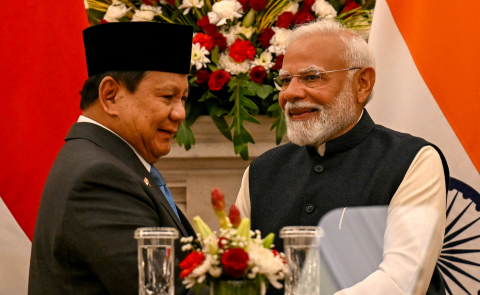
Following decades of close relations, estrangement, mutual indifference, and underperformance, India and Indonesia – bound by a Comprehensive Strategic Partnership since 2018 – have been working to give their relationship new meaning and strong momentum, especially after President Prabowo Subianto’s successful visit to India in January 2025.
What the past 18 months have achieved and how the bilateral may blossom further will become clear when Prime Minister Narendra Modi lands in Jakarta in the first week of July as part of a three-country tour that will take him to Australia and New Zealand, too. This voyage of relationship-building is preceded by the visit to India by Japanese Prime Minister Sanae Takaichi. Hence, the Indo-Pacific dimension of Modi’s dialogue with leaders of four important democracies in the region, at a time when the U.S. commitment to the Indo-Pacific and the Quad seems to be weakening, will be of wider significance and interest.
The current India-Indonesia bilateral is free from disputes and irritants. The two leaders connect very well, with Prabowo coming across as an admirer of PM Modi’s domestic policies and Modi appreciating that the current Indonesian president holds a more calibrated and nuanced view of China’s role in the Indo-Pacific.
In this light, it may be left to the leaders to use their vantage position to motivate officials, business leaders, and others to do more – and with greater speed – to increase substance to cooperation. This kind of practical approach was visible on June 7 when the two foreign ministers – S Jaishankar and Sugiono – co-chaired the 8th India-Indonesia Joint Commission meeting. After “a full spectrum” review of ties, they identified avenues for further strengthening collaboration in a slew of diverse areas: political, defence and security, maritime, trade and investment, pharma and healthcare, digital, energy, connectivity, space, education, consular, culture, and people-to-people exchange. It is reasonable to expect that several new MOUs may be signed, and a clear roadmap may emerge to nurture and deepen this vital relationship in the coming years.
But the significance of Modi’s visit goes beyond this. The two leaders are expected to achieve a closer, more aligned worldview, especially in the aftermath of the wars in Ukraine and the Gulf and amid the emerging entente cordiale between the U.S. and China. The latter, if it materialises fully, will have a significant impact on the region, where India and Indonesia are leading players. The Indo-Pacific is their shared home, as it is for other fellow democracies such as Japan, Australia, the Philippines, and South Korea. These six nations value security and stability, which are crucial to the well-being and prosperity of their people. They need to create a new forum for consultation and political-diplomatic partnership as other groupings – such as the Quad – reveal inner cracks due to American indifference. This is a key strategic aspect worth watching while Modi is in Jakarta.
A renewed expectation is that the two countries may finally agree on a deal for India to sell BrahMos missiles to Indonesia. India’s defence secretary Rajesh Kumar Singh recently disclosed, at the Shangri-La Dialogue, that terms of the deal were close to finalisation. Gradual intensification of defence cooperation may also be on the cards. The shared goal of increasing bilateral trade from $30 billion to $50 billion has run behind schedule but is extremely important, tying up the two countries in productive commercial engagements. Cooperation in critical minerals and digital commerce will hopefully be accorded special salience. Statements by the leaders, and perhaps a joint statement, may provide clues about the governments’ thinking on how to achieve this goal.
In the news era of proactive plurilateral diplomacy, India and Indonesia are certain to discuss and devise ways and means to enhance collaboration in fora such as the G20, BRICS, and the Indian Ocean Rim Association (IORA). Indonesia is a new member of BRICS and can gain much from close collaboration with a founding member like India. The latter will need Jakarta’s valuable support to ensure that the forthcoming BRICS summit in Delhi is a success.
Closer home, India will no doubt highlight its burgeoning cooperation with ASEAN, of which Indonesia has been a leading light. The two leaders may discuss their conceptions of the unfolding change in Myanmar. A visible gulf exists between ASEAN’s Five-Point Consensus formula and India’s policy of embracing the new power reality, visible during the official visit of general-turned-president Min Aung Hlaing to New Delhi recently.
India’s May 1 announcement of the Great Nicobar Project,[1] which seeks to transform the Andaman and Nicobar Islands into a strategic maritime and economic hub, gives Indonesia especial importance due to its geographic proximity to the islands. For the same regional space are ongoing discussions on connectivity and the imperative need to strengthen BIMSTEC – an area where the two sides should actively exchange views on how to involve Indonesia in the endeavour to make the Bay of Bengal Community a reality.
Several of these issues were on the discussion table at the two rounds of the Track 1.5 Dialogue between Mumbai’s Gateway House: Indian Council of Global Relations and Jakarta’s Center for Strategic and International Studies (CSIS) in Mumbai and Jakarta between the thought leaders of the two countries. The seriousness of the dialogues, held in September 2024 and September 2025, and their recommendations were acknowledged by and found mention in their joint statement of January 2025. Both capitals now have future-orientated and pragmatic policy suggestions in their respective briefcases. They need now only to activate the ideas within and expedite the plans to bring the two countries and, thereby, the two regions, together.
Rajiv Bhatia is a Distinguished Fellow at Gateway House. He is a former diplomat who served in Jakarta as DCM and in Yangon as Ambassador.
This article was exclusively written for Gateway House: Indian Council on Global Relations. You can read more exclusive content here.
Support our work here.
For permission to republish, please contact outreach@gatewayhouse.in
© Copyright 2026 Gateway House: Indian Council on Global Relations. All rights reserved. Any unauthorised copying or reproduction is strictly prohibited.
References:
[1] Press Information Bureau, Government of India, “Great Nicobar Project” Press Information Bureau, May 1, 2026. https://www.pib.gov.in/PressNoteDetails.aspx?id=158406&NoteId=158406&ModuleId=3®=3&lang=2