

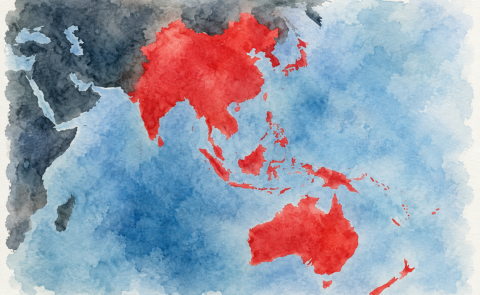
The Indo-Pacific Region (IPR) is a geopolitical idea, not a geographic reality. It offers a way to comprehend the politics and interstate relations of a large part of the planet, a reimagining that scholars can undertake with greater ease than policymakers.
Definitions of the region differ widely. Russia and China still prefer the older alternative – ‘Asia-Pacific’. The U.S., which played a pivotal role in raising awareness about China’s rise and assertiveness in Asia, defines IPR as the region stretching from ‘Bollywood to Hollywood’, or ‘Asia-Pacific plus India’. The Indian government views the region as extending from the western shores of the U.S. to the eastern shores of Africa. In this light, reputed scholar C. Raja Mohan found a nice middle ground between the Indian and American definitions. He defines IPR as “a region that includes India and East Asia, as well as the waters off this landmass in the Pacific and Indian Oceans” but excludes Central Asia, the Middle East, and Africa.
As the U.S. ‘unipolar moment’ began to end over a decade after the Cold War, Washington was confronted with the reality of China’s rapid rise, both economically and strategically. With this rise came a sharp increase in China’s aggressiveness in Asia, especially in the South China Sea. To counter it, U.S., Japanese, and Australian scholars pushed the notion of a coalition of democracies. This was the bedrock on which the narrative of IPR, with an increasing engagement of India’s strategic community and government, moved forward, particularly in the second decade of the 21st century. The progress and consolidation of the Quad – comprising the U.S., India, Japan, and Australia – gained momentum during the Trump administration 1.0. This clear trend continued and advanced further throughout Joe Biden’s presidency.
However, the third decade inaugurated the ‘Age of Polycrisis’, during which all conflicts took place in regions other than the Indo-Pacific: the Russia-Ukraine war; Israel‘s military actions in Gaza and the kinetic actions in the surrounding region; U.S.-Israel attacks on Iran in June 2025; U.S. action in Panama, Venezuela, and Cuba; and eventually a full-scale, undeclared war against Iran by the US and Israel and the Iranian strikes against the Gulf states and others. All this combined to bring a sharp reduction in the salience of the Indo-Pacific.
As a result, the IPR does not appear to be the most consequential theatre of geopolitics today. Yet its significance as the platform on which great-power contestation in political, military, technological, and economic domains will play out cannot be overstated. Strategic rivalries in the Indian Ocean, China-India competition in South Asia, India-China and India-Pakistan conflicts, and the potential for the South China Sea, the Korean Peninsula, Taiwan, and the rising China-Japan tensions as flashpoints must be factored in. Their evolution, impact, and likely repercussions need to be monitored regularly by governments and strategic communities alike.
That China remains the core strategic issue is beyond debate. Its comprehensive national power, much like its influence in the Indian Ocean region, South Asia, Southeast Asia, and East Asia, has been on the rise. It pursues an aggressive diplomacy, backed by military action, as New Delhi experienced again during and after the border clash in June 2020. ASEAN, Japan, Taiwan, and Australia – all have tasted that medicine, and they do not like it.
The Quad was crafted as the combined response of Indo-Pacific democracies, backed by deepening naval cooperation through joint exercises and other measures that were kept outside the Quad’s formal framework. The unique combination of three allies – the U.S., Japan, and Australia – with India as their common strategic partner made steady progress in building inner cohesion and external cooperation with other groupings such as ASEAN and the European Union (EU). The Quad found itself in excellent shape in September 2025, when the Biden administration held its farewell summit in Wilmington, U.S. The summit declaration reiterated the leaders’ commitment to “a free and open Indo-Pacific that is inclusive and resilient”. They projected the Quad as “a force for good that delivers real, positive and enduring impact on the Indo-Pacific”.
Since then, the Quad has faced rough weather, despite an initially optimistic signal from the Trump administration 2.0, when Marco Rubio, the U.S. secretary of state, hosted a meeting of the grouping’s foreign ministers on the first day of the administration’s tenure. Within months, India-U.S. relations went downhill, and the Trump administration began exploring a rapprochement with China, even flirting with the idea of creating a G2 to moderate their rivalry and harmonise their policies. The Quad summit, scheduled to be hosted by India in November 2025, was postponed indefinitely. At the time of this writing, the world, particularly the Indo-Pacific, anxiously awaits President Trump’s visit to China, speculating about its likely consequences. Recent indications suggest that this visit may be delayed due to the conflict in West Asia.
Over the years, India has developed an Indo-Pacific vision and a matching strategy. Its first option is to work for peace and cooperation with all stakeholders in the regions, but its other priority is to enhance its preparedness, should things go wrong. The desired preparedness stems from enhancing military and economic capabilities internally and constantly improving the power balance externally.
A key policy announcement came from Prime Minister Narendra Modi in March 2025, when speaking in Mauritius, he announced the elevation of India’s policy approach from SAGAR (‘Security and Growth for All in the Region’) to MAHASAGAR (‘Mutual and Holistic Advancement for Security and Growth Across Regions’). New Delhi has not offered a definitive explanation of what this elevation truly means, while think tanks have held scores of seminars on the subject.
Consultations with officials and experts, however, have brought some clarity. A former naval chief of India told the author that while India is busy protecting its interests globally, its real security and economic interests lie closer home, especially in the Indian Ocean region. Therefore, it is possible to surmise that, at least in the near future, though India will seek geopolitical and geoeconomic collaboration with willing partners in the Pacific region, its security and defence policy will need to concentrate largely on the nation’s perception of threats and challenges in the Indian Ocean.
In this realistically defined context, what India does and how it succeeds in its pivotal role in select plurilateral groupings such as BIMSTEC, Colombo Security Conclave, and IORA may be far more important than what it does in other regional groupings.
Finally, the three nations still committed to the Quad, namely India, Japan, and Australia, need to consider a Plan B if the U.S. loses interest in this grouping completely. They should consider inviting select nations, such as the Philippines, Vietnam, Indonesia, and Malaysia, to engage with the Quad as observers. Thus, Asian democracies can work together to address the China challenge as the core issue of IPR.
A Track 2.0 dialogue among the leading think tanks of these seven nations seems to be the prudent way forward. A Track 1.5 Dialogue may follow suit.
Rajiv Bhatia is a Distinguished Fellow at Gateway House. He served as India’s ambassador to Myanmar from 2002 to 2005. His book India-Myanmar Relations: Changing Contours won wide acclaim.
This article was first published in the Indian Foreign Affairs Journal in May 2026.