

Indian travelers rarely get to Tibet, and Indian scholars less so. But a recent visit to Tibet, organised by the Chinese government to present ‘their’ view of the autonomous region, was an education. Far from that lofty realm of the sacred Himalayan ranges, is the reality of China’s presence in Tibet, and the sweeping transformations occurring in the region economically, culturally and etymologically. The profound juxtaposition of ancient traditions and modern developments paint a vivid picture of a land in the midst of substantial evolution.
As the aircraft approaches Lhasa from Beijing, passengers are instructed not to take photographs. This is reminiscent of the recent guidelines issued by Indian authorities, which request that passengers refrain from taking pictures and also close their windows before entering the Kashmir valley. Both instructions seem superfluous, considering that numerous satellites are already capturing images from above, and are available to the public.

Source: Nayanima Basu
Lhasa International Airport is nondescript yet highly efficient. This is contrary to the popular narrative of Lhasa as a forbidden land where oracles are more common than human beings.

Source: Nayanima Basu
The drive to the hotel in Lhasa was long, along a high-speed expressway dotted with toll gates, mostly manned by women. The six-lane road was filled with high-end vehicles, including Mercedes’, Land Cruisers, and Range Rovers among others, and gigantic posters along the way, featuring a constellation of top five Communist Party leaders – Mao Zedong, Deng Xiaoping, Jiang Zemin, Hu Jintao and Xi Jinping. Lhasa’s hotels are posh, with American brands like Hilton and Asian ones like the Shangri La, present.

Source: Nayanima Basu
Tibet today is a knot of contradictions with the Chinese readying to appoint a new Dalai Lama after the passing of the current 14th Dalai Lama, Tenzin Gyatso, now 90, who escaped to India after the Chinese Communist Party took over Tibet in 1951. That was followed by the establishment of the Tibet Autonomous Region by Chinese leader Mao Zedong in 1965.
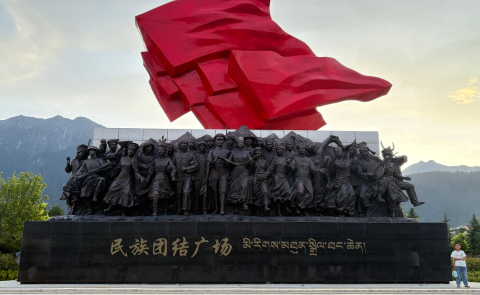
President Xi, 72, was in Tibet August 20 to celebrate 60 years of Chinese rule there (which interestingly coincided with the visit of Chinese Foreign Minister Wang Yi to India on Aug 18-20). Xi last visited Tibet in 2021 to mark 70 years of what Beijing refers to as “Peaceful Liberation” of Tibet. Since then, Tibet has been undergoing a massive transformation and Sinicisation with the increasing presence of the majority Han Chinese in that region.
Source: Nayanima Basu
The Tibetan Buddhist rituals, ancient Chinese dynastic traditions, and the geopolitics around the 14th Dalai Lama’s impressive global influence as a spiritual leader coupled with the existence of the Tibetan government-in-exile in India, makes the issue of the succession of the 14th Dalai Lama a critical matter that threatens the current modus vivendi between India and China.
Now when India is returning to the road of rapprochement with China, New Delhi should also begin putting Tibet on the table, with resolve. Because China is serious about the dynamics around Tibet. For India to continue avoiding the topic and retaining it as a religion-only issue left best to the Tibetan community living in India, will be a folly.
Chinese Foreign Minister Wang Yi’s two-day visit[1] visit to India for the Special Representatives’ dialogue, should give a clear indication to India of the times to come.
Since the June 2020 Galwan incident, Prime Minister Narendra Modi has met Chinese President Xi Jinping twice – the latest being in Tianjin, China on the sidelines of the recently concluded Shanghai Cooperation Organisation (SCO) Summit that took place from August 31- September 1. However, in both the meetings India has avoided mentioning Tibet even once, in sharp contrast to China which has been making serious statements about the succession issue of the Dalai Lama as well as on the status of Tibet.
According to China, only Beijing has the sole authority to elect the next Dalai Lama as it did during the election of the 14th and current Dalai Lama, who eventually fled to India in 1959. Officials there maintain that the same procedure of “reincarnation” of the Dalai Lama will be followed which was carried out during the election of the incumbent spiritual leader, who are referred to as “Living Buddhas” under the Chinese Buddhist tradition.
On the status of Tibet, the Chinese officials go back to the ‘Seventeeen-Article agreement’ signed in 1951 between the representatives of the Tibetan government and the Communist Party of China (CPC) which incorporated the Tibetan Autonomous Region (TAR) into the People’s Republic of China. China claims the agreement had the “full support” of the 14th Dalai Lama.
According to the documents preserved by the Chinese-government funded China Tibetology Research Centre in Beijing, the 14th Dalai Lama “sent telegrams to Chairman Mao Zedong, to express his support for the Seventeen-Article Agreement.”
When President Xi visited Tibet to celebrate the 60th founding anniversary of Tibet, Vice Premiere Wang Huning said when addressing a massive gathering in Lhasa, “Tibetan Affairs are China’s internal affairs, and no external forces are permitted to interfere. All schemes to split the motherland and undermine stability in Tibet are doomed to fail.”
This should serve as a warning to India that Beijing has significantly changed the situation in Tibet while also establishing a robust succession process for the Dalai Lama.
Across the border in Dharamsala, at his 90th birthday celebrations this July, the Dalai Lama categorically mentioned that the lineage of the Dalai Lama will continue, and his successor will be born in a “free country.” He also said that the right to select his successor rests only with the Gaden Phodrang Trust that was founded by him in 2011 and that there will be a “framework” to discuss his succession. This is the first time ever that the Dalai Lama has made such a claim, openly. China calls him a “separatist”.
There was no comment from the Indian government on the Dalai Lama’s succession comment or on China’s reaction.
On its part, China is institutionalising its intentions. Under President Xi’s rule, China has opened a series of museums housing Tibetan ancient scriptures and books that lay down the procedures on how Dalai Lamas have been selected since the institution began in 1391.The title “Dalai Lama” was first conferred upon the third Dalai Lama by the Mongol leader Altan Khan. The process of reincarnation officially began in 1578.
The current Chinese government is leaving no stone unturned to piece together the history dating back to the 14th century. It is time for India to brace up. New Delhi will soon be confronted with a situation where there might be more than one Dalai Lama.
China asserts it has exclusive authority to approve the reincarnations of Tibetan Buddhists, referencing the procedures outlined in the 1793 Qing edicts. According to these guidelines, final approval must come from the central government, which oversees the reincarnation process of “Living Buddhas,” including the Dalai Lama.
Beijing plans to implement the “Golden Urn” system, in which potential names for future Dalai Lamas are placed inside an urn. The name that is drawn first will be appointed as the next Dalai Lama – but in CPC’s China, this appointment will also require government approval. Thus, does it cleverly intertwine historical precedents with contemporary governance strategies.
The 14th Dalai Lama and the Tibetan community in India have rejected this procedure and urge Tibetans living outside of China as refugees to do the same. They have repeatedly asked India to raise the issue directly with China and eventually make them a stakeholder in the talks. So far, there has been no Indian response.
Li Decheng, Deputy Director General of the China Tibetology Research Center in Beijing said, “It is wrong to suggest that the next Dalai Lama whom China will select will not be accepted by the world. China has the maximum number of Tibetan Buddhism followers with the numbers going up to 7 million – the number of Tibetans living outside as refugees is a fraction of that. So, only China has the majority.”
There is authority to those words. Chinese development across Tibet is impressive. New Lhasa has several five-star hotels, perfectly streamlined cafes along with manicured gardens, art galleries, theaters, super specialty hospitals and schools. In terms of connectivity, Lhasa is now connected with mainland China by air or by road as also by high-speed bullet trains – the famous Qinghai-Tibet Sky train – that run perfectly on time.

Source: Nayanima Basu
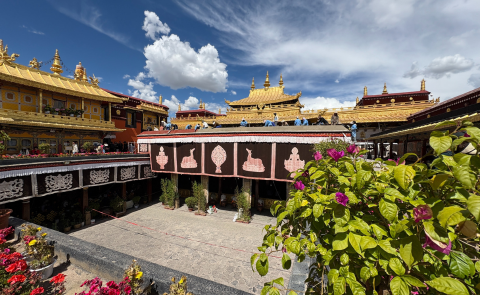
“I will come to the Potala Palace every year till I die. I believed in the 14th Dalai Lama. He lives in the heart. But he left us. But the Jokhang Temple is there, the Potala Palace is there. My children and my grandchildren live here. We are the real Tibetan Buddhists,” 84-year-old Xiang Zhuo Ma, who came to visit the Potala Palace from Sichuan Province, says.
China has made substantial efforts to convey to the international community that Tibet is an inseparable part of its territory, reframing historical narratives that suggest Tibetan independence. These actions are likely to escalate tensions between India and China, despite attempts from both nations to manage these issues discreetly.
Meanwhile, in India there are now growing calls to confer the coveted ‘Bharat Ratna’ award upon the 14th Dalai Lama, even as loyalists and experts continue to say the reincarnation issue should be seen purely from the aspect of freedom of religion.
Source: Nayanima Basu
While the Indian government has not officially responded, this demand is growing within the Tibetan refugee community and scholars. Such a move would only add one more point of tension between India and China. Instead of conferring such titles, New Delhi should rather take up the issue of Tibetan movement directly with Beijing. This will be seen as a tactical move by the Narendra Modi government. Prime Minister Modi, who is serving third tenure, is on a much stronger platform to resolve this issue with the Chinese than any of his predecessors.
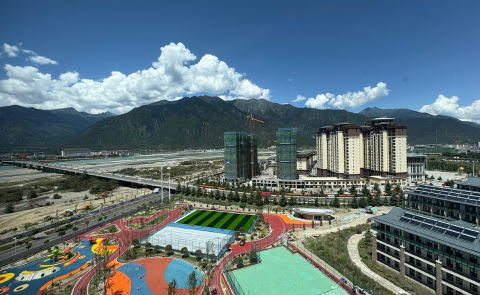
China believes the “Peaceful Liberation of Tibet” which it carried out in 1951, is bearing fruits now. Nyingchi, which is situated in the southeastern part of Tibet and which has geographical proximity to Arunachal Pradesh, is becoming a major trade and business hub with fancy high-rise buildings, offices and expansive community parks.
The transformation of Nyingchi – a prefecture-level city with a population of 2,40,000 – began in 2021 after President Xi visited the border town and vowed to develop it and adjoining areas. He was the first Chinese President ever to visit the city. Today, travel from Nyingchi to Lhasa is four hours by the Fuxing bullet train – the first bullet train in TAR, which opened in June 2021. The railway passes along the grand Yarlung Zangbo River, canyons, gorges and grasslands, reducing by half the normal travel time between the two cities.
Source: Nayanima Basu
China set the ball rolling of selecting the 14th Dalai Lama’s successor and to also integrate Tibet, which is now referred to as ‘Xizang’ in the government’s books. Geopolitical or strategic legroom for the Indian government is shrinking.
A future scenario of the world having two Dalai Lamas, one chosen in exile by the Tibetan refugee community and another by the CPC in Beijing, calls for a strategic reworking of policies by New Delhi when it comes to dealing with Beijing. Now is the time for India to be upfront and talk ‘Tibet’ with China before it is too late.
Nayanima Basu is a journalist who writes on issues of foreign policy and is the author of “The Fall of Kabul: Despatches from Chaos”.
This article was exclusively written for Gateway House: Indian Council on Global Relations. You can read more exclusive content here.
For permission to republish, please contact outreach@gatewayhouse.in.
Support our work here.
© Copyright 2025 Gateway House: Indian Council on Global Relations. All rights reserved. Any unauthorised copying or reproduction is strictly prohibited.
References:
[1] During their last bilateral meeting held in Tianjin, China on August 31, President Xi told PM Modi China and India should be “partners, not rivals” while laying down a four-point plan to upgrade bilateral ties, which includes maintaining peace and stability in border areas. With this, Xi has made it clear that China is open to discussing the border and India should not lose such an opportunity. https://www.fmprc.gov.cn/zyxw/202508/t20250831_11699054.shtml