Courts With Chinese Characteristics
China's legal system is more formalized and better functioning than many realize. Still, given the Chinese Communist Party's lock on judicial power, the country still has work to do.

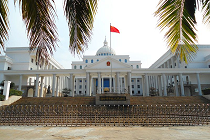 Courtesy: Anna Frodesiak/WikimediaCommons
China's legal system is more formalized and better functioning than many realize. Still, given the Chinese Communist Party's lock on judicial power, the country still has work to do.
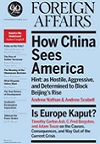 Courtesy: Foreign Affairs
Jeffrey D. Sachs argues that the mono-causal analysis of the book, 'Why Nations Fail,’ – that economic development hinges on a country’s political institutions – ignores important factors (such as geography) that can also affect growth.
 Courtesy: Th3r0/Flickr
The Japanese purchase of the Diaoyu Islands is bound to have a negative impact on China-Japan relations. If these tensions in the East China Sea persist, regional business ties and especially China-Japan economies ties - a whopping $345 billion in two-way trade - will take a hit.
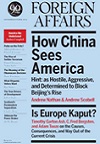 Courtesy: Foreign Affairs
Since weak demand is at the heart of the recession, governments need to enact stimulus programs along with structural reforms, argues Menzie Chinn. Structural reforms don’t always work out, writes Karl Smith. Raghuram Rajan demurs.
 Courtesy: Foreign Affairs
Until now, the U.S.-China policy has been driven by a blend of engagement and balancing. The Obama administration’s concentration on ‘engagement’ has done nothing to halt Beijing’s military build-up. The next administration should work towards bolstering the ‘balancing’ half of Washington’s strategic equation.
 Courtesy: Asia Briefing
With the introduction of new legal entities, domestic and foreign investors can now co-invest in one enterprise. The 25 % corporate income tax has theoretically been eliminated, therefore offering the prospect of substantial tax savings.
 Courtesy: Foreign Affairs
Just a few years ago, India seemed on the brink of becoming the world's next great power. Today, its future appears less certain. Although some have blamed the global economic recession, the real problem is domestic - namely, the centralized, secretive and arbitrary political culture that pervades New Delhi.
 Courtesy: Foreign Affairs
To leave behind a stable government in Afghanistan in 2014, the U.S. needs to work towards electoral reforms, negotiations with the Taliban, and a regional settlement involving Pakistan.
 Courtesy: China Briefing
Foreign investors in China can benefit from setting up Wholly Foreign-Owned Enterprises (WFOEs) and Foreign-Invested Commercial Enterprises (FICEs) to start businesses in trade and the service industry.
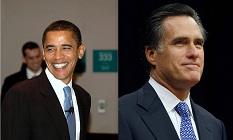 Courtesy: Malwack/Wikimedia Commons
C. Raja Mohan says Indians watching how the U.S. presidential race shapes up shows a growing appreciation of how political developments within the United States can affect Indian interests. He answered questions on a variety of subjects involving India-U.S. relations in this interview with Bernard Gwertzman.