

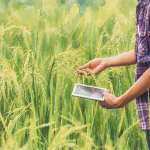

MahaVISTAAR is an agricultural advisory service run by the Department of Agriculture in Maharashtra, India’s most industrialised state. A farmer can ask a question by voice or text about crops, pests, weather, market prices, or government schemes and receive a response in an accessible language. The system searches trusted agricultural and government sources, returns a short location-aware answer, and identifies where the information came from.[1]
The platform builds on an extension system that already has substantial institutional infrastructure. Maharashtra’s 2025–2029 MahaAgri-AI Policy records more than 13,000 field technical staff, 49 Krishi Vigyan Kendras – district agriculture centres linked to local research institutes – four state agricultural universities, and existing digital systems for weather, pest surveillance, markets, farmer benefits and agricultural data. All this is mapped across a cropped area of 24.6 million hectares, equivalent to more than 1,800 hectares for each member of the department’s field extension staff, on average.[2] MahaVISTAAR brings these sources together to extend real-time, multilingual advice to farmers. In practice, that means the digital service complements an existing extension network.
The service has already reached substantial scale. An August 2026 World Bank account reported more than 3 million downloads within a few months and described farmers using the platform in local languages for questions about pests, weather and market conditions.[3] What downloads show is reach, not agricultural impact. Downloads do not establish whether farmers earned more, reduced input costs, or avoided crop losses.
India’s national picture is now changing as well. On 17 February 2026, the Union Ministry of Agriculture and Farmers’ Welfare launched Phase 1 of Bharat-VISTAAR as a nationwide AI-powered agricultural platform. At its launch, it operated in Hindi and English through a telephone number, voice chatbot, ministry web portal, and mobile application, integrating ten major central schemes with ICAR knowledge and information on weather, markets, pests, crop management, and soil health.[4]
The two platforms are linked. The Ministry’s launch material connected Maharashtra and two other states, Bihar and Gujarat, in Phase 1 through Maharashtra’s Vasudha digital service, Bihar Krishi App and AmulAI’s Sarlaben respectively, and described Bharat-VISTAAR as a framework into which state schemes and services would be added over time.[5]
MahaVISTAAR was the pioneer and launched in May 2025 around Maharashtra’s own agricultural systems. It provides an early example of the practical issues a national system will encounter. The central government initially targeted four additional languages within three months and 11 in all within six months.[6]
Central to the success of these is the use of voice versus the written word. Language is one of those issues where voice becomes important because typing assumes literacy, a suitable device, and familiarity with digital interfaces. MahaVISTAAR takes a farmer’s question in a local language, translates as necessary, searches trusted sources such as research institutes and the Department of Agriculture, and returns a short answer tailored to the farmer’s village or district.[7]
The Nandurbar district, a tribal area in northwestern Maharashtra, is a case study in the complexity of creating such services – and the necessity of them. Bhili language has an estimated 10 million speakers across western and central India, but Dehwali Bhili, the variety spoken in Nandurbar, has had almost no digital representation of its own. Through Project Astitva, Karya, a social enterprise that organises paid data work, worked with the Nandurbar district administration and more than 400 native Bhili speakers to create the data needed for a usable language system. The project produced more than 30,000 translation pairs, 120 hours of speech data and 6,500 glossary terms. The resulting Dehwali Bhili capability is now used through MahaVISTAAR and BHASHINI, the Government of India’s national language-translation mission.[8]
This is an important moment because it shows that the recordings are not an end in themselves. They become speech, translation, and vocabulary resources that allow digital services to recognise and respond in a language they previously could not handle. The Nandurbar example also shows how many institutions can sit behind a seemingly simple AI interaction. The district administration and Karya organised the community data effort; Maharashtra’s Department of Agriculture provides the public-service setting through MahaVISTAAR; EkStep Foundation, which focuses on literacy, numeracy, and digital public infrastructure, works with the state on the voice and deployment layer; AI4Bharat at IIT Madras contributes open-source Indic-language models and tools to the wider voice-AI ecosystem; and BHASHINI supplies national language infrastructure.[9] The specific roles differ across deployments, but the wider point holds: agricultural AI at this scale depends on coordination across public authorities, communities, data organisations, research groups and digital infrastructure. Copying the interface alone would have reproduced only the visible layer.
There is also an evidence question. Maharashtra’s own policy anticipates it. Its implementation roadmap provides for independent impact evaluation and cost-effectiveness analysis, followed by documented outcomes, cost-benefit ratios and policy learning.[10] Public evidence already shows substantial reach, advice delivered in Marathi and Dehwali Bhili, and a system designed to draw on trusted agricultural sources and provide location-specific guidance. What it does not yet establish is whether that advice is consistently accurate, or whether it translates into higher farmer incomes, improved yields, lower input costs or greater resilience.
The economics need similar care. Maharashtra’s policy proposes an initial ₹500 crore (about $52 million) allocation for its broader Agri-AI programme, including ₹10 crore (about $1 million) for VISTAAR.[11] That is a programme allocation, not a cost per farmer or proof of savings. A serious economic assessment will have to compare the full cost of digital advisory, including data, integration, evaluation and human oversight, with the costs and limitations of the extension channels it supplements.
However, the wider relevance is already visible outside India, although institutional settings differ. Ethiopia launched Ethiopia OpenAgriNet in February 2026 as a national digital backbone for agriculture, with voice-first access, local-language advisory, location-specific recommendations and shared infrastructure connecting public and private agricultural services.[12] It is not a copy of MahaVISTAAR; it has used India’s AgriStack as a model, with Ekstep Foundation as a collaborator, and it reflects a similar recognition – that agricultural AI has to fit the language, connectivity, and institutional conditions in which farmers operate.
Maharashtra’s experience therefore offers more than an application to replicate. It shows that agricultural AI at population scale depends on the public systems around it: trusted knowledge, local-language capability, interoperable data, institutional responsibility and evaluation of outcomes. If those assets accumulate with each deployment, the next system does not have to begin from zero.
Serish Gandikota is an Honorary Fellow at the Centre for India & Global Business, Cambridge Judge Business School, University of Cambridge, and co-founder and co-lead of the Frugal AI Hub.
This article was exclusively written for Gateway House: Indian Council on Global Relations. You can read more exclusive content here.
Support our work here.
For permission to republish, please contact outreach@gatewayhouse.in
© Copyright 2026 Gateway House: Indian Council on Global Relations. All rights reserved. Any unauthorised copying or reproduction is strictly prohibited.
References:
[1] World Bank. “Small AI Transforms Farming in India.” August 27, 2026. https://www.worldbank.org/en/news/feature/2026/08/27/small-ai-transforms-farming-in-india.
[2] Agriculture Department, Government of Maharashtra. MahaAgri-AI Policy 2025–2029, p. 6 (cropped area of 246 lakh hectares, 2023–24); pp. 7–8 (field technical staff, Krishi Vigyan Kendras, state agricultural universities); p. 17 (VISTAAR). https://krishi.maharashtra.gov.in/Site/Upload/Pdf/MahaAgri%20AI%20Policy%202025%20-%202029%20English.pdf.
[3] Ibid. Note 1.
[4] Ministry of Agriculture & Farmers’ Welfare, Government of India. “AI farmer revolution to begin from Jaipur…” Press Information Bureau, February 16, 2026. https://www.pib.gov.in/PressReleseDetailm.aspx?PRID=2228842®=3&lang=2; and “Rollout of BHARAT-VISTAAR Platform.” Press Information Bureau, March 13, 2026 (written reply, Rajya Sabha). https://www.pib.gov.in/PressReleasePage.aspx?PRID=2239788®=3&lang=1.
[5] Ibid. Note 4, Press Information Bureau release of February 16, 2026 (“Services and language capabilities available at launch”).
[6] Ibid. Note 4, Press Information Bureau release of February 16, 2026 (“Services and languages to be added phase-wise”).
[7] Ibid. Note 1.
[8] Karya. “Building a Tribal Language Voice Assistant Co-built with Communities.” Accessed September 2026. https://www.karya.in/case-studies/bhili-tribal-language-voice-assistant/; and IndiaAI, AIKosh. “Dehwali Bhili Conversational Dataset” (Project Astitva). https://aikosh.indiaai.gov.in/home/datasets/details/dehwali_bhili_conversational_dataset.html
[9] EkStep Foundation. “Voice AI.” Accessed September 2026. https://voiceai.ekstep.org/.
[10] Ibid. Note 2, Part C, Phase IV (independent impact evaluation and cost-effectiveness analysis).
[11] Ibid. Note 2, Part E (Budget Allocation).
[12] Ethiopian Agricultural Transformation Institute, Center for Open Societal Systems and Protean eGov Technologies. Press release on the launch of Ethiopia OpenAgriNet. Addis Ababa, February 3, 2026. https://cms.proteantech.in/sites/default/files/2026-02/Press%20Release%2011.pdf.pdf.