

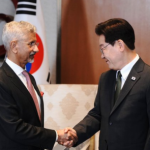

The April 2026 state visit of South Korean President Lee Jae-myung to India represents less a dramatic breakthrough and more a deliberate attempt to reset and re-energise a relationship that has hovered below its potential. The visit was a carefully constructed effort to move the India-Republic of Korea (ROK) partnership into a “new sunrise” phase – an overdue necessity, given the ubiquity and success of Korean investment in India. Is the optimism justified?[1]
At the structural level, the visit is best seen as a response to accumulated drift. Over the past several years, India-ROK relations have suffered from a perceptible decline in high-level political engagement, even as economic ties remained strong. This is partly due to ROK’s own internal political upheavals, the absence of sustained summit diplomacy, delays in upgrading the Comprehensive Economic Partnership Agreement (CEPA), and stalled defence projects, all of which contributed to a sense that the “Special Strategic Partnership” of 2015 lacked strategic depth. The Ministry of External Affairs (MEA) itself implicitly acknowledges this by emphasising in its post-meeting briefing that the leaders “laid out an ambitious agenda” and reviewed progress across key pillars, suggesting that momentum has to be consciously rebuilt rather than simply continued.[2]
The visit then serves a corrective function. Coming within a year of President Lee assuming office in June 2025 and after meeting PM Modi at various international summits, it restores political attention to a relationship that had become overly transactional. It now repositions India and Korea within the broader Indo-Pacific context, especially with ROK now agreeing to adhere to the Indo-Pacific Oceans Initiative of India.[3]
India and Korea are in many ways “natural partners,” shaped by shared strategic instincts rather than formal alliances. This framing is important. It suggests that the relationship is not driven by ideological alignment or treaty obligations, but by converging responses to a changing global order, particularly the need to hedge against supply chain vulnerabilities, technological dependence, and geopolitical uncertainty.
The countries have now announced a Joint Strategic Vision for implementing and adding further content to the India-ROK Special Strategic Partnership over the next five years (2026-2030).[4] According to the MEA, ‘India views the ROK as an indispensable partner in its “Act East” Policy. Similarly, the ROK views India as a central pillar of the ROK’s pragmatic diplomacy and heir to and evolver of the achievements of the New Southern Policy. India and the ROK also acknowledge the significant role of their partnership in fostering peace, stability, and security in the Indo-Pacific region.’
The economic outcomes of the visit are evident, yet they too reveal both ambition and limitation. The decision to double bilateral trade to $50 billion by 2030 is doable, as are efforts to reduce trade imbalances. At one level, this reflects a pragmatic recognition that the economic relationship has underperformed. Despite South Korea’s strong corporate presence in India, overall trade volumes remain modest relative to the size of the two economies, and the trade balance has consistently favoured Seoul. India exports are about $5.8 billion, and ROK exports are over $21 billion.[5] This reflects a pragmatic recognition that the economic relationship has underperformed.
The emphasis on “upgrading” CEPA points to a structural problem: the inability of both sides to resolve long-standing regulatory and market access issues. The negotiations have dragged on for 11 rounds over years without resolution; political will alone may not be sufficient. In this, the visit reiterates familiar goals rather than breaking new ground. The ambition is clear, but the mechanisms for achieving it remain uncertain. After the flurry of Free Trade Agreements (FTAs) to the west of India, it is now required that greater attention be paid by the Ministry of Commerce and Industry to the CEPAs with Japan and ROK and the pending review of the ASEAN-India Trade in Goods Agreement with ASEAN.
Foreign Direct Investment (FDI) from Seoul is, quote, dismal and requires serious attention. The ROK is India’s 13th largest FDI investor, with cumulative investments of $6.91 billion since 2000. FDI accelerated significantly in the post-CEPA period, rising from $523 million to $6.386 billion, with a strong sectoral focus on metallurgy, automobiles, electronics, and manufacturing. The revised CEPA needs to emphasise this aspect. India plans to establish a dedicated “Korea-specific” industrial enclave to attract investment and provide infrastructure for South Korean companies, similar to existing Japanese industrial townships.
Collaborations will focus on semiconductors, e-mobility, electronics, advanced manufacturing, shipbuilding, green energy, and digital trade.
This is long overdue. India is already a major market for several Korean consumer brands, including Samsung, Hyundai and LG. Hyundai and LG have also listed their India arms on the Indian bourses – both account for a significant chunk of the parent company valuations. This is a sharp contrast to China, where Samsung and Hyundai have been reduced to a market share of less than 1% – partly due to hostile policies by the host government. The Korean (and Japanese) investments in India show it is a more stable jurisdiction compared to China, geopolitically and otherwise – this should be a major comfort for Korean firms concerned about safeguarding intellectual property. The two initial public offering (IPOs) raised a total of $4.6 billion. At $3.3 billion Hyundai IPO, has been the largest share issue to date in India.
Where the visit does mark a qualitative shift is in its focus on emerging sectors. Cooperation in semiconductors, artificial intelligence, shipbuilding, critical minerals, and supply chain resilience is envisaged. These are not incidental areas; they lie at the heart of contemporary geopolitical competition. South Korea’s strengths in advanced manufacturing and India’s growing ambitions in digital infrastructure and industrial policy create a potentially powerful synergy. The emphasis on shipbuilding, in particular, reflects a strategic convergence: India’s ship-building sector has been a dismal player. South Korea brings technological expertise, while India offers scale and a policy push under initiatives such as “Make in India” and the broader SAGAR and SagarMala projects. This segment has greater ambitions attached to it in the Comprehensive Framework for Partnership in Shipbuilding, Shipping and Maritime Logistics, a well-crafted document that was signed during the visit.
Yet even here, caution is warranted. Much of this cooperation remains at the level of frameworks, memoranda, and intent. The history of India-ROK relations is replete with such agreements that have struggled to translate into tangible outcomes. The real test will be whether these new agreements lead to sustained investment, technology transfer, and industrial integration.
The strategic dimension of the visit, while less visible, is arguably more significant. Both sides reaffirmed their shared commitment to a free, open, and inclusive Indo-Pacific and discussed regional challenges ranging from supply chain disruptions to energy security. The backdrop to these discussions is a world marked by instability, from tensions in West Asia affecting energy flows to broader geopolitical rivalries reshaping global trade routes. India, Japan, Korea and China are the world’s biggest importers of fuel, and have been negatively impacted by the ongoing Iran war. President Lee’s emphasis on securing maritime routes such as the Strait of Hormuz underscores the extent to which economic and security concerns are now intertwined.
In this context, the India-ROK partnership acquires a broader strategic meaning. It is not simply about bilateral cooperation, but about contributing to a more resilient regional order. Both countries see themselves as stakeholders in maintaining open sea lanes, stable supply chains, and a rules-based system. However, this convergence remains cautious and calibrated. Seoul’s security priorities are still anchored in the Korean Peninsula and its alliance with the U.S., while India maintains a tradition of strategic autonomy. The result is a partnership that is strategically relevant but not strategically transformative.
The visit expands the scope of cooperation into softer but increasingly important domains. Four agreements and 25 outcomes including on cultural exchange, creative industries, education, and people-to-people ties are an attempt to build a more durable societal foundation for the relationship. The extension of cultural exchange programmes and the designation of 2028–29 as a “Year of Friendship” reflect an awareness that economic and strategic ties alone are insufficient without broader public engagement. A “new sunrise” in the Indo-Pacific is as much about connectivity and shared cultural space as it is about hard power.
Nevertheless, the optimism surrounding the visit must be tempered by a realistic assessment of its limitations. The partnership continues to face structural constraints, including trade imbalances, regulatory barriers, and differing strategic priorities. Defence cooperation, despite incremental progress, has yet to achieve the depth seen in India’s partnerships with countries like Japan or the U.S. The relative lack of public and political visibility of the relationship reduces the pressure for sustained follow-through.
Ultimately, the visit of President Lee Jae-myung represents an important moment of recalibration rather than transformation. It reflects a shared recognition that India and South Korea can no longer afford a relationship that underperforms its potential, particularly in a world where economic resilience and technological capability are increasingly tied to strategic influence.
In that sense, the visit leaves behind a paradox. It reinforces the idea that India and South Korea are natural partners in an uncertain world yet highlights how much work remains to translate that natural affinity into a truly consequential partnership.
Gurjit Singh is a former Indian Ambassador to Germany and author of The Durian Flavour: India, ASEAN and the Act East Policy. He is currently promoting the impact investment movement for implementing SDGs in Africa.
This article was exclusively written for Gateway House: Indian Council on Global Relations. You can read more exclusive content here.
Support our work here.
For permission to republish, please contact outreach@gatewayhouse.in
©Copyright 2026 Gateway House: Indian Council on Global Relations. All rights reserved. Any unauthorised copying or reproduction is strictly prohibited.
References:
[1] South Korea working with India to secure Hormuz. President Lee interview to Times of India 20 April 2026,
http://timesofindia.indiatimes.com/articleshow/130380123.cms?utm_source=contentofinterest&utm_medium=text&utm_campaign=cppst
[2] Transcript of Special Briefing by MEA on the State Visit of President of the Republic of Korea to India , MEA,20 April 2026,https://www.mea.gov.in/media-briefings.htm?dtl/41069/Transcript_of_Special_Briefing_by_MEA_on_the_State_Visit_of_President_of_the_Republic_of_Korea_to_India_April_20_2026
[3] Joint Strategic Vision for India-ROK Special Strategic Partnership, MEA, 20 April 2026,https://www.mea.gov.in/bilateral-documents.htm?dtl/41066/Joint_Strategic_Vision_for_IndiaROK_Special_Strategic_Partnership
[4] Ibid
[5] India, South Korea working to double bilateral trade by 2030: Piyush Goyal, The Mint,