

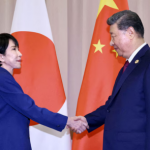
On October 31, new Japanese Prime Minister Sanae Takaichi, met Chinese President Xi Jinping[1] at the APEC Summit in Korea.[2] By all accounts, it was a cordial meeting where they discussed the stability of the relationship. By the time the G20 Summit in South Africa rolled around on November 23, Takaichi and Chinese Prime Minister Li Qiang were walking in opposite directions, ignoring each other.[3] What happened? A specific statement, which was made by Takaichi on November 7, when she stood before Japan’s parliament and in response to a question, answered that a Chinese attack on Taiwan could represent a “survival-threatening situation” for Japan. This candid expression of a suppressed reality admits that, legally, Japan can exercise collective self-defence under its security laws.
As Beijing sharpens its rhetoric and applies selective economic pressure on Japan, Tokyo finds itself navigating a tightening strategic bind. Every Chinese move following Prime Minister Sanae Takaichi’s remarks on the risks a Taiwan contingency would pose to Japan has manifested into how much leverage China still possesses over the Japanese economy, and how constrained Tokyo remains in responding. [4]
China’s swift retaliation has been carefully choreographed: warnings to Chinese tourists to avoid Japan, the suspension of Japanese seafood imports, a freeze on film and anime approvals, and quiet pressure on travel agencies and cultural exchange programs. These actions, while limited in scope, deliver a clear message about Beijing’s ability to disrupt key Japanese industries at will.[5]
The broader effect has been paradoxical. Instead of intimidating Tokyo into silence, these measures have pushed Japan even further toward the U.S. and its allied network. The more Beijing escalates symbolic or economic pressure, the more Tokyo leans on Washington for reassurance and strategic cover. Takaichi’s remarks were already aligned with the U.S. position on Taiwan; China’s response has only accelerated Japan’s willingness to deepen intelligence-sharing, contingency planning, and diplomatic coordination with the U.S. As the chill deepens, Japan is also quietly strengthening ties with Australia, India, and European partners who share concerns over China’s behaviour in both the East China Sea and the Taiwan Strait.[6]
For now, however, Japan continues to follow its familiar crisis-management script. Tokyo has avoided tit-for-tat retaliation, holding back from imposing any counter-restrictions or criticising Beijing too sharply. This posture reflects decades of experience with volatile China-Japan cycles: when pressure rises, Tokyo prefers not to fuel the escalation. Instead, it keeps communication channels open at the bureaucratic and ministerial levels, expresses regret rather than anger, and waits for the temperature to fall. Japanese officials still insist that stability in the bilateral relationship remains a priority.
Yet China’s signalling has grown sharper. Beijing has taken the extraordinary step of raising Takaichi’s remarks in the United Nations Security Council (UNSC), presenting Japan’s Taiwan position as a destabilising provocation with global implications.[7] This move is less about achieving diplomatic outcomes, as the UNSC is unlikely to act, and more about elevating the issue onto the international stage, exerting political pressure on Japan, and warning others against taking similar positions. It is a symbolic weapon, but also a reminder of how seriously Beijing views Takaichi’s framing of Taiwan as inherently tied to Japan’s national defence.
Following that, Chinese Foreign Minister Wang Yi raised the level of criticism by stating that Japan crossed a red line and was heading towards remilitarisation.[8] And on November 25, Xi Jinping called U.S. President Donald Trump to discuss their relations, evidently including concerns on Taiwan. Trump quickly called Takaichi.[9] None of the three openly admits that Taiwan was discussed, but now Trump appears to be playing peacemaker between Japan and China.
China’s restraint is as important as its escalation. To understand what Beijing is not doing today, it is essential to recall 2012, when Japan nationalised the Senkaku Islands, and the Chinese government encouraged protests that targeted Japanese businesses and included banners demanding Japan’s annexation as a Chinese province. Back then, such mobilisation was relatively safe: the Chinese economy was strong, nationalism was confident, and public anger could be channelled outward without threatening internal stability. Today, however, China faces falling property prices, weak consumer confidence, persistent youth unemployment, and the lingering memory of the 2022 white-paper protests, when dissent spilled into open criticism of the Party itself. In this anxious environment, large-scale anti-Japan demonstrations risk morphing into broader anger against the government. Nationalism, once a reliable political tool, has become combustible, a double-edged sword Beijing wields cautiously. As a result, China’s retaliation against Japan remains controlled, symbolic, and state-managed: loud enough to convey displeasure, but carefully designed to avoid sparking public unrest.[10]
The longer the confrontation continues, the more difficult Japan’s cautious approach becomes. Tokyo knows that China’s pressure is calibrated, not maximal. Beijing has refrained from hitting Japanese automotive firms or disrupting critical supply chains, measures that would inflict serious economic damage. Tokyo also recognises that China could escalate further if it chose to. Each restriction on tourism, food imports, or entertainment licensing is a reminder of how easily Beijing can squeeze targeted Japanese sectors without incurring high costs itself. The asymmetry in economic leverage remains stark.
A prolonged standoff will likely produce deeper U.S.-Japan coordination, more explicit G7 statements on Taiwan, tighter alignment with Australia and India, and expanded outreach to Southeast Asian partners who privately share Japan’s concerns about coercive Chinese behaviour.
Domestically, patience for quiet diplomacy may also erode. Japanese public opinion has long held deep scepticism about China’s intentions, particularly regarding the Senkaku Islands and Taiwan. If China escalates its punitive measures or increases military activity around Japanese airspace and waters, Japanese sentiment could harden rapidly. This would give Takaichi greater political space to adopt a firmer line and accelerate ongoing defence reforms, from increased military spending to expanded missile capabilities and closer interoperability with U.S. forces. A Kyodo News poll after her remarks showed 70% support for Takaichi as Prime Minister, with 49% supporting the exercise of Japan’s right to collective self-defence in the event of a Taiwan contingency.[11] Beijing’s selective pressure may disrupt Japanese economic interest in the short term, but it is unlikely to alter Tokyo’s long-term trajectory.
The result is a confrontation that remains sharp but controlled, a contest of signalling, selective coercion, and political manoeuvring rather than outright rupture. But the strategic direction is unmistakable: China’s pressure over Taiwan is accelerating Japan’s integration into a broader coalition of democracies, reinforcing the security architecture Beijing seeks to undermine.
Gurjit Singh is a former Indian Ambassador to Germany. He is currently promoting the impact investment movement for implementing SDGs in Africa.
This article was exclusively written for Gateway House: Indian Council on Global Relations. You can read more exclusive content here.
Support our work here.
For permission to republish, please contact outreach@gatewayhouse.in
©Copyright 2025 Gateway House: Indian Council on Global Relations. All rights reserved. Any unauthorised copying or reproduction is strictly prohibited.
References:
[1] Press Conference by Prime Minister TAKAICHI Sanae regarding the Japan-China Summit Meeting, PMO Japan, 31 October 2025,https://japan.kantei.go.jp/104/statement/202510/31kaiken.html
[2] President Xi Jinping Meets with Japanese Prime Minister Takaichi Sanae, MFA China, e31 October 2025,https://www.fmprc.gov.cn/eng/xw/zyxw/202511/t20251101_11745380.html
[3] Beijing says no meeting planned with Japan PM, urges Tokyo to behave, China Daily, 20 November 2025,https://global.chinadaily.com.cn/a/202511/20/WS691eccc0a310d6866eb2a8a3.html
[4] Japan’s PM Takaichi says no changes in policies affirmed with China’s Xi, NHK, 21 November 2025,https://www3.nhk.or.jp/nhkworld/en/news/20251121_14/
[5] Foreign Ministry Spokesperson Mao Ning’s Regular Press Conference on November 17, 2025, MFA China 17 November 2025,https://www.fmprc.gov.cn/mfa_eng/xw/fyrbt/202511/t20251117_11754686.html
[6] Is Beijing’s spat with Japan sending a message to US and allies over Taiwan? SCMP, 1 November 2025, https://www.scmp.com/news/china/diplomacy/article/3333653/beijings-spat-japan-sending-message-us-and-allies-over-taiwan
[7] China sends letter to UN over Japanese prime minister’s remarks on Taiwan, China Daily, 22 November 2025,https://www.chinadaily.com.cn/a/202511/22/WS69212a31a310d6866eb2ae0c.html
[8] Chinese foreign minister says Takaichi’s remarks ‘crossed a red line that must not be touched’ Global Times, 23 November 2025,https://www.globaltimes.cn/page/202511/1348886.shtml
[9] Japan-U.S. Summit Telephone Talk MFA Japan, 25 November 2025, https://www.mofa.go.jp/na/na1/us/pageite_000001_01390.html
[10] Katsuji Nakazawa, XI Jinping hesitates to draw the double-edged sword of anti-Japan protests, Nikkei Asia, 20 November 2025,https://asia.nikkei.com/editor-s-picks/china-up-close/analysis-xi-jinping-hesitates-to-draw-double-edged-sword-of-anti-japan-protests?utm_campaign=GL_china_up_close&utm_medium=email&utm_source=NA_newsletter&utm_content=article_link&del_type=9&pub_date=202511202330000900&seq_num=5&si=__MERGE__user_id__MERGE__
[11] Support rate for Japan PM Takaichi’s Cabinet rises to 69.9%: poll, Mainichi Shinbun, 16 November 2025, https://mainichi.jp/english/articles/20251116/p2g/00m/0na/033000c