

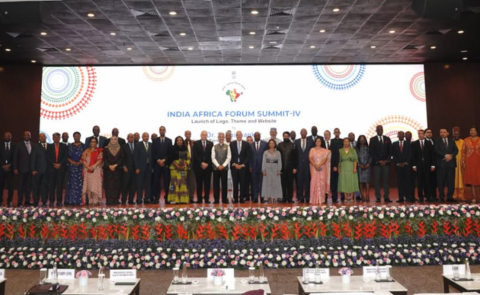
The fourth India-Africa Forum Summit (IAFS IV) will convene in New Delhi on May 31, 2026, after an 11-year gap – the longest of any interval in the summit’s 18-year history. The delay, however, does not mean that the bilateral is fading or India is not prioritising the continent. After his 2015 visit, Prime Minister Narendra Modi observed that Africa and the Indian Ocean had the highest primacy for India’s foreign policy,[1] and that remains true still.
IAFS IV’s theme, “IA SPIRIT: India-Africa Strategic Partnership for Innovation, Resilience and Inclusive Transformation”, is therefore not merely a diplomatic event but a credibility test in terms of its outcomes. The summit will heavily focus on economic partnership.
The economic relationship has, by headline numbers, never looked better. India-Africa bilateral trade has risen 112% over two decades, reaching $89 billion in 2025,[2] nearly double from 2008, when it was $45 billion. India is now Africa’s fourth largest trading partner alongside China, the European Union (EU) and the UAE.[3]
India is also the second-largest lender in Africa, after China. India’s cumulative investments in Africa amount to $75 billion, which India’s private and public sector aim to double by 2030.[4]
India has extended 196 Lines of Credit (LoC) worth over $12 billion to 42 African countries, supporting projects across power, water, agriculture, transport, and digital connectivity.[5] But much more must be done to enhance this genuine progress so that the natural advantages of both India and Africa’s are not underleveraged.
India is earnest in its intentions: it has opened 17 new diplomatic missions in Africa in 2018[6] since 2018, bringing the total number of missions in Africa to 46 – making the continent home for the highest number of Indian missions globally.[7][8]
But good intentions must understand and fill the gaps – and there are plenty. The trade trajectory has not been linear, as Graph 1 below shows. Trade peaked at $97.8 billion in 2022, driven by the post-COVID markets surge, but then it dropped by 14.9% in 2023, the very next year.
Graph 1: Trade trajectory
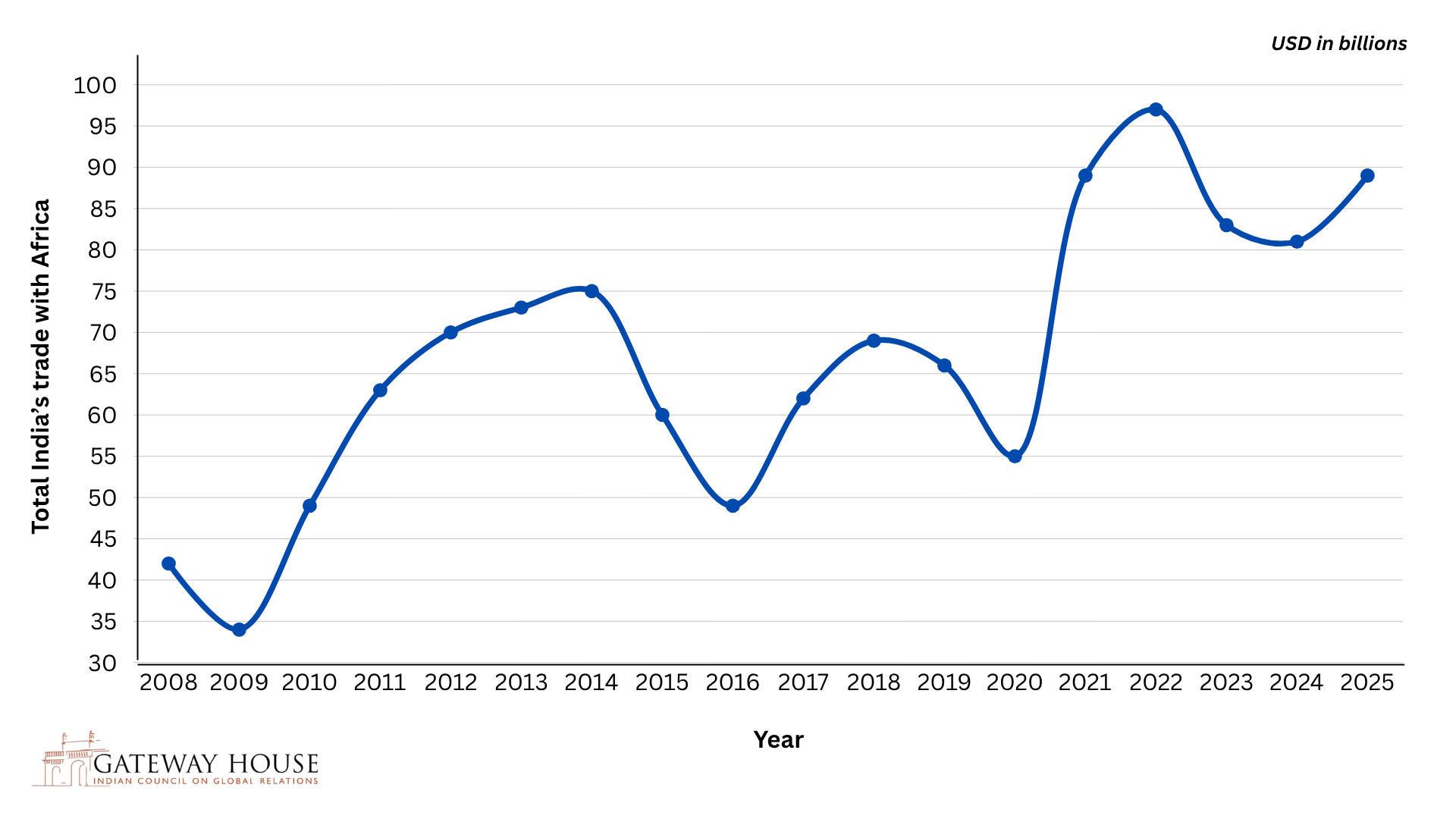
Source: ITC Trade Map (from the years 2008-2016),[9] Ministry of Commerce and Industry, and Tradestat (from the years 2017-2024).
India’s exports to Africa are largely value-added: refined petroleum products, rice, pharmaceuticals, engineering goods and vehicles. Africa’s exports to India are dominated by raw materials: crude oil, gold, diamond, pulses, coal, and minerals. This asymmetry is similar to other trade partners of Africa, but it is not optimal: India benefits from Africa’s resources while Africa captures limited value from the exchange.
Africa has a trade surplus with India, exporting more to India than it exports (See Graph 2).
Graph 2 – Exports and Imports
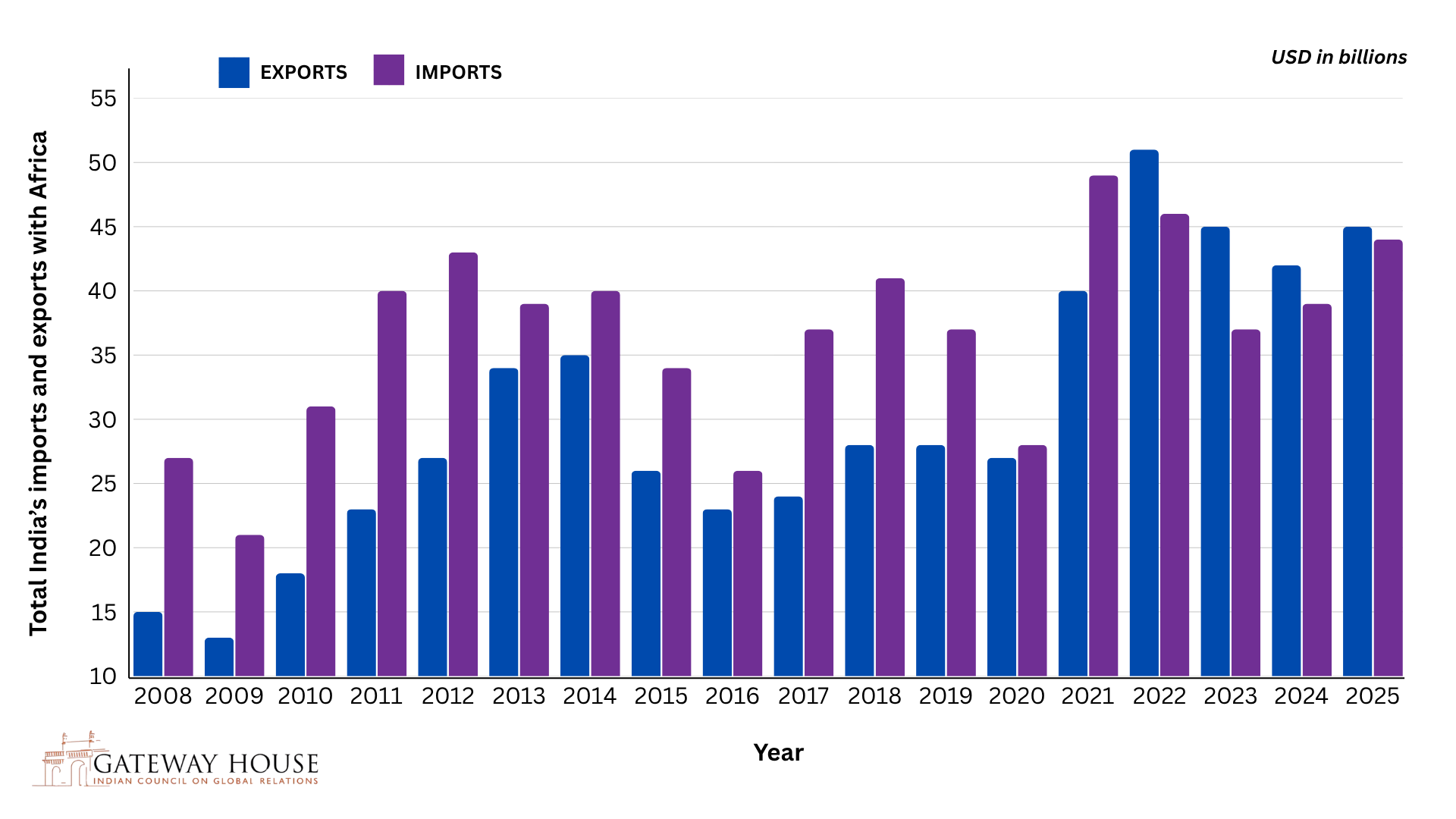
Source: ITC Trade map (from the years 2008-2025)
Africa accounts for 9.6% of India’s total global exports and 7.8% of total global imports. For Africa, India accounts for 6% of total global exports and 5.6% of global imports.[10] These figures are disproportionately low when compared with Africa’s other trading partners of Africa, such as China, whose trade with Africa is thrice that of India’s at $348 billion in 2025[11] and the EU, whose trade is four times India’s at $400 billion in 2025.[12]
India has bilateral trade agreements with 22 African countries, a network built over six decades, from the Indo-Tunisian Trade Agreement of 1960[13] to the Rwanda Trade Cooperation Framework of 2018. The signing of 20 of the 22 agreements was done just before the first India-Africa Summit. Since then, only two new agreements have been formalised: the Rwanda framework (2018) and, crucially, the Comprehensive Economic Cooperation and Partnership Agreement (CECPA) with Mauritius (2021).[15] This is the only modern, comprehensive agreement India has with any African country, with tariff schedules, services provisions, and rules of origin.[16] Every other agreement is a legacy framework with little trade in practice (see Table 1).
Table 1 – Timeline of all trade agreements with Africa
| Sr no | Countries | Trade Agreement | Year |
| 1 | Tunisia | Indo-Tunisian Trade Agreement | 1960 |
| 2 | Tanzania | Trade Agreement[17] | 1966 |
| 3 | Cameroon | Trade Agreement[18] | 1968 |
| 4 | Senegal | Trade Agreement[19] | 1974 |
| 5 | Egypt | The India-Egypt Bilateral Trade Agreement[20] | 1978 |
| 6 | Mozambique | Trade Agreement | 1982 |
| 7 | Nigeria[21] | Trade Agreement | 1983 |
| 8 | Zimbabwe | Trade Agreement | 1981 |
| 9 | Ghana | Bilateral Trade Agreement[22] | 1981 |
| 10 | Zambia | Trade Agreement | 1981 |
| 11 | Angola | Trade Agreement[23] | 1986 |
| 12 | Zaire (now the Democratic Republic of the Congo) | Trade Agreement[24] | 1988 |
| 13 | Côte d’Ivoire | Trade Agreement | 1993 |
| 14 | South Africa | Trade Agreement | 1994 |
| 15 | Ethiopia | Trade Agreement[25] | 1997 |
| 16 | Liberia | Trade Agreement | 1998 |
| 17 | Seychelles | Trade Agreement[26] | 2000 |
| 18 | Botswana | Trade Agreement | 2001 |
| 19 | Swaziland (now Eswatini) | Trade Agreement[27] | 2002 |
| 20 | Uganda | Trade Agreement | 2003 |
| 21 | Rwanda | Trade Cooperation Framework | 2018 |
| 22 | Mauritius | Comprehensive Economic Cooperation and Partnership Agreement (CECPA) | 2021 |
India is in active negotiations for a Preferential Trade Arrangement with the Southern African Customs Union (SACU), comprising South Africa, Botswana, Namibia, Eswatini, and Lesotho. These have been ongoing since 2007. The most recent engagement took place in March 2026, where India’s High Commissioner to South Africa expressed confidence about concluding the agreement.[28] Informal indications suggest that India and Africa may take forward the SACU negotiations.
The African Continental Free Trade Area (AfCFTA), operational since 2021, is an opportunity for India but one which it has not fully engaged with. On May 13, 2026, at the Curtain Raiser on the India-Africa Business Dialogue & Exhibition, Piyush Goyal, India’s Union Minister of Commerce & Industry, emphasised the economic potential of this collaboration, which has a potential of $3.4 trillion. The opportunities, if seized, will create resilient partnerships, diversify supply chains, and move beyond raw material trade towards higher-value manufacturing and integrated value chains.[29]
IAFS IV is the natural moment to announce a structured AfCFTA engagement strategy and treat Africa as a meaningful economic bloc, not a collection of bilateral relationships.
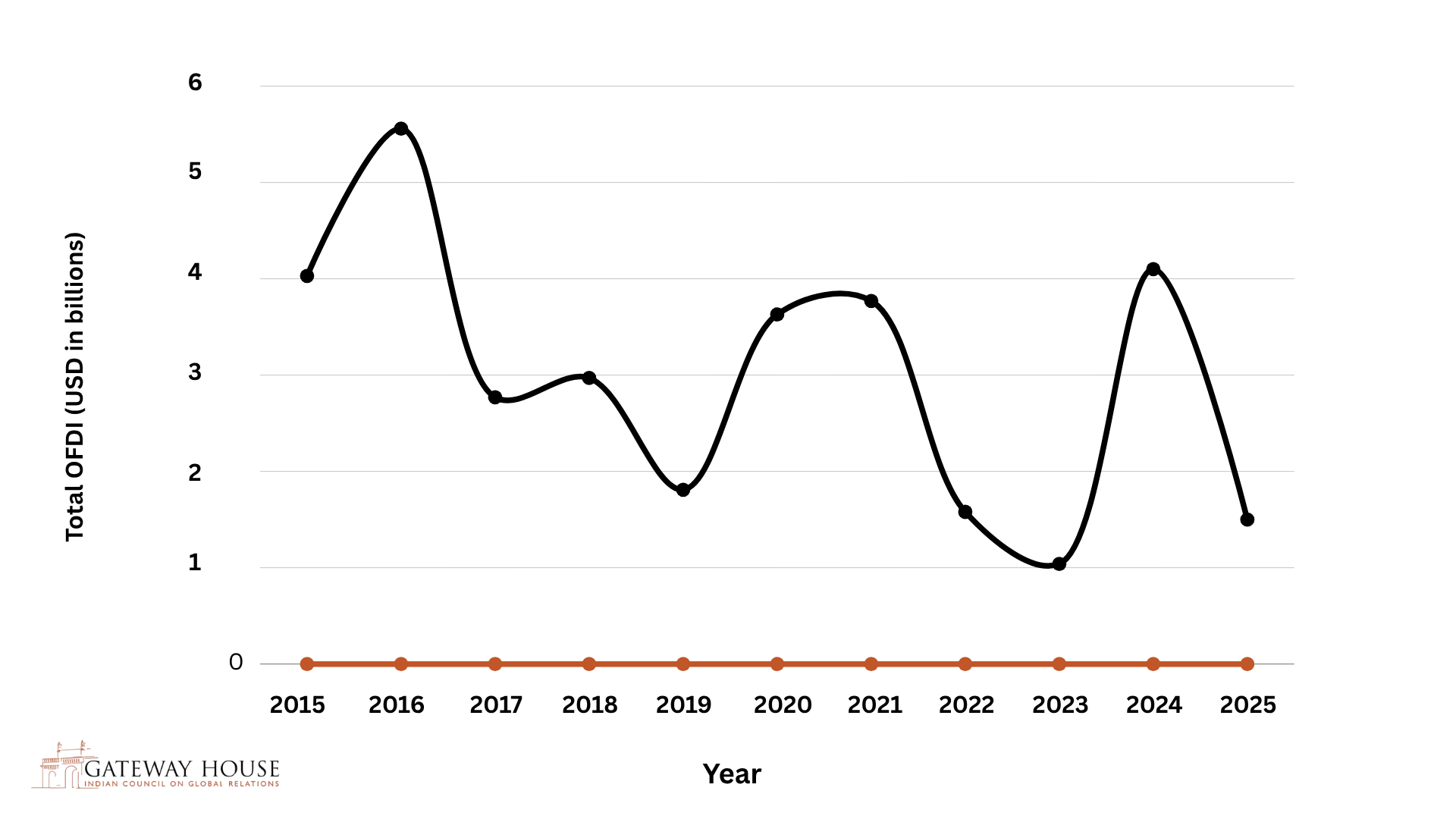
This will require India to step up its[30] Outward Foreign Direct Investment (OFDI) flows to the African continent (see Graph 3).
Graph 3: Total OFDI flows from India to Africa, 2015 to 2025
Source: Compiled from India’s Outward Foreign Direct Investment Report, CII and Reserve Bank of India’s Data on Overseas Investment monthly data[31][32]
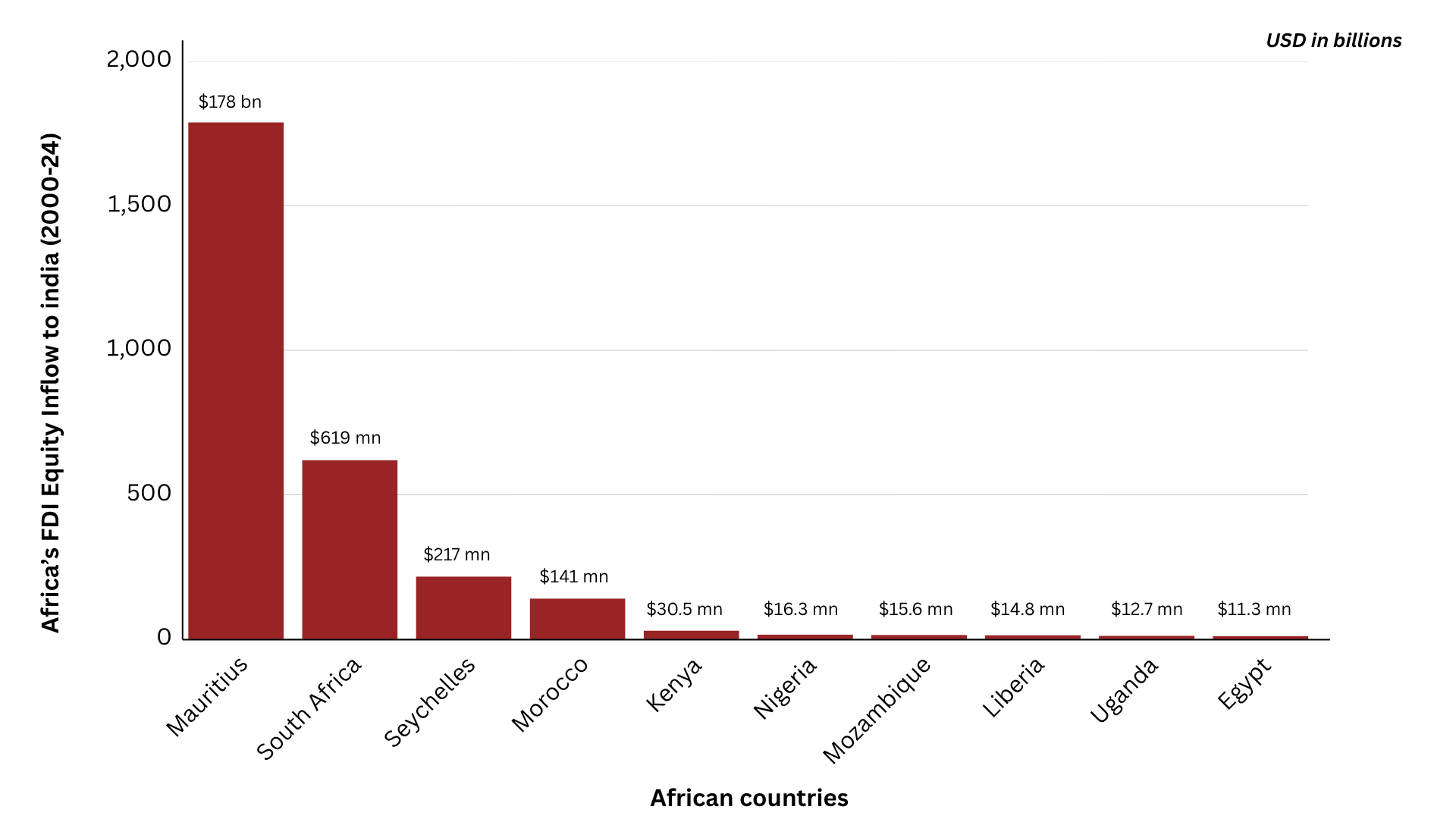
India’s annual OFDI to Africa peaked at $5.5 billion in 2016, then declined sharply to under $1 billion by 2023; in 2024, it again increased to $4.1 billion and declined again in 2025 by $1.5 billion. India-Africa OFDI is dominated by a single country, Mauritius. From 2000 to 2024, Mauritius channelled $178 billion in FDI into India, dwarfing every other African country combined. South Africa ($619 million), Seychelles ($217 million), and Morocco ($141 million) follow at a considerable distance (see Graph 4).
Graph 4: Top 10 countries’ FDI Equity Inflows from Africa to India
Source: Compiled from DPIIT, country-wise FDI Equity Inflow to India. [33]
The 2015-2026 summit gap was punctuated by a mid-term review meeting in 2019, which outlined the progress of the commitments made in the last summit. This had precious time and opportunity costs. In the 11-year gap, China held three summits – the Forum on China-Africa Cooperation summits in 2018, 2021, and most recently in 2024, each anchored by concrete financing commitments. France has held 28 summits since the 1970s, the most recent being held May 11-12 in Kenya. The EU held AU-EU Summits in 2022 and 2025. The U.S. hosted the U.S.-Africa Leaders Summit in 2022.[34] India’s absence from the summit calendar, therefore, is significant.
India still retains an edge in two areas where African demand is structural and growing: technology and capacity-building/human capital/education. Unlike infrastructure and finance, where China leads the race and makes it difficult for India to compete, India uses its excellent digital public infrastructure model and capacity-building programmes, which offer a better value proposition that no other partner can replicate. IAFS IV is the moment to convert that latent advantage into concrete, measurable commitments.
Technology collaborations are a strong pillar of India-Africa relations. Recognising that information technology has become a fundamental part of infrastructure and socio-economic development, India and African countries have undertaken several initiatives (see Table 2).
Table 2: Status of India-Africa technology initiatives
In addition to technology, education collaborations are a bilateral strength. India offers hundreds of scholarships for researchers from Africa under CV Raman Fellowship or Indian Council for Cultural Relations programmes. For African students, tuition costs are significantly lower than in many Western countries. And India’s programmes are well regarded, particularly in medicine, pharmacy, engineering, and technology (see Table 3).[52]
Table 3: Status of educational initiatives between India and Africa
While several commitments made under the IAFS framework have been implemented, the overall implementation rate is moderate, with significant room for improvement. This is the time for IAFS IV to fulfil some of the past commitments and make ambitious future goals, with implementable timelines.
As the summit convenes, three commitments will meaningfully advance the relationship:
First, operationalise the monitoring mechanism. A third-party review body implementation was promised in 2015 but was never created. IAFS IV should announce its establishment with a clear mandate, timeline, and reporting structure. Without an accountability architecture, the disbursement/implementation rate will not improve, regardless of how large the next commitment is.
Second, announce an AfCFTA engagement strategy. India needs a structured approach to AfCFTA and to treat Africa as a single integrated market rather than 54 bilateral relationships.
Third, anchor a critical minerals partnership. Africa holds over 70% of global cobalt reserves, substantial manganese and platinum[71] and significant lithium in Zimbabwe and the Congo. India’s clean energy transition, its solar and EV ambitions, creates a structural import dependence on these materials. An India-Africa Critical Minerals Framework, with investment commitments and processing partnerships that allow African countries to move up the value chain, will serve both sides’ interests.
India and Africa are each, in their own ways, at a turning point. Africa is the world’s fastest-growing demographic bloc. India has goodwill and is largely seen as a partner of choice rather than of necessity. The AU became part of the G20 in 2023 during India’s presidency year and is represented by Egypt and Ethiopia in the expansion of BRICS. India, on the other hand, is pursuing Viksit Bharat, its vision of developed-country status by 2047, which depends on diversified markets, secure resource access, and consolidated Global South cooperation, which can be gained by an enhanced partnership with Africa.
Rajiv Bhatia is the Distinguished Fellow for Foreign Policy Studies and a former ambassador.
Raveena Shivashankar is the Digital Media Associate, Gateway House.
This article was exclusively written for Gateway House: Indian Council on Global Relations. You can read more exclusive content here.
Support our work here.
For permission to republish, please contact outreach@gatewayhouse.in
©Copyright 2026 Gateway House: Indian Council on Global Relations. All rights reserved. Any unauthorised copying or reproduction is strictly prohibited.
References:
[1] Bhatia, Rajiv. India-Africa Relations: Changing Horizons. New Delhi: Routledge India, 2022
[2] The figure is compiled from the International Trade Centre (ITC)’s trade data for India and Africa. International Trade Centre. “TradeMap: India-Africa Trade Data.” https://beta.trademap.org/en/goods/time-series/exports/c/000/c/000/p/ALL/byProduct/year/default/4/direct/values/USD/table
[3] News on Air. “India Is Africa’s 4th Largest Trading Partner; Bilateral Trade Nears $100 Billion: EAM Jaishankar.” https://www.newsonair.gov.in/india-is-africas-4th-largest-trading-partner-bilateral-trade-nears-100-billion-dollar-eam-jaishankar/
[4] Confederation of Indian Industry. Pathways for Shared Progress: India-Africa Economic Cooperation. New Delhi. https://www.cii.in/International_ResearchPDF/Pathways%20for%20Shared%20Progress%20India_Africa%20Economic%20Cooperation.pdf
[5] Ministry of External Affairs, Government of India. “Lines of Credit for Development Projects.” https://www.mea.gov.in/Lines-of-Credit-for-Development-Projects.htm
[6] Press Information Bureau, Government of India. “Development Partnership Administration Related Press Release.” https://www.pib.gov.in/PressReleasePage.aspx?PRID=1525694®=3&lang=2
[7] Embassy of India, Bamako. “Newsletter.” https://www.embassyofindiabamako.gov.in/news_letter_detail/?id=81
[8] Ministry of External Affairs, Government of India. “Question No. 1675: Full-Fledged Embassy.” Lok Sabha. https://www.mea.gov.in/lok-sabha.htm?dtl/34845/question+no1675+full+fledged+embassy
[9] Ibid (ref no 2)
[10] Export-Import Bank of India. India-Africa Trade and Economic Relations Report. Mumbai: Exim Bank of India, 2025. https://www.eximbankindia.in/sites/default/files/2025-07/175file.pdf
[11] Nanyang Technological University. “China-Africa Trade Hits Record US$348bn as Deficit Balloons.” https://www.ntu.edu.sg/cas/news-events/news/detail/china-africa-trade-hits-record-us-348bn-as-deficit-balloons
[12] International Trade Centre. “TradeMap Import Data.” https://beta.trademap.org/en/goods/time-series/imports/g/42/g/7/p/ALL/byProduct/year/2024-2025/4/direct/values/USD/table
[13] Ministry of External Affairs, Government of India. India-Tunisia Bilateral Relations. New Delhi: MEA, 2022. https://www.mea.gov.in/Portal/ForeignRelation/Tunisia_November_2022.pdf
[14] Press Information Bureau, Government of India. “India-Mauritius Comprehensive Economic Cooperation and Partnership Agreement.” https://www.pib.gov.in/newsite/PrintRelease.aspx?relid=183122
[15] Many say the CECPA is the first trade agreement between India and Africa; however, in the past, India has formalised trade agreements with other African countries too.
[16] High Commission of India, Mauritius. “Comprehensive Economic Cooperation and Partnership Agreement (CECPA).” https://www.hcimauritius.gov.in/page/comprehensive-economic-cooperation-and-partnership-agreement-cecpa/
[17] Ministry of External Affairs, Government of India. “Trade Agreement.” https://www.mea.gov.in/bilateral-documents.htm?dtl/6023/Trade+Agreement
[18] Ministry of External Affairs, Government of India. “Trade Agreement.” https://www.mea.gov.in/bilateral-documents.htm?dtl/5574/Trade+Agreement
[19] Government of India. Trade Agreement between India and Senegal. https://indiantradeportal.in/uploads/Documents/Trade_Agreements/India_Africa/Senegal.pdf
[20] ibid
[21] Government of India. Trade Agreement between India and Nigeria. https://indiantradeportal.in/uploads/Documents/Trade_Agreements/India_Africa/Nigeria.pdf
[22] Ministry of External Affairs, Government of India. India-Ghana Bilateral Brief 2025. New Delhi: MEA, 2025. https://www.mea.gov.in/Portal/ForeignRelation/GhanaBilateralBrief2025.pdf
[23] Government of India. Trade Agreement between India and Angola. https://indiantradeportal.in/uploads/Documents/Trade_Agreements/India_Africa/Angola.pdf
[24] Government of India. Trade Agreement between India and Zaire. https://indiantradeportal.in/uploads/Documents/Trade_Agreements/India_Africa/Zaire.pdf
[25] Ministry of External Affairs, Government of India. India-Ethiopia Bilateral Relations. New Delhi: MEA, 2022. https://www.mea.gov.in/Portal/ForeignRelation/EthiopiaOct_2022.pdf
[26] Ministry of External Affairs, Government of India. India-Seychelles Bilateral Relations. New Delhi: MEA, 2024. https://www.mea.gov.in/Portal/ForeignRelation/India-Seychelles-Bilateral-27.8.2024.pdf
[27] Government of India. Trade Agreement between India and Swaziland. https://indiantradeportal.in/uploads/Documents/Trade_Agreements/India_Africa/Swazilad.pdf
[28] Press Trust of India. “India Confident about Revived SACU Trade Pact Talks: Envoy.” https://www.ptinews.com/story/business/india-confident-about-revived-sacu-trade-pact-talks-envoy/3454830
[29] Press Information Bureau, Government of India. “Press Release.”https://www.pib.gov.in/PressReleasePage.aspx?PRID=2261202®=3&lang=1
[30] Federation of Indian Chambers of Commerce and Industry. “Africa.” https://ficci.in/international/africa-ficci
[31] Confederation of Indian Industry. India’s Outward Foreign Direct Investment Report. https://www.cii.in/International_ResearchPDF/India%E2%80%99s%20Outward%20Foreign%20Direct%20Investment%20Report.pdf
[32] Reserve Bank of India. “Overseas Investment Data.” https://rbi.org.in/Scripts/Data_Overseas_Investment.aspx
[33] Department for Promotion of Industry and Internal Trade. FDI Factsheet 2025. New Delhi: Government of India, 2025. https://www.dpiit.gov.in/static/uploads/2025/12/c708bb500dc2b64c63ece116aaad301f.pdf
[34] U.S. Department of State. “U.S.-Africa Leaders Summit.” https://2021-2025.state.gov/africasummit/
[35] Ministry of External Affairs, Government of India. 50 Years of ITEC. https://www.mea.gov.in/Uploads/PublicationDocs/24148_REVISED_50_yrs_of_ITEC_brochure.pdf
[36] Diplomatist. “Uniting Minds and Shaping Futures through India-Africa Educational Partnerships.” https://diplomatist.com/uniting-minds-and-shaping-futures-through-india-africa-educational-partnerships/
[37] Indian Institute of Democracy and Election Management. IIIDEM. https://iiidem.igotkarmayogi.gov.in/
[38] Press Information Bureau, Government of India. “Pan-African e-Network Project Related Press Release.”https://www.pib.gov.in/newsite/PrintRelease.aspx?relid=149191®=3&lang=2
[39] India Science, Technology & Innovation. “India-South Africa Cooperation in Science and Technology.”https://www.indiascienceandtechnology.gov.in/bilateral-cooperations/department-science-technology-dst/south-africa?language=en
[40] Department of Science and Technology, Government of India. “India-South Africa Strengthen Cooperation in Astronomy, Advanced Materials and Indigenous Knowledge Systems.” https://dst.gov.in/pressrelease/india-south-africa-strengthen-cooperation-astronomy-re-advanced-materials-indigenous
[41] Press Information Bureau, Government of India. “Press Release.” https://www.pib.gov.in/PressReleaseDetail.aspx?PRID=1505164®=6&lang=1
[42] Gandhi Mandela Foundation. Gandhi Mandela Foundation. https://www.gandhimandelafoundation.com/
[43] Gandhi Mandela Academy. “Programs.” https://gandhimandela.academy/programs/
[44] Research and Information System for Developing Countries. “Asia-Africa Growth Corridor Road Map.” https://aagc.ris.org.in/en/road-map
[45] Gateway House. “Japan and the Asia-Africa Growth Corridor.” Gateway House: Indian Council on Global Relations. https://www.gatewayhouse.in/japan-aagc/
[46] Indian Council of Medical Research. About the India-Africa Health Sciences Platform (IAHSP). New Delhi: ICMR. https://www.icmr.gov.in/icmrobject/static/icmr/dist/images/pdf/iahsp/V5_About_IAHSP.pdf
[47] Ibid (ref no 46)
[48] Ecofin Agency. “Six African Countries Adopt India’s Digital Public Infrastructure Framework.” February 12, 2026. https://www.ecofinagency.com/news-digital/1202-52814-six-african-countries-adopt-india-s-digital-public-infrastructure-framework
[49] Press Information Bureau, Government of India. “Press Release.” https://www.pib.gov.in/PressReleseDetailm.aspx?PRID=2143585®=3&lang=2
[50] Mint. “India Expanding Unified Payment Interface (UPI) to African Countries for Commercial Partnerships and Financial Inclusion.” August 24, 2023. https://www.livemint.com/news/world/india-expanding-unified-payment-interface-upi-to-african-countries-for-commercial-partnerships-and-financial-inclusion-11693155015557.html
[51] International Livestock Research Institute. “ICRISAT and Partners Launch AI-Powered Climate Advisory Initiative.” https://www.ilri.org/knowledge/publications/icrisat-and-partners-launch-ai-powered-climate-advisory-initiative-boost
[52] Parul University. “India-Africa Education in 2026.” https://www.paruluniversity.ac.in/blog/india-africa-education-in-2026-why-a-former-prime-minister-told-students-that-india-has-everything-africa-needs-what-parul-university-offers-international-students-and-how-the-global-perspective-se/
[53] India Science, Technology & Innovation. “India-South Africa Cooperation in Science and Technology.” https://www.indiascienceandtechnology.gov.in/bilateral-cooperations/department-science-technology-dst/south-africa?language=en
[54] Funds for NGOs. “South Africa-India Joint Science and Technology Research Collaboration 2016.” https://www.fundsforngos.org/developing-countries-2/south-africa/south-africaindia-joint-science-and-technology-research-collaboration-2016/
[55] The PIE News. “32,000 Africans Benefit from Indian Scholarships Since 2015.” https://thepienews.com/32000-africans-benefit-from-indian-scholars-since-2015/
[56] Ibid (ref no 53)
[57] Barefoot College. “About.” https://barefootcollege.org/about/
[58] Ministry of New and Renewable Energy, Government of India. “Barefoot College Tilonia.” https://mnre.gov.in/en/barefoot-college-tilonia/
[59] Ghana-India Kofi Annan Centre of Excellence in ICT. “Ongoing Projects.” https://gi-kace.gov.gh/on-going-projects/
[60] Ministry of External Affairs, Government of India. “Agreement between NUEPA and the Government of Burundi for Setting up of IAIEPA.” https://www.mea.gov.in/bilateral-documents.htm?dtl/15066/Agreement+between+NUEPA+and+the+Government+of+Burundi+for+setting+up+of+IAIEPA++in+fulfillment+of+commitment+made+at+the+First+India+Africa+Forum+Summit+2008
[61] Ministry of External Affairs, Government of India. Bilateral Brief. https://www.mea.gov.in/portal/countryquicklink/708_bilateral_brief.pdf
[62] High Commission of India, Accra. “Educational and Development Cooperation.” https://www.hciaccra.gov.in/pages/ODAz
[63] Federation of Indian Chambers of Commerce and Industry. “Press Release.” https://ficci.in/public/press_release_details/2997
[64] Pratham. “Pratham: A Movement Born in India, Spreading in Botswana and Beyond.” February 20, 2020. https://www.pratham.org/2020/02/20/pratham-a-movement-born-in-india-spreading-in-botswana-and-beyond/#:~:text=The%20first%20time%20we%20saw,numeracy%20skills%20for%20their%20students.
[65] Abdul Latif Jameel Poverty Action Lab. “Teaching at the Right Level.” https://www.povertyactionlab.org/evidence-effect/teaching-at-the-right-level
[66] National Institute of Rural Development and Panchayati Raj. “Centre for Geoinformatics Application in Rural Development (CGARD).” https://nirdpr.org.in/cgard.aspx
[67] Embassy of India, Asmara. “eVidyaBharti and eArogyaBharti Network Project.”https://eoiasmara.gov.in/evbab.php
[68] Government of India. iLearn Guidelines. New Delhi: Government of India. https://ilearn.gov.in/static/static/pics/iLearn%20-%20Guidelines.pdf
[69] National Forensic Sciences University. “International Cooperation and Partnerships.” https://nfsu.ac.in/details/99
[70] High Commission of India, Nairobi. “Archived Announcement.” https://hcinairobi.gov.in/eoinrb_listarchview/OTE0
[71] International Monetary Fund. “Harnessing Sub-Saharan Africa’s Critical Mineral Wealth.” April 29, 2024. https://www.imf.org/en/news/articles/2024/04/29/cf-harnessing-sub-saharan-africas-critical-mineral-wealth