


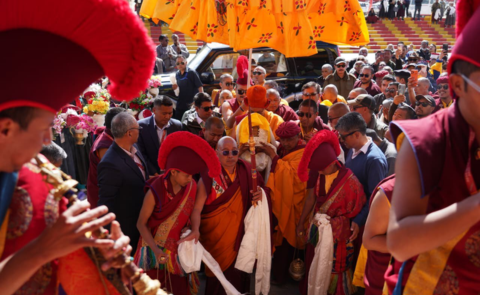
The May sun shone brightly and a gentle Himalayan breeze blew through the Buddhist teaching centre at Jivetsal in Choglamsar on the outskirts of Leh. The site was filled with thousands of devotees gathered for the prestigious exposition of the Holy Buddha Piprahwa relics. On May 1, vibrant Tibetan prayer flags fluttered in shades of blue, white, yellow, green and red, and the grandeur of the surrounding mountains echoed with prayers and chants as the relics were officially inaugurated in a grand ceremony led by Amit Shah, India’s Minister of Home Affairs.
The arrival of the sacred Piprahwa relics in Leh was of profound significance, transcending religious celebrations and reaching deep into the realms of civilisational heritage and now with geopolitical connotations as well. These relics,[1] which include bone fragments, reliquary caskets, intricately carved crystal and soapstone, ornate ornaments, and various funerary objects connected to the life and teachings of the Buddha, represent some of the most significant Buddhist archaeological finds in India. Discovered in 1898 at the site of Piprahwa in what is now Uttar Pradesh, the relics are believed to be linked to the Sakya clan, the very community to which the Buddha belonged.
Their return to Indian soil in 2025, after spending 127 years in foreign custody and an attempted auction in Hong Kong, was a momentous occasion celebrated as a powerful act of cultural reclamation and was also a reassertion of India as the birthplace of Buddhism, particularly Himalayan Buddhism – sending a strong signal to China. The arrival of these relics in Leh restores them to one of the ancient frontiers of Indian civilisation and Buddhism, a region that has harboured rich traditions of spiritual and cultural exchange for centuries. The last time these significant relics were brought to this region was in May 1950, after then Prime Minister Jawaharlal Nehru made a historic visit to Ladakh for four days. Then, the 19th Kushok Bakula Rinpoche, a key figure in Ladakh’s Buddhist community and future representative in the Jammu and Kashmir administration, seized the opportunity to make a special request. He asked Nehru to send the sacred relics of the Lord Buddha and his two principal disciples, Sariputta and Mahamoggallana, that were in the custody of the Mahabodhi Society at Sarnath near Varanasi, to Ladakh.
Nehru’s decision to transport these relics was not merely a gesture aimed at invigorating the local populace’s morale post the 1947 war with Pakistan; it was a strategic move at a time when India was acutely aware of its geopolitical standing as a frontier nation. By taking such symbolic actions, Nehru sent a powerful message to China and the international community, reaffirming India’s commitment to its cultural heritage and civilisational roots. Thus, the arrival of the Piprahwa relics in Leh this year holds immense significance, rekindling historical connections and fostering a renewed appreciation for India’s rich Buddhist heritage among both the local population and visitors from around the world.
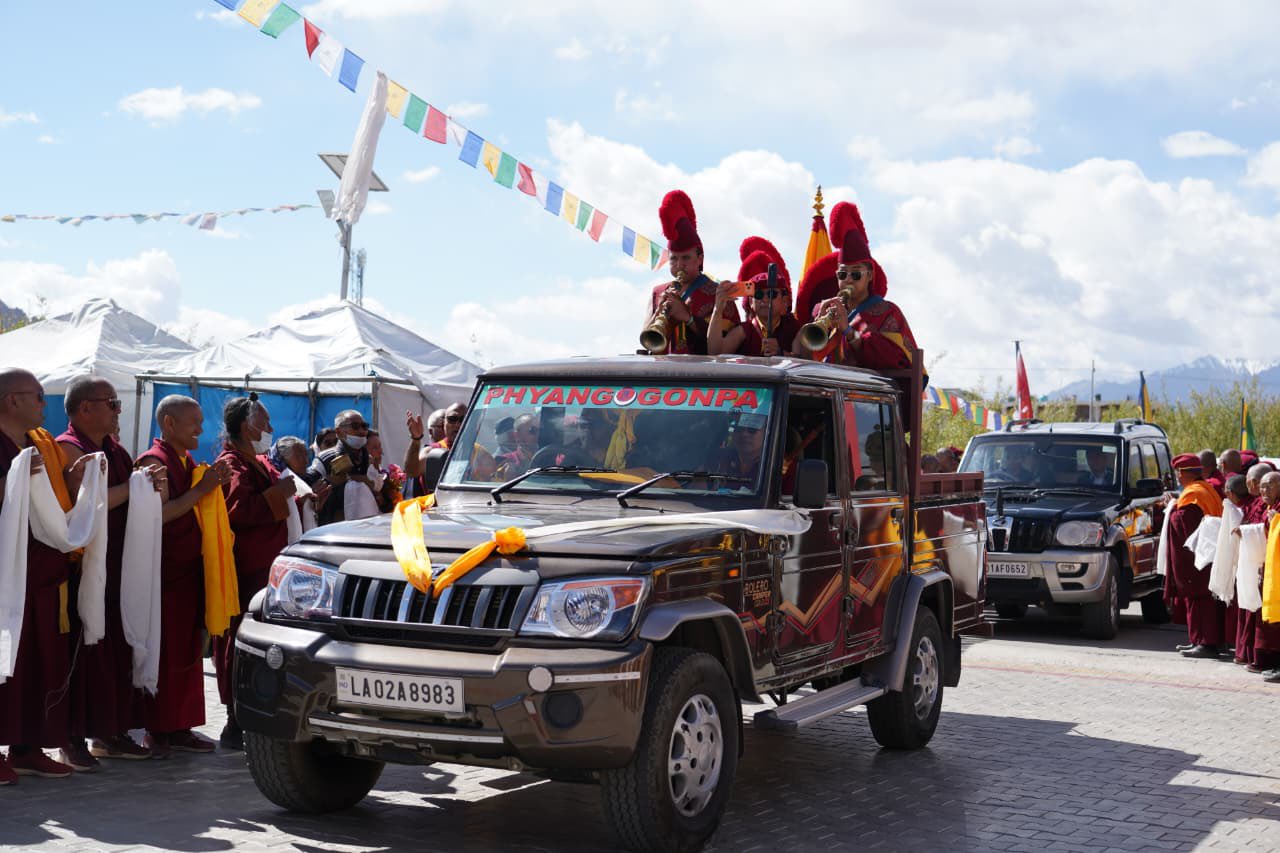
Shah, who visited Leh for two days, made sure that the message went out to China loud and clear. In his inaugural address, the Home Minister, flanked by army officers and top-ranking officials from the Intelligence Bureau, stated that India is a “living laboratory of Buddhist culture and compassion” and spoke of Ladakh’s pivotal role in keeping Himalayan Buddhism alive.
The exposition of the holy relics of Tathagata Buddha – the fully enlightened Buddha – ran for two weeks, from May 1 to 14. The relics arrived in Leh on April 29, 2026, via Indian Air Force aircraft and transported with high-level protection. This was followed by a grand ceremonial procession in Ladakh, amid tight security. There was a threat of the relics being stolen by adversaries and also of the relics being replaced by duplicates.

Before being put under the auctioneer’s block last May, the Piprahwa relics had travelled to Mongolia in 2022, Thailand in 2024, and Russia and Bhutan in 2025. Earlier this month, an exposition of the Holy Relics of the chief disciples of the Buddha—Arahant Sariputta and Arahant Mahamoggallana—was organised in Mongolia from 1 to 10 June 2026 by the Indian Ministry of Culture, the International Buddhist Confederation (IBC), and the National Museum, New Delhi.
Mongolia has been a particular recipient of Buddhist relics from India. In June 2022, four sacred Kapilavastu relics of the Buddha were taken from the National Museum of India to Mongolia for an 11-day exposition, marking their first visit to the country in 29 years. The exposition began on 14 June 2022, celebrated as Mongolian Buddha Purnima. The Relics were displayed alongside Mongolia’s revered Buddha Tooth Relic at the Gandantegchinlen Monastery. These Relics were taken on board a C-17 transport aircraft of the Indian Air Force and accompanied by the then Minister of Law and Justice, Kiren Rijiju, and the 20th Kushok Bakula Rinpoche.
While this may seem a simple act of soft cultural diplomacy, the strategic significance is notable, as Buddhism is now seen as a competitive geopolitical tool, particularly between India and China and also in the wider world. At the centre lies the issue of re-incarnation of His Holiness the 14th Dalai Lama and the existential crisis facing Tibetan Buddhism today all across the Himalayas.
Several Tibetan scholars and experts today believe that the survival of Tibetan Buddhism in India, especially in the Ladakh region, should be given utmost importance by India if it has to face a belligerent China that has made Tibetan Buddhism and the reincarnation of the Dalai Lama a political issue and part of its foreign policy too.
On February 3, 2026, the fourth session of China’s 12th People’s Congress came to a close, marked by the official endorsement of the outline for the 15th Five-Year Plan (2026–2030) for Tibet. This heralded the beginning of a new era in Chinese geopolitics characterised by comprehensive efforts aimed at systemic assimilation of Tibetan Buddhism within the Communist system of governance. The adoption of this plan indicates a strategic shift in governance and development priorities for the region, as authorities focus on integrating economic, cultural, and social initiatives within a broader framework aimed at fostering greater unity and cohesion within China, and that includes both Tibet and Xinjiang.[2]
China is brazenly building a narrative to make the world believe that it was the great Chinese civilisation in which Buddhism was born. Recently, Wang Junzheng, the secretary of the party committee of the Tibet Autonomous Region (TAR), in his “clarion call” to Tibet’s future, accorded approval of the Regulations on Religious Affairs, reinforcing the mandate to adapt Tibetan Buddhism to a socialist society. The session reaffirmed the “Four Major Tasks” — stability, development, ecology and border strengthening — as the bedrock of TAR governance.[3]
It is imperative for India to first firmly assert both the origins and the enduring presence of Buddhism within its borders and its historical ties to Tibetan Buddhism. This rich tradition is upheld by monks and rinpoches, alongside ancient stupas, inscriptions, rock carvings, and sculptures. The significance of these cultural elements must be prominently highlighted, especially in strategic regions like Ladakh and Arunachal Pradesh, which are under constant surveillance by China.
Second, engage more deeply with the Tibetan diaspora living in India, especially on the reincarnation process, which can become a friction point with China.
Third, it is crucial for New Delhi to develop a clear roadmap for how it intends to uphold the traditional Nalanda school of Buddhism, which is followed by Indian and Tibetan Buddhists. It will provide religious and geopolitical gains.
This precious heritage is a strategic bargaining chip against China, which is preparing to elect the 15th Dalai Lama by setting in motion a comprehensive process for his reincarnation.[4]
Nayanima Basu is the Adjunct Fellow at Gateway House and an author.
This article was exclusively written for Gateway House: Indian Council on Global Relations. You can read more exclusive content here.
For permission to republish, please contact outreach@gatewayhouse.in.
Support our work here.
© Copyright 2026 Gateway House: Indian Council on Global Relations. All rights reserved. Any unauthorised copying or reproduction is strictly prohibited.
References:
[1] Sifra Lentin, “Crystal Ash: The Buddha at Piprahwa,” Gateway House: Indian Council on Global Relations, June 11, 2026 https://www.gatewayhouse.in/crystal-ash-the-buddha-at-piprahwa/
[3] International Campaign for Tibet, “Tibet Roundup: February 2026,” International Campaign for Tibet, February 2026 https://savetibet.org/news/tibet-roundup-feb-2026/
[4] Nayanima Basu, “Talk Tibet with Candour,” Gateway House: Indian Council on Global Relations, September 4, 2025 https://www.gatewayhouse.in/talk-tibet-with-candour/