


Every time Jews and Hindi films come up in the same sentence, it is the glamorous Baghdadi Jewish actresses of the silent and early talkies era who dominate the imagination. Actresses like Sulochana (Ruby Myers), who successfully transitioned from silent to talkie films, and was the highest paid actor in her time, or Pramila (Esther Victoria Abraham), the first actress to set-up her own production company (Silver Films), or the famous 1950s-60s vamp Nadira (Florence Ezekiel), who began her career as a leading lady in Mehboob Khan’s Aan (1952) but later went on to set the template of the Westernised, chain-smoking, seductive vamp.
During this high point of Jewish glamour in Hindi films, all contributed by Indian Baghdadi Jewish women, were two German-speaking European Jewish men, refugees in Bombay’s Hindi film industry. They were among a small group of German refugees in the industry, like cinematographer Josef Wirsching and director Franz Osten of Bombay Talkies. They introduced a new sensibility and modern techniques into the early talkie era of Hindi cinema. Unlike Wirsching and Osten, music composer-conductor-musician and ethnomusicologist, Walter Kaufmann, and his friend, script and scenario writer Willy Haas, worked with Mohan Bhavnani of Bhavnani Productions.[1]
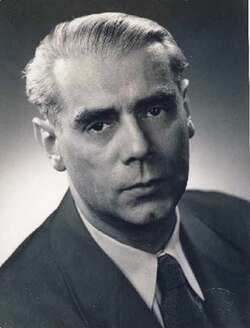
Source: Wikipedia
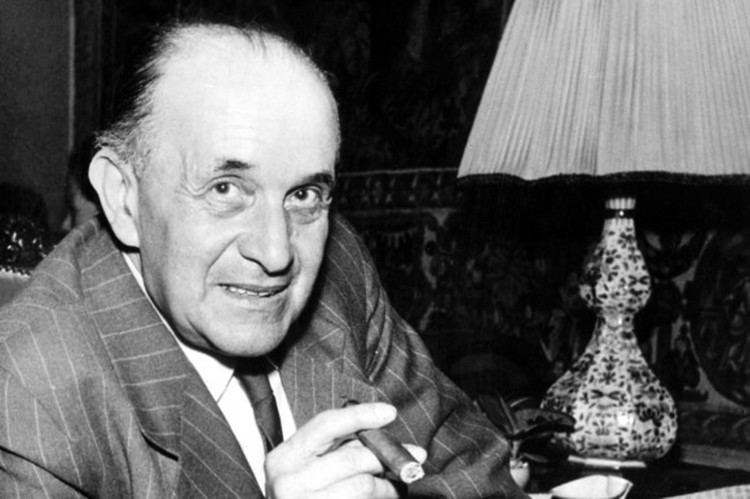
Source: Wikipedia
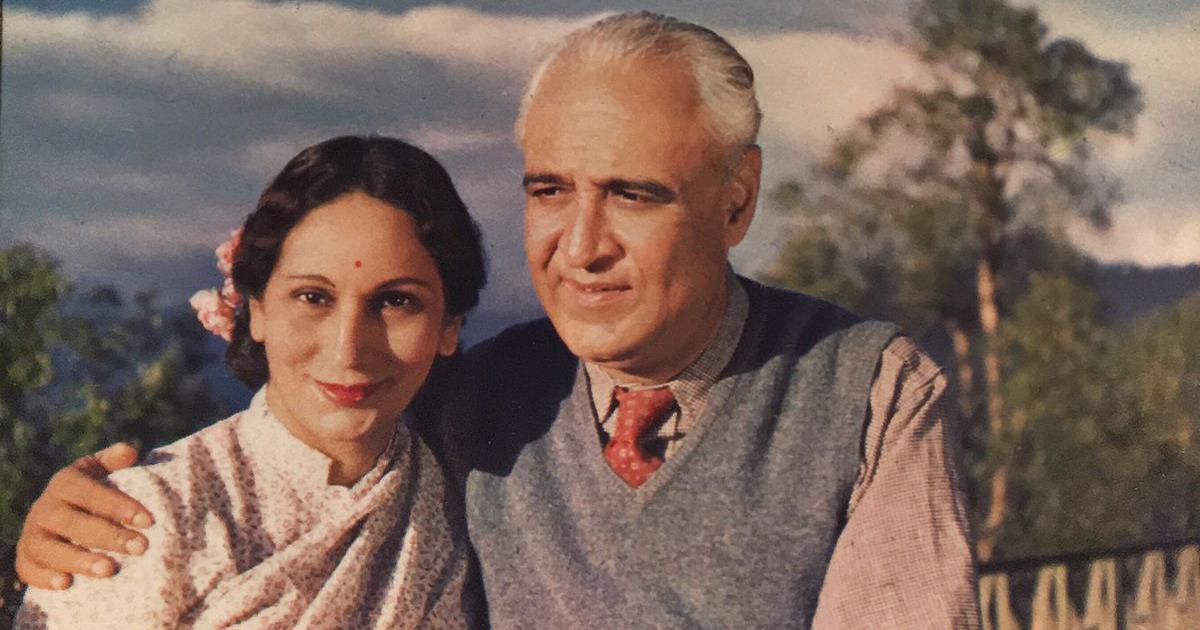
Bhavnani the first big name from India’s Sindhi community in Hindi films, drew these two well-known names from Universum-Film-Aktiengesellschaft (UFA) Studios in the then state-of-the-art New Babelsberg Studio Complex in Berlin. He urged Kaufmann first, in 1934, to seek refuge in Bombay, by offering him work in his production company. Haas’ job offer from Bhavani in 1939, to join as script and scenario writer at Bhavnani Productions, his new banner, was mediated by Kaufmann.[2] [3] Rather than going west to Hollywood, as most European Jews did, Kaufmann and Haas were tempted by Bhavnani’s offer, which made it easy for them to procure a British India visa. Both also had some exposure to India’s history and culture, which made it easier for them to make this decision. [4] [5] The solid offer of work by Bhavnani, who befriended Kaufmann at UFA Studios during a stint there, sealed the deal.
Source: The Scroll
The British Indian government did not encourage European refugees to disembark at Indian ports, although Pandit Jawaharlal Nehru was in favour of hosting the skilled and highly educated European Jews being persecuted under Hitler’s regime in Germany. He felt they could contribute to India’s betterment in agriculture, industry, and medicine. The British Indian government prevailed: it did not permit European refugees to disembark in Bombay unless they had a job offer in writing and were guaranteed by a British Indian resident. Most refugee ships were redirected to Shanghai during the inter-war and Second World War years, with very few refugees disembarking in Bombay.[6] Sources state that European refugees (Jewish and non-Jewish) in India were just 1051 before the outbreak of the Second World War in 1939.[7]
The guarantor for European Jews in India was arranged by the Jewish Relief Association (JRA, est. 1934), whose board was composed of prominent expat German and local Baghdadi Jews.[8] The JRA raised money for their housing and upkeep till they could support themselves. Script writer Willy Haas, who arrived on the Conte Rosso liner in 1939, was quickly cleared by immigration, in the presence of a JRA representative, and soon whisked off by his friend Kaufmann to his home, while his luggage was sent to the JRA lodgings in Lesser’s Guest House on the second floor of Soona Mahal building on Marine Drive.

Image credits: A.Savin, Wikimedia Commons
According to a translation of Haas’ 1958 article in Die Literarische Welt (The Literary World) – the two friends had dinner that same evening with their benefactor, Bhavnani, and his actress wife, the beauteous Enakshi Rama Rau, at Kaufmann’s home on the ground floor of Rewa House in Mahalaxmi.[9] Haas, 12 years older than Kaufmann, had a formidable reputation as a scriptwriter, literary critic and journalist in Berlin and Prague. He was the editor of the renowned Die Literarische Welt from 1925 to 1932, a widely respected literary journal in Germany and Europe, and had written the scripts for 20 films for UFA Studios, Berlin, before fleeing to India. Despite this, he was racked by doubts because of his inability to speak English, let alone Hindustani, the lingua franca of the Hindi film industry.
It was Bhavnani’s fluent German and his promise to have Haas’ scripts translated into Hindi that offered some consolation. What did come as a culture shock, though, was Haas’ first exposure to the non-linear storyline and the disruptions of ‘impromptu’ song-and-dance sequences in Hindi films. Actor David Abraham, a Bene Israel Jew who began his career with Bhavnani Productions and later became a good friend of Haas, took him for his first Hindi movie. He instructed Haas to meet him at a cinema in Fort, thirty minutes after the start of the film at 9 pm, chuckling that they wouldn’t miss much. They finally stumbled out of the theatre, along with an audience made up of families with infants and food baskets, at 1.30 am. This film had five intervals, numerous narrative disruptions, and ended only with Lord Krishna appearing to offer hope to the widowed heroine.[10]
Haas’ first script, Jhooti Sharm (1940), for Bhavnani Productions, was based on Henrik Ibsen’s Ghosts.[11] A ‘social’ film with a message about the malaise of sexually transmitted diseases, it was a deliberate choice, not just because of Haas’s familiarity with Ibsen’s works, but also Bhavnani’s decision to stay away from mythological films and politically controversial themes.[12] This film was a hit, but Haas could not recognise his own script when he visited the sets, as Bhavnani irretrievably altered it during filming to suit what the audience wanted.
While he was struggling to understand Indian sensibilities, traditions, mythologies, and ‘village life’ (as he described it), which were so diametrically different to the Weimar Republic’s minimalism and Expressionism in filmmaking, his friend Kaufmann was on a creative high.[13]
By 1938, Kaufmann, who had been joined by his wife, Gerti, was living on the ground floor of the Maharaja of Rewa’s bungalow.[14] The Maharaja, Martand Singh, was an aficionado of Western classical music. Along with Mehli Mehta, Zubin Mehta’s father, and one or two expats, Kaufmann established the Bombay Chamber Music Society (BCMS) in 1936. By the time he left India in 1946, the Society had given 600 concerts, either as a trio or a quartet. By this year, too, he was head of European music at Bombay’s All India Radio & Studio, then located at Marine Lines.

Source: Wikipedia
Despite his rigorous training in Western classical music since childhood, Kaufmann still had to make a concerted effort to understand the sounds and tonal variations of Indian musical instruments such as the veena, sarangi, sitar, and tabla, as well as Indian musical notations and classical singing. He travelled across the Subcontinent studying the music of the mountains (Nepali and Kashmiri), hills and plains, and the ragas of Hindustani and Carnatic music.
Kaufmann’s greatest contribution was the introduction of orchestral music, using Indian instruments, in Hindi films and documentaries produced by Information Films of India. He also combined the sounds of Indian musical instruments with Western ones into his own compositions. The most well-known of these is All India Radio’s (today’s Akashwani) signature morning tune, based on the raga Shivaranjini, played on the violin (believed to have been played by Mehli Mehta), tanpura and viola.[15] [16] Kaufmann also evoked India in many of his compositions written during his time in India. His Indian Piano Concerto was performed for Prague Radio in 1937.
Kaufmann’s musical universe was not confined to his routine work at AIR and performances with the BCMS. He partnered with Willy Haas on the radio opera The King Calls (1940) and, before this, wrote and performed India’s first radio opera, Anasuya (1938). He also composed music for Bhavnani’s films and Information Films of India (the precursor to Films Division of India), thus making his years in India from 1934 to 1946 his most creative.
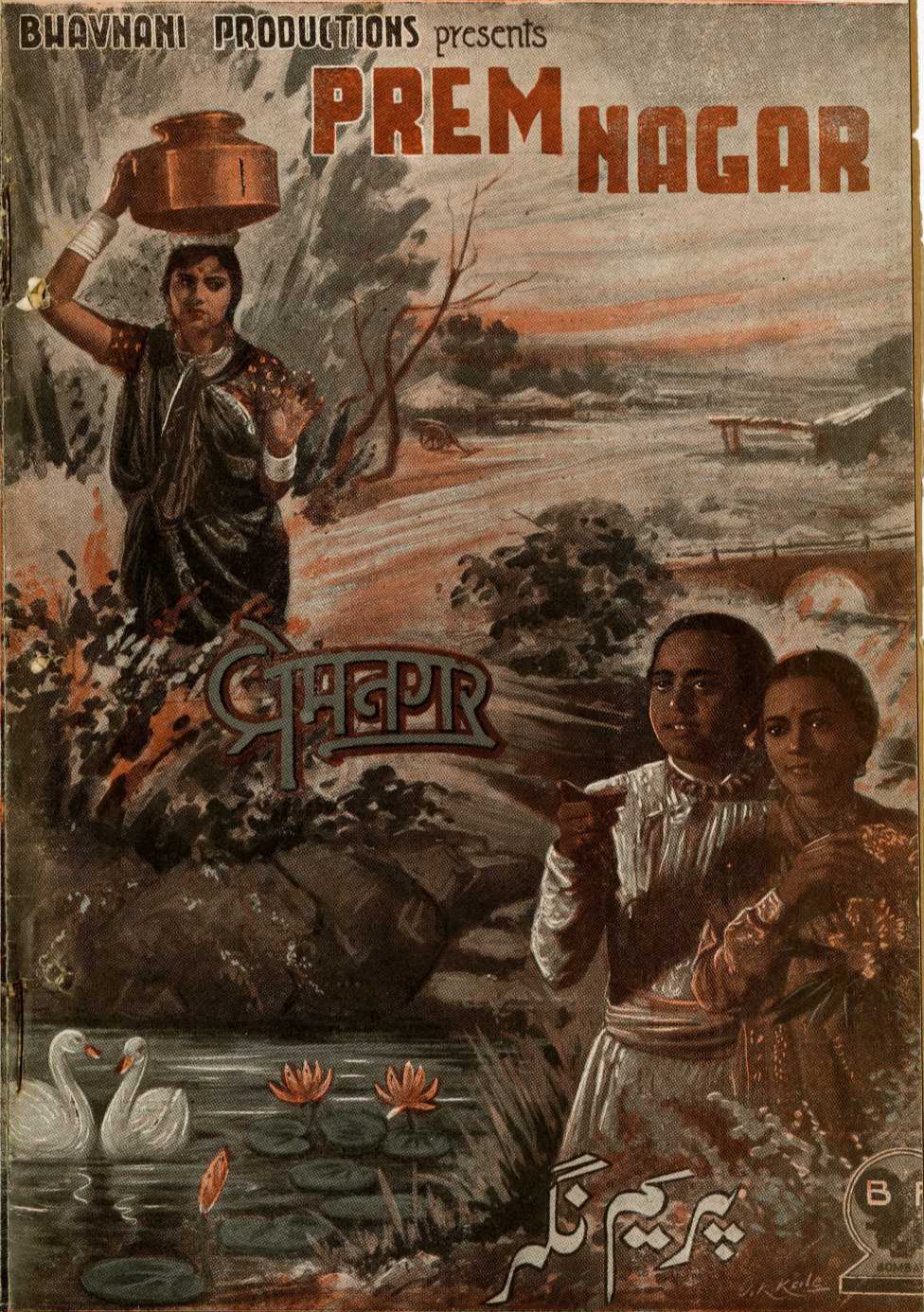
Willy Haas, in the meantime, in his quest to understand India and its people, convinced Bhavnani that he needed to immerse himself in the real India. He travelled to the native Kingdom of Limbdi (Saurashtra), and experienced life in a village there, returning to Bombay full of ideas for his next script. The outcome was Prem Nagar (The City of Love), a formulaic but charming love story of good and evil, fate and destiny, plus the spiritual enlightenment as the happy ending.[17] This movie which opened at Novelty cinema in Bombay’s Grant Road in April 1941, was an instant hit.[18]
Haas left Bhavnani Productions a few months before this film’s premiere, going full-time into freelance journalism. He wrote for the Bombay Chronicle and The Illustrated Weekly and wrote plays for the radio.[19] He left Bombay soon after for Dehradun to work in the British Indian Army as a translator-interpreter at the Central Internment Camp there. According to Uma Anand, producer Chetan Anand’s wife, and daughter of Haas’ close ‘Doon’ friend, Haas was “our intellectual lifesaver in Dehradun ”.[20] She credits the many ideas that Haas discussed with her film producer husband and her, as finding their way into India’s first Cannes Grand Prix (now Palme d’Or) win, Chetan Anand’s Neecha Nagar (1946).
Kaufmann and Haas left India soon after the Second World War ended, but the precious few years these two European Jewish refugees lived in India and interacted with its intellectual and cultural life have left a lasting imprint on Mumbai’s Hindi film industry, just as the contributions of yesteryear’s beautiful, pioneering Jewish actresses had in overcoming the taboo for respectable women acting in Hindi films.
Sifra Lentin is Bombay History Fellow at Gateway House.
This article was exclusively written for Gateway House: Indian Council on Global Relations. You can read more exclusive content here.
Support our work here.
For permission to republish, please contact outreach@gatewayhouse.in
©Copyright 2026 Gateway House: Indian Council on Global Relations. All rights reserved. Any unauthorised copying or reproduction is strictly prohibited.
References:
[1]Instead of using the German Wilhelm for his screen credits, Haas used the Czech variation Vilém.
[2] Bhavnani’s first film production company, Ajanta Cinetone, was short-lived. (1933-1939). It closed because of an extended and expensive tussle with the colonial censors over The Mill (1934).
[3] See: Lentin, Sifra, Mercantile Bombay: A Journey of Trade, Finance and Enterprise (New Delhi, Routledge/Taylor & Francis Group, 2022), pp.116-118, on the Weimar Republic’s cultural influence on films, art, literary criticism, in Bombay, during the inter-war years.
[4] According to Anil Bhatti, in his chapter “Willy Haas and Exile in India”, Haas in his autobiography questions why he chose India. He writes, “One of the reasons, he subsequently realised while in exile, was Kipling’s Kim, which he had read as a boy…. It seemed to him that subconsciously he had retraced the path of the narrative action of the book as an exile in India.” Other reasons Haas cites are Gandhi, Indology lectures at the University of Prague, and Paul Deussen’s translations of Indological texts. Likewise, Kaufmann too had taken Indology classes.
See: Bhatti, Anil, ‘Willy Haas and Exile in India’, in Bhatti, Anil, and Voigt, Johannes H. edited, Jewish Exile In India 1933-1945 (Delhi, Manohar/Max Mueller Bhavan Delhi, 2005), p.115.
[5] Two biographies on Kaufmann, one by Gangar, Amrit, The Music that Still Rings at Dawn, Every Dawn: Walter Kaufmann in India 1934-1946 (Mumbai, Goethe Institute/Max Mueller Bhavan, 2013), and Agatha Schindler’s chapter ‘Walter Kaufmann: A Forgotten Genius’ in Bhatti, Anil, and Voigt, Johannes H., Jewish Exile In India 1933-1945 (Delhi, Manohar/Max Mueller Bhavan Delhi, 2005) both point to Kaufmann’s keen interest in understanding and learning the music from the Subcontinent. He subsequently wrote two authoritative works: one on the music of South India and the other on the music of North India. His most creative years were spent in India, interacting with the best exponents of various Indian musical instruments and classical singers at All India Radio, and travelling the length and breadth of the country to collect ragas, instruments, and record sounds.
[6]Shanghai once had a substantial European Jewish community due to this British India policy.
[7] Bhatti, Anil, and Voigt, Johannes H. edited, Jewish Exile In India 1933-1945 (Delhi, Manohar/Max Mueller Bhavan Delhi, 2005), p. 28.
[8] The Jewish Relief Association (JRA) office in Bombay was given material and political support by the Council of German Jewry in London. Funding for the destitute refugees was later raised largely from amongst the European refugees who had begun working and were financially able to contribute; the rest was raised from among the well-to-do Baghdadi Jewish businessmen in Bombay and Calcutta. In terms of political support, by March 1939, the Council had reached an agreement with the India Office that the ultimate discretion to permit refugees to disembark at Indian ports vested with the colonial Government of India, combined with a guarantee of support for five years from the JRA in Bombay.
See: Siddiqi, Majid Hayat, “Jews and Central European Nationals in Exile in Colonial India between Two World Wars”, in Bhatti, Anil, and Voigt, Johannes H., Jewish Exile In India 1933-1945 (Delhi, Manohar/Max Mueller Bhavan Delhi, 2005), p.48.
[9] The translation is by Xan Holt and reproduced in parts in Mukherjee, Debashree, and Xan Holt, ‘Willy Haas in Bombay’ ( Sage Journals: Bioscope: South Asian Screen Studies, 5 June 2024)
[10] Ibid, 9
[11] The original title of this 1881 play Ghosts by Henrik Ibsen is Gengangere. Written in Dano-Norwegian, this term literally translates as “those who walk again” or “revenants,” rather than simply meaning spirits or spectres. The title refers to past inherited sins and old ideas that refuse to stay buried and continue to haunt the living.
[12] Bhavnani’s last two film for his first production company, Ajanta Cinetone’s “Mazdoor” or “The Mill” (1934), script written by Munshi Premchand, the legendary Hindi litterateur, and “Jagran” or “The Awakening” (1935). Both films encountered issues with the censors, and he was forced to close this company.
[13] Film Noir was a cinematic genre that took root in the 1940s-50s in American crime dramas, which was a direct outcome of the number of European refugees who worked in Hollywood. It was characterized by cynical, fatalistic themes, moral ambiguity, and a dark, shadowy, black-n-white visual style. It was an outcome of the influence of German Expression on film-making.
[14] Gerti Hermann was the philosopher Franz Kafka’s niece and became a French teacher in Bombay.
[15] Walter Langhammer was no stranger to the radio. Even before joining AIR in 1937, his compositions written in India were played on Prague Radio, conducted by Heinrich Swoboda.
See Gangar, Amrit, The Music that Still Rings at Dawn, Every Dawn: Walter Kaufmann in India 1934-1946 (Mumbai, Goethe Institute/Max Mueller Bhavan, 2013), p.37.
[16] The AIR signature tune was adopted to be played by all AIR studios across India in 1939. This fact is known to us from an article in The Listener Magazine, volume 4, dated 7 February 1939. The article describes a visit to the AIR studio by the Viceroy of India, who is entertained by the AIR orchestra conducted by Kaufmann. The Viceroy later congratulates him on his tune being chosen as the signature tune for all AIR radio stations.
[17] According to Haas’s autobiography, he was upset with the ending of this film being changed from spiritual enlightenment to the last scene showing a happy couple rocking their baby in a crib.
[18] See Christoph von Ungern-Sternberg. “Willy Hass.” METROMOD Archive, 2021, https://archive.metromod.net/viewer.p/69/2912032691 (Last modified on 15.09.2021)
[19] Haas during his short time in Bombay from 1939 to 1941, was involved substantially in four movies, aside from Jhooti Sharm and Prem Nagar the other two were Kanchan (1941) and Asir of Asirgarh (1949), the latter was Bhavnani’s last movie and was released under the titles Ajit or Raangeela Zameen. He left Bombay in 1941 for Dehradun to begin work as a translator/interpreter in the British Indian Army’s Central Internment Camp for enemy aliens, located just outside Dehradun.
[20] Ibid 11.