


Five Indian states have gone to the polls in April 2026: Assam, Kerala, Tamil Nadu, West Bengal, and Puducherry. They are all important, but by far the most significant election is that of West Bengal, for several reasons.
This crucial border state has been ruled by two regional parties for 45 years: the Communist Party of India for 30 years, and the Trinamool Congress Party for the last 15 years. Their focus was on social engineering, over economic growth. Industry left, talent left. Expectedly, during this period, Bengal’s economic indicators have plummeted. According to a 2026 report by NITI-Aayog, Bengal ranked 16th of India’s 18 major states, with high debt, low fiscal scores, low revenue and low capital expenditure.[1][2] Per capita GDP[3] growth in Bengal is the lowest in the country today.
The tragedy of Bengal is hard to overstate. Bengal in the 1960s was home to one of India’s largest industrial clusters and was the third-largest contributor to India’s newly-independent economy, at 10.5% of total GDP.[4] The region sits on the prosperous Ganges delta and has been a centre of maritime trade and commerce since ancient times, a thriving entrepôt on the Silk Road, a cultural and knowledge hub, and the capital of the British Raj in India. By 2023-24, the state’s share of national GDP had halved, to 5.6 per cent, leaving it a laggard in a surging India.
The deterioration in Bengal is physically evident. A recent week-long road trip to the poll-bound state showed a physical lack of development, low income, despondency among youth, and a mix of fear and hope in anticipation of the election’s outcome, depending on individual political inclinations. The election seems to have coalesced around one overt issue: that of illegal migrants from Bangladesh, who have been given official documentation and become a vote bank for the state’s ruling Trinamool Congress (TMC) party and whom the opposing Bharatiya Janata Party (BJP), in power in Delhi, has urged the Election Commission of India to delete from the electoral rolls through a Special Intensive Revision (SIR). The covert issues are those of jobs for youth and security, especially for women.
At stake in this intense struggle is the 15-year regime of Chief Minister Mamata Banerjee and the TMC, the Bengali notion of ‘independence’ from Delhi’s ‘rule,’ economic integration with the growing Indian economy – and the revival of a critical border state that is India’s connector to its northeast, to its fragile eastern neighbours, and to a vast trading and cultural opportunity with ASEAN.
In north Bengal, the mood is decidedly in favour of the BJP. Himanta Biswa Sarna, the BJP chief minister of neighbouring Assam state, is campaigning in Siliguri, the picturesque and largest city in that region. He has a captive audience, that knows his state, till recently a laggard, is now the fastest growing in India. He tells them he has generated 200,000 jobs and a vote for the BJP in Bengal will surely generate at least that. The TMC rule has driven industry out of Bengal, and welcomed in outsiders – often radicalised – who slip in from the open borders in Fulbari, barely 20 km away from Siliguri, and are treated better than residents. And he reiterates: he is not against Muslims, only illegal migrant Muslims from Bangladesh. This seems to resonate with the crowd. He promises the BJP will bring in hospitals and elite educational institutions.
The issue of jobs and income is grave in Bengal. The northern region, which houses Darjeeling, was famous for its tea and tea estates. India is the world’s second-largest producer of tea after China, and Darjeeling exports half its production. This export industry is now in an ‘existential crisis’ with tea estates neglected and production the lowest in 170 years. Climate change and underinvestment are key reasons, but so is underpaid labour – tea pickers in North Bengal are paid just Rs. 250 a day, compared to a minimum of Rs. 400 a day earned by their counterparts in South India. Bengalis who migrate to Tamil Nadu, and work in the construction industry, are paid up to Rs. 900 a day – a huge differential.
Like most in the northeast, the people are charming, carrying the beauty prevalent in most hill communities. The ubiquitous ‘beauty parlour’ is everywhere. Young women made a respectable living by providing beauty treatments and Bollywood hairdos to young brides, and the village ladies especially, during the famous Durga Puja festivals. The Indian Idol TV show is a top hit – and visiting Mumbai, the glittering city of lights and glamour, is a distant dream, but one close to their hearts. Many of the ladies are graduates – Bengal literacy levels are 73% and female participation in the labour force is reasonably high – but because jobs are hard to come by, self-employment becomes the only recourse. Pradeep Barul, whose wife Mamata runs a beauty ‘parlour’ in the farming village of Pamal Hat in Uttar Dinaspur, says he doubles up as the wedding DJ to complement his wife’s work. In a good month, they can earn Rs. 20,000. They won’t tell who they vote for, but remark cryptically, “We have hope, and we have a target.”

Harsh Shringla, a former foreign secretary of India and ambassador to the U.S. and to Bangladesh, is a native of Darjeeling and has been campaigning for change and for the ruling BJP. He reminds that the impact of Bengal on India’s foreign policy is huge: its proximity to China, has multiple ports, holds the key to sharing the waters of the Teesta River with Bangladesh and trades with Asia. He spends his time explaining the BJP blueprint for Bengal to voters: to bring change (pariborton) to the state’s youth, women, farmers, fisheries, jute, and textiles, and “bring Bengal back into the mainstream of national development.”
South of this region is the voting block of Central Bengal, which has the sharpest contrast of religious diversity. Here, 56% of the electorate is Hindu, and 43% is Muslim, and the TMC is the dominant party. Like other parts of Bengal, the roads are dismal, especially as they are predominantly rural. Crossing from North to South Bengal into the trading hub of Murshidabad requires taking the Farakka Bridge, built along with the famous Farakka Barrage over the Ganges River in 1970. It seems like no maintenance has been done in over 50 years. A new bridge is under construction, with the usual delays holding it back. The shock of seeing poor roads in a country that is rolling out 8 km a day of new highways is jarring.

Even more jarring is the crossover into Murshidabad, which was the hub of global trade in the 18th and 19th centuries. At its peak it contributed 5% to global GDP, connecting the Mughal and British empires to Europe, Southeast Asia and the Middle East. The area was home to Jagat Seth, a Jain financier and trader who funded the Mughals and the British, as also local kingdoms, and commanded a vast global trading empire. He was often known as the Medici of Asia or the Banker to the World.
Alas, that era has long passed. Murshidabad is a distant memory of itself, with no trade and apparent poverty. In the village of Lalgola, the largely Muslim population is complaining of their vote being taken away by the SIR. While they are angry about their lack of franchise, they are also angry about the lack of development. Sinarul SK is 23, and finishing college still. He says neither his village council leader nor his candidate in the state election has completed cementing the dusty roads of his home. “They keep saying, we will do it – but it never gets done. All they do is talk politics, the development agenda is not forthcoming.” Eventually, he too will have to join his cohort and leave his home in search of a job. He says his peers are in Chennai, working in construction as carpenters, masons and solderers.
In Kolkata lies the final destination of the state election. This is the bastion of Mamata Banjerjee, and it is where her loyalists are concentrated. In the last election, the TMC won 98 seats, and the BJP won just two. The city is in a shambles, and even here, the blue and white paint of the TMC projects, is barely visible. A visit to Presidency University, one of the best in Bengal, which has produced two Nobel Prize winners, is a walk into despondency. Students of STEM feel no differently from their rural counterparts. Kolkata offers no jobs, and even those studying STEM subjects know that they will have to leave home to find work. In her annual budget, Banerjee has allocated Rs. 5,000 crores to madrasa schools, and Rs. 80 crore to science and technology. Young women say they can’t be out on the streets after 6.30pm, given the dismal security for women and the highly publicised rape cases in the state. These students too, see no future in Bengal.

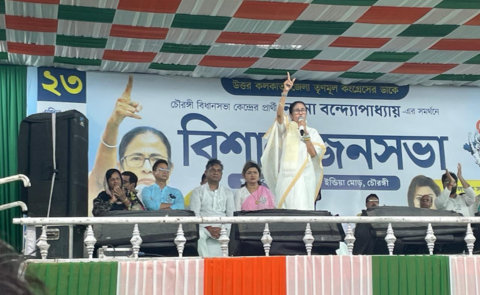
These concerns seem far from the political pitch that Mamata Banerjee and her heir apparent, nephew Abhishek Banerjee, give to their public. Her rallies are full of her die-hard supporters, and as she walks up and down the stage, equating herself with Prime Minister Narendra Modi and bludgeoning his policies, the crowd roars in approval. Her nephew’s show is more staged-managed. Not for him the natural politician’s love of pressing the flesh and plunging into the crowd. He drives up to the dais of his rally, steps onto the long ramp, and gives a lusty talk against the BJP – omitting talk of development and jobs. Once done, he steps down and is carried away in his fleet of dark cars to his next destination.
The BJP has been vigorously campaigning against this force, never failing to remind Bengalis about their great past – and their great future, should they vote for the BJP. The first small power industry in India, Triveni, was set up in Bengal, as was the first auto hub and the first satellite town, Kalyani, in independent India. Those are long gone: in the last year alone, 6,800 companies have left Bengal, frustrated with the extortion and lack of investment – just 1% of the state budget is allocated to business and investment, and most to social welfare schemes – which, too, are not enough to make up for a decent income.
Which way will Bengal vote? Prime Minister Modi is betting on the BJP. He has made eight visits in the last month alone, telling the voters that this time, the vote for Bengal will be a vote for him. His party has brought all its structure and strengths to Bengal, with a war room full of data of Bengal’s diverse communities and their desires and needs. On May 4, the results will be declared: will Bengal continue to keep to itself, or will it move to join its counterparts in the rest of India and reclaim its role as India’s most famous entrepot and trading hub?
Manjeet Kripalani is the Executive Director, Gateway House.
This article was exclusively written for Gateway House: Indian Council on Global Relations. You can read more exclusive content here.
Support our work here.
For permission to republish, please contact outreach@gatewayhouse.in
©Copyright 2026 Gateway House: Indian Council on Global Relations. All rights reserved. Any unauthorised copying or reproduction is strictly prohibited.
[1] NITI Aayog. Fiscal Health Index 2026. New Delhi: Government of India, 2026. https://niti.gov.in/sites/default/files/2026-03/Fiscal-Health-Index-2026.pdf
[2] NITI Aayog. Macro and Fiscal Landscape of the State of West Bengal. New Delhi: Government of India, 2025. https://niti.gov.in/sites/default/files/2025-07/Macro-and-Fiscal-Landscape-of-the-State-of-West-Bengal-1.pdf p. 7
[3] Per capita GDP is Rs.181,000 or $1,900.
[4] Economic Advisory Council to the Prime Minister. State GDP: A Working Paper. New Delhi: Government of India, 2024. https://eacpm.gov.in/wp-content/uploads/2024/09/State-GDP-Working-Paper_Final.pdf p. 5