

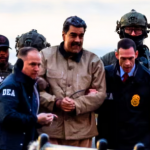
In the early morning of January 3, the U.S. Delta Force and other special forces, supported by the U.S. Air Force and U.S. Navy, captured Venezuelan President Nicolás Maduro and his wife, Celia Flores at their residence on a military base. More than 150 aircraft of different types and about 20 U.S. bases were said to be involved in this spectacularly successful exfiltration known as Operation Absolute Resolve, which had been planned for months in concert with U.S. intelligence and law enforcement sources. Evidently power in Caracas was cut off by U.S. cyberattacks, and Venezuelan air defenses were suppressed to allow entry of multiple types of helicopters. Maduro and his wife are now in New York; he is charged with cocaine trafficking as leader of a cartel known as Cartel de los Soles. His wife and son (not in custody) have also been charged along with some others.[1] Venezuelan sources report dozens of security personnel killed, including 32 Cubans.[2] No U.S. deaths were reported.
As expected, criticism has been expressed by the leaders of the Democratic Party, advising that the rule of law was compromised, that Congressional approval should have been obtained, and that there is no well-defined plan for the “day after.” Allies of Venezuela issued harsh condemnation. For Colombia, Mexico, Russia, Iran, China, and North Korea the violation of international law and Venezuelan sovereignty have been the mantra. The Europeans had a muted response, and did not condemn the raid. India too, was subdued, keeping in mind a possible deal on tariffs and other potential U.S. engagement such as the acquisition of F-35 generation 5 aircraft which are more important than a deposed Venezuelan leader now arraigned on narco-trafficking charges.[3]
Confusion about the stated purpose of the exfiltration has given more arguments to critics. The Trump administration described it as a law enforcement operation,[4] however the president was also quick to say that he would “run”[5] Venezuela. Secretary of State Marco Rubio, however, issued the contrasting suggestion that the U.S. would not govern Venezuela ‘s daily affairs except for supporting the current “oil quarantine.” Even without Maduro, the Venezuelan military, secret police, and government have many Maduro loyalists, and it is hard to fathom how Venezuela can be run from the White House. For now, at least on an interim basis, Delcy Rodríguez, Venezuela’s vice president and a known Maduro ally, will govern the country.
There is some conjecture that the exfiltration of Maduro is really about American access to Venezuela’s oil reserves, reported to be about 300 billion and the largest in the world. U.S. oil companies have been nationalised there over the years, and this and other political risks (fiats, decrees, arbitrary and capricious conduct) will continue regardless of who is in power. It also remains to be seen if Venezuelan crude can be extracted and exported profitably, given the decrepit state of its energy infrastructure and the amount of capital needed to modernise it.
The attack and removal of Maduro are philosophically in concert with the recently issued National Security Strategy of the White House,[6] which affirms that the U.S. will limit its focus in international affairs to the core interests of national security. Destruction of Iran’s nuclear infrastructure, attacks against the Houthis to keep the Red Sea open, and bombardment of ISIS in West Africa would also be deemed to qualify as such core interests – as would recent seizures of tankers of shadow fleets (also known as ghost fleets) that carry oil with fake flags to avoid U.S. sanctions. While on the one hand President Vladimir Putin of Russia and President Xi Jinping of China may use U.S. intervention in Latin America as a pretext for their invasion of Ukraine and designs on a Taiwan takeover, they have also witnessed the massive firepower, logistics coordination and expert execution of the U.S. military. The question is whether this will be seen in Moscow and Beijing as a demonstration of will power and a potential deterrent for their own ambitions.
U.S. action in Venezuela has resurrected the Monroe Doctrine declared by President James Monroe in 1823, which sought to prevent foreign interference in the Western Hemisphere, seeing it as a threat to U.S. security. Originally, it intended to keep European colonial powers away, but it has been reinterpreted over the years beyond that,[7] including justification for intervention by the U.S. within the Western Hemisphere. Presently, China’s increasing influence in Venezuela to access oil and critical minerals has been of concern to Washington,[8] which is aware of the vulnerability of U.S. supply chains. Russia’s military and economic assistance to Venezuela has also been deemed problematic. Donald Trump has reasserted the 200-year-old policy, updating the term to the “Donroe Doctrine,” a play on words that seeks to revitalize U.S. hegemony in Latin America – and through it, some reduction of Chinese and Russian influence in what is viewed as America’s vicinage.
Besides removing a head of state and alleged drug lord, Trump’s action in Venezuela also should be seen in a larger context. The U.S. has adopted an aggressive foreign policy with a willingness to use force to relentlessly support core interests, in contrast to the Obama-Biden years which tended to favor diplomacy and multilateralism. Trump’s recently announced withdrawal from 66 multilateral organisations,[9] nearly half of which are affiliated with the United Nations, is yet another example of policies that favor “America First.” The days of conciliatory benevolence are over. The Trump administration is indeed signaling, “No more Mr. Nice Guy.”
Frank Schell is a business strategy consultant and former senior vice president of the First National Bank of Chicago. He was a Lecturer on South Asia affairs at the Harris School of Public Policy, University of Chicago, and served in the U.S. Peace Corps in India. He has been involved with India in development, banking, academia and consulting.
This article was exclusively written for Gateway House: Indian Council on Global Relations. You can read more exclusive content here.
Support our work here.
For permission to republish, please contact outreach@gatewayhouse.in.
©Copyright 2026 Gateway House: Indian Council on Global Relations. All rights reserved. Any unauthorised copying or reproduction is strictly prohibited.
References:
[1] U.S. Department of Justice, Justice News. “Media Release,” January 2026. https://www.justice.gov/opa/media/1422326/dl
[2] BBC News, “Thirty-Two Cubans Killed During US Attack on Venezuela,” BBC News, January 5, 2026. https://www.bbc.com/news/articles/cj9r0eyw0jno
[3] India Today. “Trump–Venezuela Attack: Maduro, India’s Modi Response, Russia Oil Threat,” India Today, January 6, 2026. https://www.indiatoday.in/india/story/trump-venezuela-attack-maduro-india-pm-modi-muted-response-russia-oil-threat-2847305-2026-01-06
[4] United States Mission to the United Nations. “Remarks at a UN Security Council Briefing on Venezuela,” USUN Mission, January 2026. https://usun.usmission.gov/remarks-at-a-un-security-council-briefing-on-venezuela-2/
[5] NPR. “Trump Claims U.S. Will Run Venezuela, but There Are No Troops in the Country,” NPR, January 5, 2026. https://www.npr.org/2026/01/05/nx-s1-5666333/trump-claims-u-s-will-run-venezuela-but-there-are-no-troops-in-the-country
[6] The White House. 2025 National Security Strategy. Washington, December 2025. https://www.whitehouse.gov/wp-content/uploads/2025/12/2025-National-Security-Strategy.pdf
[7] U.S. National Archives. Milestone Documents: The Monroe Doctrine (1823). https://www.archives.gov/milestone-documents/monroe-doctrine
[8] Bruegel. “Venezuela: Upending Values and Another Warning for Europe,” Bruegel First Glance, 2025. https://www.bruegel.org/first-glance/venezuela-upending-values-and-another-warning-europe
[9] Verfassungsblog. “The Announced U.S. Withdrawal from Many International Entities,” Verfassungsblog, 2025. https://verfassungsblog.de/the-announced-u-s-withdrawal-from-many-international-entities/