

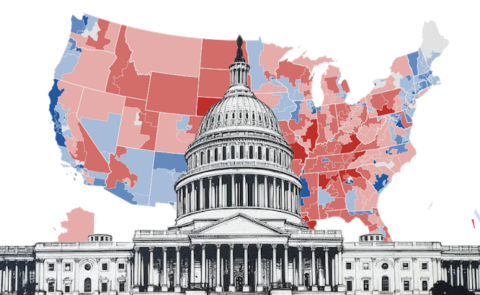
The remarkable result of the recent midterm elections was a ‘bluenami’ that witnessed the Democratic Party’s sweeping victory in the House and the Senate.[1] It stunned the world, but for India especially, this could provide some much-needed tariff relief, as the U.S. is one of the most consequential partners for India. The Democratic victory is not a guaranteed triumph for them in the upcoming 2028 U.S. Presidential elections. New Delhi should use the two years starting now to relook at its engagement with Washington and widen and deepen its relationships with America’s diverse political class amid a sudden re-emergence of the progressive forces.
With the Democrats now firmly in control of both the House of Representatives and the Senate, there is renewed optimism within diplomatic and strategic circles in India that New Delhi may soon see a resolution to the persistent threats surrounding tariffs. The shift in congressional power could pave the way for a more accelerated and advantageous Bilateral Trade Agreement (BTA) between the U.S. and India, fostering stronger economic ties between two countries that have long considered themselves to be “natural allies”. An easing of tensions related to the Iran conflict holds the potential to alleviate the energy crisis and ongoing supply chain disruptions, bringing relief to businesses and consumers alike, even as the recurring threat of deep and detrimental economic sanctions on Russia will give New Delhi some strategic breathing space.
However, while a Democratic win in the midterms – one of the worst midterm upsets for a sitting President since 1974 – may have tied U.S. President Donald Trump’s hands internally, externally he will continue to wield power with considerable authority; he is still the President.
Prime Minister Narendra Modi will likely meet Trump during the East Asia Summit scheduled in Manila, Philippines, from November 16 to 18 and then again at the G20 Summit in Miami, Florida, on December 14 to 15, 2026. This is perhaps India’s last opportunity to get the trade deal signed on reasonable terms after New Delhi faced an onslaught in terms of tariff whip and sanctions threat. The trade deal, if signed, will be the first of its kind between India and the U.S. and will give New Delhi an economic edge in such turbulent times and also provide some strategic heft.
For New Delhi, it is essential to approach the relationship with Washington with a nuanced, two-pronged strategy that reflects the evolving political landscape in the U.S. First, India must actively and more strategically broaden its engagement with the diverse political spectrum emerging in the U.S. Historically, India has leaned on its traditional bipartisan support from both major political parties. However, this approach is increasingly outdated, with the political climate in the U.S. becoming much more polarised, and support from either party is not guaranteed. Therefore, India must build relationships across the aisle, fostering dialogues with not just established figures but also emerging political leaders such as the newly elected senators like Abdul El-Sayed – the first Muslim senator – from Michigan, Peggy Flanagan – the first Native American woman senator – from Minnesota, James Talarico – the first Democrat to win a Texas Senate seat in nearly 40 years – and Annie Andrews – South Carolina’s first elected female Democratic senator – among others. One way to achieve this for Indian diplomats in the U.S. – and Indian scholars and academics – is to make a focused effort to understand the U.S. states and their players, and especially the new and emerging political class across the key winning states. The U.S. is not a centralised monolith but a successful federation of powerful states.
India’s engagement from now on must also understand and address the interests and concerns of different political factions and underlying groups that drive them, ensuring that New Delhi’s voice and perspectives are included in the discussions that shape U.S. policy towards India.
Second, no matter what the Democrats in D.C. say, a President of the U.S. is never a lame duck. U.S. Presidents typically wield significant power until the very last moment of their presidency. Thus, India must remain vigilant and proactive, continuing to maintain strong ties with the White House, regardless of which party is in power. For India, the overarching aim is to navigate the U.S. relationship effectively, capitalising on the executive branch’s ability to dictate key policy directions like the imposition of trade tariffs and sanctions.[2] By understanding the political currents in Washington, where both the Senate and the House of Representatives will soon be firmly under Democratic control, and responding with flexibility and insight, India can position itself as a crucial and long-term partner for the U.S., one that contributes meaningfully to shared global challenges while advancing its own national interests.
An imminent challenge is the appointment of Stephen Miller as the White House Chief of Staff. Miller had taken a tough stance on India in his former role as White House Deputy Chief of Staff, particularly on New Delhi purchasing Russian oil.
Neither India nor China figured in the midterms at all. What figured were Russia, Ukraine, Israel and Iran because they have direct economic repercussions on the U.S.’ domestic economy. The Iran war reached America’s gas stations and kitchens; hence, the defeat of the Republicans became inevitable.
A Stimson Centre report on the U.S. midterms rout said that “New Delhi craves the restoration of what had been a U.S. consensus favouring partnership with a rising India as a core pillar in a global geopolitical strategy to balance China. This election cannot deliver full confidence on that score, but it will give India’s leaders new reasons to take a “wait and see” approach over the next two years rather than altogether losing their patience with Washington.”[3]
On the optimistic side, the potential benefits for India from the midterm upset could be considerable. A change in leadership may lead to an end to the Iran conflict, ease energy prices and, with the intensifying competition with China following the Nvidia-Jensen Huang matter, perhaps reposition India as a counterbalance to China’s growing influence. A more flexible U.S. stance toward Moscow could ease tensions in India’s diplomatic relationships.
The 120th United States Congress will convene on January 3, 2027, at noon, providing India a two-month strategic window to work on enhancing new ties with the U.S. While a Democratic victory will not reverse Trump’s foreign policy moves, the ease with which he took decisions regarding America’s long-time allies and partners, including India, might see a slowdown as Congress will surely challenge those decisions. The immediate task for India for the remaining two years of the Trump presidency is to get the BTA signed while, in the long term, deepening its familiarity and engagement with Congress. From this moment, New Delhi will have to abandon its long-time strategy of playing defensively and position itself as proactive – because Trump has forever changed the way the U.S. deals with India.
Nayanima Basu is the Adjunct Fellow at Gateway House and an author.
This article was exclusively written for Gateway House: Indian Council on Global Relations. You can read more exclusive content here.
For permission to republish, please contact outreach@gatewayhouse.in.
Support our work here.
© Copyright 2026 Gateway House: Indian Council on Global Relations. All rights reserved. Any unauthorised copying or reproduction is strictly prohibited.
References
[1] U.S. Vote Foundation. ‘What Are Midterm General Elections?’ Accessed 12 November 2026. https://www.usvotefoundation.org/what-are-midterm-elections.
[2] ‘The Executive Branch’. The White House, n.d. Accessed 12 November 2026. https://www.whitehouse.gov/government/executive-branch/.
[3] Matamis, Joaquin. ‘Experts React: The Midterms and America’s Place in the World • Stimson Center’. Stimson Center, 4 November 2026. https://www.stimson.org/2026/experts-react-the-midterms-and-americas-place-in-the-world/.