

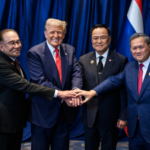
Nine months after assuming the American presidency for the second time, Donald Trump embarked on a five-day trip to Asia, arriving in Kuala Lumpur on October 26. He covered three countries—Malaysia, Japan, and South Korea. His advisers arranged a schedule packed with participation in several international conferences and interactions with multiple leaders, including President Xi Jinping of China.
Trump shifting his gaze from the Ukraine and Gaza conflicts to Southeast and East Asia was especially welcome, as foreign policy experts hoped that the plethora of meetings held during the swing through Asia might encourage the administration to finalise and announce its China policy and Indo-Pacific strategy.
The Trump voyage took place in the broader background of his success in brokering a peace agreement between Israel and Hamas, although scepticism prevails about whether it would actually lead to a lasting resolution of the real issues facing West Asia. Peace, however, continued to elude him in Ukraine. Asia, therefore, provided a welcome escape and an opportunity to assert U.S. leadership and obtain a direct feel of how his trade-oriented diplomacy was winning grudging acceptance.
Ever a deal-maker, Trump agreed to visit Malaysia as a condition: let the U.S. and Malaysia first work together to mediate and resolve the Thailand-Cambodia conflict on a host of border-related issues. The ceasefire agreement was secured in July. Consequently, Malaysian Prime Minister Anwar Ibrahim obtained Trump’s assurance of the visit, which was a certain guarantee for the global coverage of the 47th Asean Summit and other related summits.
The territorial conflict between Cambodia and Thailand dates to 1954. While border clashes have ceased, a durable political resolution remains elusive. Historic differences over the border remain unresolved. The responsibility to steer the dispute to a regional resolution will now pass on from the present ASEAN chair, Malaysia, to the next chair, the Philippines, but these are finer points.
What mattered to Washington was that the fighting had stopped due to its active endeavours, enabling the president to claim that he had stopped “eight wars in eight months”. At the signing ceremony for the Kuala Lumpur Peace Accords, Trump grandly declared that it was “a momentous day for Southeast Asia, a monumental step”.
The U.S. also announced new trade agreements with four ASEAN countries—Malaysia, Thailand, Cambodia, and Vietnam. A uniform tariff rate of 19 per cent would be maintained on most exports from the first three countries, whereas a 20 per cent tariff would be retained on Vietnam’s exports to the U.S. In a broad political signal, Trump stated, “Our message to the nations of Southeast Asia is that the United States is with you 100 per cent, and we intend to be a strong partner for many generations.”
Speaking realistically about ASEAN, Malaysian Foreign Minister Mohamed Hasan noted that the grouping stands at a crossroads, given that the international landscape is dominated by contestation rather than consensus. “Our space for neutrality and centrality is narrowing,” he stressed, “particularly in areas such as trade, technology, and regional security arrangements.” In this backdrop, the U.S. signed a joint vision statement on how to make both sides “safer, stronger, and more prosperous” through “uninterrupted, continued cooperation”.
A meeting that evoked considerable international interest was between Trump and Brazilian President Luiz Inácio Lula da Silva, who was in Kuala Lumpur as the guest of the chair and host, Malaysia. Irritated by the Brazilian government’s cases against the previous president, Bolsonaro, the Trump administration had raised tariffs on Brazilian exports from 10 per cent to 50 per cent in August. Following the meeting, the two sides agreed to begin their negotiations immediately. Lula described the meeting as positive, adding that there was “no reason for conflict”.
Even as the U.S. president was wrapping up his stay in Kuala Lumpur, U.S. officials began to project that the U.S.-China trade agreement was drawing near, in a bid to enhance the prospects of the success of the Xi Jinping-Trump meeting on 30 October. This revealed Washington’s perception that the most important meeting of the entire trip would be with the Chinese leader.
On Day 2 (November 1), Trump travelled to Japan. His first call was on Emperor Naruhito before holding substantial discussions with the new Japanese PM, Sanae Takaichi. They covered security, economic ties, and other facets of the U.S.-Japan equation. She welcomed him with meticulous protocol blended with much warmth. He was full of praise for her, assuring Japan that he would be there for “anything you want”.
The leaders signed an agreement on rare earths and an agreement heralding “a new golden age of U.S.-Japan relations”. This covered the previous U.S. decision to reduce tariffs on Japanese exports to 15 percent and Japan’s stance to invest $550 billion in the U.S.
The defence dimension was highlighted with some fanfare through the joint visit by the two leaders to the USS George Washington, a U.S. aircraft carrier, with thousands of U.S. troops greeting them. PM Takaichi is set to increase defence spending to 2 per cent of GDP, ahead of the previously announced schedule, a move that was certain to please the U.S. president. Leaving nothing to chance, the Japanese side also announced that it would nominate Trump for the Nobel Peace Prize.
Reaching Gyeongju on October 29, Trump’s agenda was full—participation in the Asia-Pacific Economic Cooperation (Apec) summit, bilateral discussions with South Korean President Lee Jae Myung, and the much-anticipated meeting with the Chinese President on October 30.
However, the last item garnered most media attention, with a commentator describing the Trump-Xi meeting as “arguably the most significant one hour and twenty minutes” of the entire Asia trip. The contrast in portrayal of the summit was stark: the Chinese side was measured, calling it “a good start”, whereas Trump asserted that it was an amazing meeting, rating it as ‘12 out of 10’.
Its main outcomes: China would suspend export control measures on rare earths for a year and buy “tremendous amounts of soybeans and other farm products”, while the U.S. would drop a part of the tariffs imposed on Chinese exports. A U.S. business leader called it “a truce”. More significantly, Trump’s visit to China in 2026 was confirmed. By describing the summit in Busan in advance as “the G2 meeting”, Trump signalled its unique significance.
Concerning the South Korean leg of Trump’s historic “Indo-Pacific trip”, the White House claimed it secured “billions of dollars in landmark deals, including initiatives to support American jobs, further America’s energy dominance, promote American leadership in the technology domain, and build our maritime partnership”.
President Trump’s five-day foreign trip has undoubtedly yielded important results. But it will take time to assess their immediate and long-term impact. For the present, the China policy has become clearer: it will be characterised by conciliation and cooperation rather than confrontation, although consistency is not assured.
Most U.S. partners appeared willing to accept the new reality and adapt to the shifting power dynamics. How this affects the Indo-Pacific strategy of the U.S. remains to be seen. Nations such as India and Australia will need to evaluate the wide-ranging implications and then devise a suitably amended policy approach.
More clarity is expected as New Delhi accelerates its preparations for Russian President Vladimir Putin’s visit to India and as the coming weeks provide an answer to an oft-raised question: Will the India-U.S. trade agreement be signed before the end of the year?
Rajiv Bhatia is the Distinguished Fellow for Foreign Policy Studies and a former ambassador.
This article was first published in First Post.