


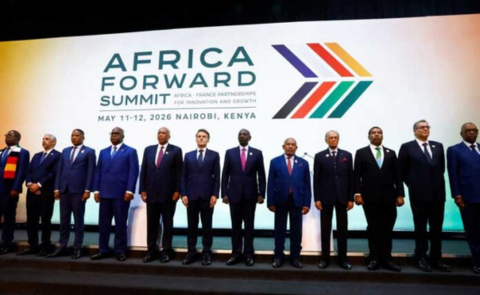
The 2026 Africa-France Summit, rebranded as “Africa Forward: Africa–France Partnerships for Innovation and Growth” and held in Nairobi on May 11–12,[i] represents one of the clearest attempts in decades to recast a historically fraught relationship. Co-hosted by Emmanuel Macron and William Ruto, the President of Kenya, the choice of Nairobi, rather than a Francophone capital, was itself a strategic statement. It signalled both a geographic and conceptual shift away from the legacy circuits of Françafrique and toward a broader, continent-wide engagement grounded in economics, technology, and new partnerships.
From the outset, the summit carried significance beyond its formal agenda. It came at a moment when France’s influence in large parts of Francophone Africa has visibly eroded, particularly in the Sahel following the withdrawal of French forces from Mali, Burkina Faso, and Niger.[ii] Against this backdrop, the Nairobi meeting was as much about repositioning France as it was about engaging Africa. For Kenya, meanwhile, the summit was an opportunity to project itself as a continental diplomatic hub and a gateway to African markets and innovation ecosystems.
Participation reflected this dual ambition. Around 30 African heads of state and government attended, along with representatives from the African Union, the European Union, international financial institutions, and private-sector leaders. This level of attendance showed that, despite African reservations, France still has an attraction, even if challenged by others.
The current Summit differed from earlier Summits in its themes. Traditional France-Africa Summits, held since 1973, have pursued geo-strategic collaboration. In the Cold War era, they exerted sustained influence over their former colonies, mainly through a strong grip on local leadership. Even in the post-Cold War period, summits such as those in Bamako (2005) or Dakar (2014) continued to emphasise counterterrorism, migration control, and military partnerships, particularly as jihadist threats expanded in the Sahel.
By contrast, the Nairobi summit focused on economic transformation.[iii] Its agenda left behind the dated schema, instead prioritising investment, energy transition, artificial intelligence, digital infrastructure, health systems, and reform of global financial institutions. Macron announced investment commitments of roughly €23 billion ($27 billion), spanning both French and African contributions.[iv] The emphasis was not on aid flows but on “bankable projects,” private capital mobilisation, and structural reform—especially of credit rating systems that African leaders argue unfairly inflate risk and borrowing costs.
This shift is significant. It reflects a broader change in African expectations: from dependency-orientated partnerships to those centred on capital access, industrialisation, and technological upgrading. In that sense, the Nairobi summit aligned more closely with contemporary African priorities and with global economic realities.
At the same time, the symbolism of location should not be underestimated. Hosting the summit in Kenya, the first non-Francophone African country to do so, was a deliberate break with a tradition of reinforcing a perception of exclusivity and hierarchy. Nairobi, by contrast, projected inclusivity and diversification. It also underscored Kenya’s own ambitions. Ruto used the platform to position his country as a convening centre for finance, diplomacy, and innovation, aligned with the opportunities presented by the African Continental Free Trade Area.
Concrete outcomes further reinforced Kenya’s role as a key beneficiary.[v] French announcements included around €1 billion in bilateral initiatives focused on development and sustainability: civilian nuclear cooperation for long-term energy security, investments in wind energy and battery storage, support for hydroelectric infrastructure and flood management, expansion of the port of Mombasa, and financing for sustainable aviation fuel production. Additional projects targeted digital connectivity, meteorological systems, agricultural resilience, and support for Kenyan export sectors such as tea.
Though it had innovative ideas, the Africa Forward Summit struggled to leap over hurdles of anxiety and mistrust.
First, the credibility gap remains substantial. The language of “partnership of equals” has featured in previous summits as well, notably in the 2017 Africa-France Summit hosted in Abidjan, but implementation has often lagged behind rhetoric. Popular sentiment in Africa is still influenced by a history of geoeconomic intervention, the basing of French troop contingents across several African countries, and economic inequality. Innovative ways will need to overcome this legacy.
Secondly, the threat of hollow diplomacy remains. Huge economic declarations and promises are often recycled without fulfillment. The Nairobi Summit sought to rectify this perception by including implementation and the role of the private entrepreneurs. Success will be measured by how many announcements will be turned into real employment-generating projects. Without such perceptible results, the summit risks becoming another overambitious adventure.[vi]
Thirdly, the strategic context needs to be acknowledged. Unlike earlier times, when France was unique in its African engagements with few rivals, now it is one among many partners. China, India, Russia, Turkey, and the Gulf states have well-established programmes and cooperative ventures across Africa. With alternative models of partnership. Hence, Africa Forward can be perceived as France rising to a new challenge in the wake of its loss of strategic space in West and Central Africa. Macron’s outreach reflects adaptation to a multipolar Africa rather than a continuation of past dominance.
Finally, the summit highlighted how sensitive the politics of perception have become. A widely noticed incident in which Macron criticised a feisty audience during a discussion with youth drew varied remarks. Some saw Macron trying to keep the session in order; others saw it as a manifestation of persistent paternalism. These isolated incidents often resonate beyond their immediate context, where historical perspectives simmer.
In its new form, the Africa Forward summit shows a transitional phase. It departs from earlier France–Africa summits in three key ways: its geographic shift beyond Francophone Africa, its economic and technological focus, and its explicit, at least rhetorical, acknowledgement of African agency. At the same time, it remains constrained by structural legacies, credibility challenges, and intensifying global competition.[vii]
Its long-term significance will depend less on its declarations and more on its outcomes. If France can genuinely recalibrate its role from dominant partner to one among many, and if promised investments materialise in ways that benefit African economies and societies, Nairobi may mark the beginning of a more balanced and pragmatic relationship. If not, it will be remembered as another well-branded summit whose aspirations outpaced its delivery.
Gurjit Singh is a former Indian Ambassador to Germany and author of The Durian Flavour: India, ASEAN and the Act East Policy. He is currently promoting the impact investment movement for implementing SDGs in Africa.
This article was exclusively written for Gateway House: Indian Council on Global Relations. You can read more exclusive content here.
Support our work here.
For permission to republish, please contact outreach@gatewayhouse.in
©Copyright 2026 Gateway House: Indian Council on Global Relations. All rights reserved. Any unauthorised copying or reproduction is strictly prohibited.
References:
[i] Élysée Palace. “Africa Forward: Africa-France Partnerships for Innovation and Growth Summit.” May 6, 2026. https://www.elysee.fr/en/emmanuel-macron/2026/05/06/africa-forward-africa-france-partnerships-for-innovation-and-growth-summit
[ii] Modern Diplomacy. “Macron and Ruto Strengthen Ties at Nairobi Africa-France Summit.” May 11, 2026. https://moderndiplomacy.eu/2026/05/11/nairobi-africa-france-summit-reflects-strategic-convergence-between-macron-and-ruto-amid-shifting-global-alliances/
[iii] Agence Française de Développement. “Africa Forward: Key Takeaways from the Nairobi Summit.” May 13, 2026. https://www.afd.fr/en/news/africa-forward-key-takeaways-nairobi-summit
[iv] Africa Forward Summit. https://africaforwardsummit.go.ke/
[v] African Business. “Africa Forward Summit Will Be Judged by What It Delivers.” May 6, 2026.
https://african.business/2026/05/trade-investment/africa-forward-summit-will-be-judged-by-what-it-delivers
[vi] Ibid (ref no 3)