

Five years after the February 2021 military coup and eight weeks after the general elections were held, Myanmar is getting ready, once again, to transition from military rule to a ‘hybrid democracy’ stipulated in the 2008 Constitution. A civilian government, which shares powers with the Tatmadaw or the Armed Forces, will be formed in April, with a new president and a vice president elected in the coming days. The new Parliament has already been convened.
This is a re-enactment of the political landscape of March 2011, following the 2010 elections, except that hope prevailed then, whereas scepticism and despair now rule in many quarters. Myanmar analysts view it as less of a transition to democracy and more of a transition from “a military-clad dictatorship to a civilian-clothed one.”[i]
The new leadership is facing multiple crises. First, the West Asia conflict has risked dramatically deepening Myanmar’s problems and obscuring it from the international view. The UN special rapporteur on human rights points out that humanitarian aid for over 3.5 million people displaced due to the Myanmar civil war is likely to dwindle further as international organisations shift their focus and resources to West Asia.[ii]
Second, even after the elections, armed clashes between the military and the resistance have not ceased. They continue with varying intensity and frequency across several parts of the country, including the Kachin, Shan, Chin, Karen, and Rakhine states. Aerial strikes by the Tatmadaw and attacks by select Ethnic Armed Organizations (EAOs) on government troops, with civilian casualties being a regular feature, have continued unabated.
Yet, there is little doubt that the military situation has turned in favour of the government. The Tatmadaw has come a long way since October 2023, when the Operation 1027 of the Three Brotherhood Alliance, composed of Ta’ang, Kokang, and Rakhine EAOs, inflicted a series of humiliating defeats on government troops in the northern Shan State. Through a mix of retreat, reinforcement, and securing China’s crucial support, Naypyidaw eventually gained ground to the extent that two years later, it succeeded in holding elections in 80% of the country’s townships in a peaceful environment.
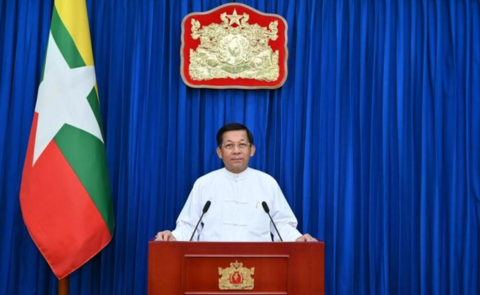
Now, military strategists are busy re-arranging the political chessboard. Speakers for the two houses of Parliament have been selected from among the top army or police personnel. The trusted colleagues of Commander-in-Chief Min Aung Hlaing staff the senior-most positions of the Tatmadaw. The only uncertainty is about him. The option of his retirement, which was touted before the elections, is off the table. He aspires to be the next president, while retaining effective control of the Tatmadaw. Moves are afoot to get him elected president and to enable him to serve as chair of the newly created Union Consultative Council, which will oversee all state functions. With him at the apex of the new power architecture, political opposition and many EAOs are unlikely to participate in any national dialogue the government may try to convene. Thus, Myanmar may well have to live with a continued and costly stalemate.
The international situation, too, favours the military government. Apart from China, Russia, Belarus, Kazakhstan, the Indo-China region (Vietnam, Laos, and Cambodia), and Thailand are all inclined toward this status. ASEAN, saddled with its failed Five Point Consensus formula, may still take more time to craft a fresh basis for dealing with the new military-civilian government. The UN, the U.S., and the EU remain opposed to the emerging political configuration, but they are far too distracted elsewhere to pay much attention to Myanmar. Yet, some in Washington have begun advocating a ‘calibrated engagement’ with the military to counter China’s mounting influence. The lifting of long-standing sanctions on Myanmar will help establish goodwill.
India’s traditional ‘two-track’ policy of cultivating cooperation with the military government and extending political and moral support for the cause of democracy has delivered largely satisfactory results. However, now in the fast-changing context, the time has come to factor in recent developments that necessitate a more nuanced policy. For instance, New Delhi should engage with the new civilian government as early as possible.
Three key challenges are relevant here.
One, China’s footprint has expanded considerably since the coup. Beijing’s triple role – as a reliable partner of several EAOs, a friend of the military, and a mediator between the two sides – has been markedly successful. In contrast, India wisely avoids getting involved in internal conflicts. But it is constrained by indefinite delays in completing its mega projects, such as the Trilateral Highway and Kaladan multi-modal transport projects, due to the unstable security situation. Bilateral trade has increased, but few new development projects have been announced. The completion of some projects will demonstrate good intent and ease the lives of ordinary people.
Two, the military’s loss of control over large parts of the western region bordering India has motivated New Delhi to adopt a policy of ‘benign engagement’ with the EAOs that control this region. However, there is a vast gap between the expectations of one side and the capabilities of the other. Hence, the effectiveness of this policy needs to be re-examined if India is to see visible benefits and see some of its initiatives move ahead.
Three, new challenges have appeared in the Northeast. These are a significant increase in drug trafficking; expansion of cybercrimes along the Myanmar-Thailand border with the involvement of a large number of Indian IT professionals; illegal inflow of arms into India; and, as the recent case of a U.S. citizen and six Ukrainians apprehended by the National Investigation Agency (NIA) shows, the growing involvement of external forces that help Indian Insurgent Groups (IIGs) operating from Myanmar. Speaking recently in Delhi at a conference at the United Service Institution of India (USI), a senior Army official asserted that India’s handling of insurgencies in its own border areas, its work on healing ethnic tensions, and its efforts to reduce external influences have improved the situation today. But other experts point out that it grows ever murkier with shades of grey dominating the entire security and strategic landscape in the Northeast.
Another dimension is the government’s attempt to improve border management through ‘hybrid fencing’ along the entire 1,643-kilometer-long border with Myanmar and by suspending the Free Movement Regime. The Indian establishment is fully committed to them, whereas at the people’s level in a few Northeastern states, discontent prevails. A delegation of experts from the Ministry of External Affairs visited the area in mid-March 2026 to gather perceptions of government policy and returned with valuable inputs about ground realities.
Indian policymakers must closely monitor how Myanmar’s second shot at limited democracy evolves, given the wide gap between the government and the opposition. They should also ensure that India-Myanmar border management promotes better relations with Myanmar and a more effective security and social environment in the Northeast.
In the end, however, the Southeast Asian nation’s political transition will be shaped by its own leaders, elites, and the people themselves. Their internal dynamics will determine the exact blend of hope and despair for Myanmar’s future.
Rajiv Bhatia is the Distinguished Fellow for Foreign Policy Studies and a former ambassador.
This article was exclusively written for Gateway House: Indian Council on Global Relations. You can read more exclusive content here.
For permission to republish, please contact outreach@gatewayhouse.in.
Support our work here.
©Copyright 2026 Gateway House: Indian Council on Global Relations. All rights reserved. Any unauthorised copying or reproduction is strictly prohibited.
References:
[i] ‘Myanmar Parliament says to start process to select new president on March 30’, The Straits Times, 20 March 2026, The quotation is attributed to independent analyst Htin Kyaw Aye. https://www.straitstimes.com/asia/se-asia/myanmar-parliament-says-to-start-process-to-select-new-president-on-march-30
[ii] ‘Mideast war risks dramatically deepening Myanmar crisis: UN expert’, Mizzima, 13 March 2026, The quotation is attributed to Tom Andrews. https://eng.mizzima.com/2026/03/13/32130