

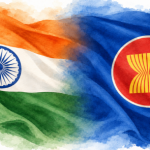

Prime Minister Narendra Modi’s expected participation in the ASEAN and East Asia Summits in Manila in November will provide an opportunity to take stock of a relationship that has acquired fresh momentum in 2026. Despite delays in reviewing the ASEAN–India Trade in Goods Agreement (AITIGA), an unsettled global economy, and intensifying strategic competition in the Indo-Pacific, India and ASEAN have continued to broaden their cooperation. The 2026 declaration of ASEAN-India as the Year of Maritime Cooperation[1] has given this engagement a distinctive focus: translating a longstanding geographical relationship into practical cooperation in security, connectivity, commerce, and the blue economy.
The year’s significance lies less in any single breakthrough than in the widening range of shared interests. India’s Act East Policy increasingly intersects with ASEAN’s own concerns about maritime security, supply-chain resilience, digital transformation and strategic autonomy. The Comprehensive Strategic Partnership established in 2022[2] provides the institutional framework, while the Plan of Action for 2026–2030 offers a basis for sustained engagement. As geopolitical alignments shift, both sides have reasons to strengthen a partnership that does not require agreement on every international issue. Five ASEAN leaders attended the BRICS summit in New Delhi, including Philippines’ President Marcos, an invited guest as Chair of ASEAN.[3]
Maritime cooperation has been the most visible expression of this renewed engagement. The second ASEAN-India Maritime Exercise, held in the Philippines in September-October 2026,[4] brought Indian naval ships Sahyadri and Kulish together with maritime forces from ASEAN member states. Conducted under the theme ‘Anchored in Trust, United at Sea’, the exercise included operational coordination, humanitarian assistance and disaster-relief drills, and visit, board, search and seizure procedures. Building on the inaugural exercise in 2023, it demonstrated that maritime cooperation is moving beyond declarations toward greater familiarity and interoperability among participating forces. The exercise was particularly appropriate in the Philippines, where maritime security and the interpretation of international maritime law remain central strategic concerns.
The next challenge is to extend such cooperation beyond exercises. Information-sharing, maritime domain awareness, preventing illegal fishing and trafficking, search and rescue, and humanitarian assistance after natural disasters offer practical avenues for progress. India’s Information Fusion Centre – Indian Ocean Region (IFC-IOR) in Gurugram can contribute by facilitating the exchange of maritime information with partner countries. The broader objective should be to build a more connected maritime-security architecture spanning the eastern Indian Ocean and the approaches to the Malacca Strait, while remaining complementary to ASEAN-led institutions and respectful of national sensitivities. Now six ASEAN countries are associated with the IFC, with four having resident liaison officers.[5]
Connectivity is the second important dimension. The sea lanes linking India’s eastern coast with Singapore, Malaysia, Thailand, and Indonesia carry commercial traffic and the digital infrastructure on which modern economies depend. Submarine cables are therefore as strategically important as shipping routes. The Malaysia-India-Singapore Transit (MIST) cable, which was activated in 2025, connects India with Southeast Asian network hubs and provides additional high-capacity data routes.[6] In June 2026, Tata Communications announced a $152 million investment in system capacity, securing a 20-terabit-per-second connection between Mumbai and Singapore.[7] The I2C (India-Southeast Asia) Subsea Cable System is a 3,600-kilometre undersea cable project led by a consortium including Lightstorm that will link India’s east coast to Southeast Asia by 2029. Its landing points will be South Chennai and Machilipatnam, Singapore and Morib in Malaysia.[8]
Such investments strengthen the resilience of digital communications and support growing demand from cloud computing, data centres and artificial intelligence. They also underscore the need to protect critical undersea infrastructure.
Physical maritime connectivity deserves comparable attention. India’s Andaman and Nicobar Islands sit strategically close to Southeast Asia, while eastern-coast ports provide natural gateways to regional markets. Better shipping services, port cooperation, and logistics integration could reduce business costs and make it easier for smaller Indian and Southeast Asian enterprises to participate in regional value chains.
Economic relations nevertheless remain the partnership’s principal test. Bilateral trade reached approximately $128 billion in 2025–26, and Indian exports in the first five months of 2026 rose by 56% to $23 billion, making ASEAN one of India’s most important trading partners.[9] Yet the existing AITIGA framework has not delivered all the benefits expected from a free-trade arrangement. Concerns over market access, rules of origin, non-tariff barriers and the distribution of gains have complicated negotiations. The fifteenth meeting of the AITIGA Joint Committee, held in Jakarta from 6-9 October, called for expediting outstanding issues. The review remains unfinished, but the continued negotiations demonstrate that both sides recognise the importance of modernising the agreement. Hopes of its being concluded by 2027 are high.
A successful review must do more than revise tariff schedules. It should make the agreement easier to use, improve customs procedures and address barriers that prevent Indian firms from accessing ASEAN markets. Equally, India must recognise that Southeast Asian economies are deeply integrated into global manufacturing networks. A more predictable trade regime would encourage investment, strengthen supply-chain diversification and help both sides benefit from the restructuring of global production. Singapore’s role as a major source of foreign investment in India illustrates the potential, while Indian businesses have opportunities in renewable energy, automobiles, digital services and infrastructure across Southeast Asia. These opportunities require project-specific evidence and cannot be measured simply by investment announcements. AI, data centers, consolidation of green power resources, and a look at the ASEAN power grid are on the cards.
Digital cooperation offers another promising area. Project Nexus,[10] moving toward implementation, aims to connect national instant-payment systems so cross-border payments can become faster, cheaper, and more accessible. The Reserve Bank of India and the central banks of Malaysia, the Philippines, Singapore and Thailand are participants; Indonesia formally joined the initiative in February 2026. This is not yet equal to a fully operational network linking every participating country’s payment system, but it represents an important step towards practical financial connectivity. For tourists, students, migrant workers and small businesses, the eventual benefits could be tangible.
Tourism, education and people-to-people contacts provide a complementary foundation. Visa facilitation, more direct flights and better links between Buddhist pilgrimage destinations in India and Southeast Asia can expand travel in both directions. Vietnam’s Sun Phu Quoc Airways, for instance, has announced direct Ahmedabad-Phu Quoc services beginning in December 2026, illustrating the potential for new connections beyond established metropolitan routes. Malaysia set an ambitious target of 2.1 million Indian tourist arrivals for 2026 (up from over 1.6 million), supported by more than 190 weekly direct flights;[11] Thailand ranked India among its top five international source markets, with over 382,000 Indian visitors in early 2026 alone. The Philippines saw direct flights between Delhi and Manila from October 2026.
Cooperation in higher education, research, skills, and technology should be treated as a long-term investment in the relationship, not a peripheral cultural activity. The results of the IIT fellowship, the agricultural fellowships and the India-ASEAN network of universities remain opportunities. Nalanda University has attracted nearly 300 ASEAN students.[12]
The Manila summits should therefore be judged by whether they give this broad agenda sharper direction. India and ASEAN need to sustain maritime cooperation, improve the reliability of transport and digital links, strengthen educational exchanges and bring the AITIGA review to a mutually beneficial conclusion. Neither side can insulate itself from great-power rivalry, trade fragmentation or regional conflict. Both can, however, increase their room for manoeuvre through practical cooperation and stronger regional institutions. It’s more important to enhance the partnership through non-government sources and more sustained people-to-people and civil society engagement.
The promise of 2026 is that India-ASEAN relations are becoming more multidimensional. Maritime cooperation supplies the organising theme, but its real value will be measured in safer seas, more resilient connections, easier trade and closer links between people. If Manila turns the year’s activities into durable commitments, Act East will have gained not merely another diplomatic milestone but a stronger regional foundation.
Gurjit Singh is a former Indian Ambassador to Germany and author of The Durian Flavour: India, ASEAN and the Act East Policy. He is currently promoting the impact investment movement for implementing SDGs in Africa.
This article was exclusively written for Gateway House: Indian Council on Global Relations. You can read more exclusive content here.
Support our work here.
For permission to republish, please contact outreach@gatewayhouse.in
© Copyright 2026 Gateway House: Indian Council on Global Relations. All rights reserved. Any unauthorised copying or reproduction is strictly prohibited.
References:
[1] Prime Minister’s participation in the 22nd ASEAN-India Summit in Kuala Lumpur , PMO, 26 October 2025, https://www.pib.gov.in/PressReleasePage.aspx?PRID=2182724®=3&lang=2
[2] Joint Statement on ASEAN-India Comprehensive Strategic Partnership, MEA, 12 November, 2022, https://www.mea.gov.in/bilateral-documents?dtl/35876/Joint_Statement_on_ASEANIndia_Comprehensive_Strategic_Partnership
[3] Gurjit Singh: Expanding the Diplomatic Toolbox: Southeast Asia at the New Delhi BRICS Summit, Fulcrum, 21 October 2026, https://fulcrum.sg/article/commentaries/expanding-the-diplomatic-toolbox-southeast-asia-at-the-new-delhi-brics-summit/
[4] ASEAN-INDIA MARITIME EXERCISE (AIME-2026) COMMENCES IN SUBIC BAY, PHILIPPINES, PIB, 30 September 2026, https://www.pib.gov.in/PressReleaseDetail.aspx?PRID=2317206®=48&lang=1
[5] IFC-IOR, Indian Navy, https://ifcior.indiannavy.gov.in/home#partners
[6] NTT DATA commissions MIST submarine cable system to link India and Southeast Asia, w.media, 17 March 2025, https://w.media/ntt-data-commissions-mist-submarine-cable-system-to-link-india-and-southeast-asia/
[7] Tata Communications To Invest $152 Million In Subsea Cable Systems To Boost India-Singapore AI Corridor, Submarine Cable Networks, I July 2026, https://www.submarinenetworks.com/en/nv/insights/tata-communications-to-invest-usd-152-million-in-subsea-cable-systems
[8] I-2SEA, Submarine Cable Networks, https://www.submarinenetworks.com/en/systems/intra-asia/i-2sea
[9] Indian exports in the first 5 Months of 2026 rose by 56% to $23 billion making ASEAN one of India’s most important trading partners, ET, 18 October 2026, https://economictimes.indiatimes.com/news/economy/foreign-trade/indias-exports-surge-africa-and-asean-drive-growth-in-key-markets/articleshow/135030347.cms?from=mdr
[10] Project Nexus, BIS, https://www.bis.org/project/nexus
[11] Malaysia Retains 2.1 Million India Visitor Target, Expands Focus on Sports and Niche Tourism, Travel News Digest, 26 August 2026, https://travelnewsdigest.in/digests/malaysia-targets-21-million-indian-tourists-arrivals-pushes-for-direct-air-connectivity
[12] Remarks by Secretary (East) at Inaugural Ceremony – Centre for Southeast Asian Studies Nalanda University, Rajgir, Bihar, MEA, 31 March 2026, https://www.mea.gov.in/speeches-statements?dtl/41060/Remarks_by_Secretary_East_at_Inaugural_Ceremony_Centre_for_Southeast_Asian_Studies_Nalanda_University_Rajgir_Bihar