

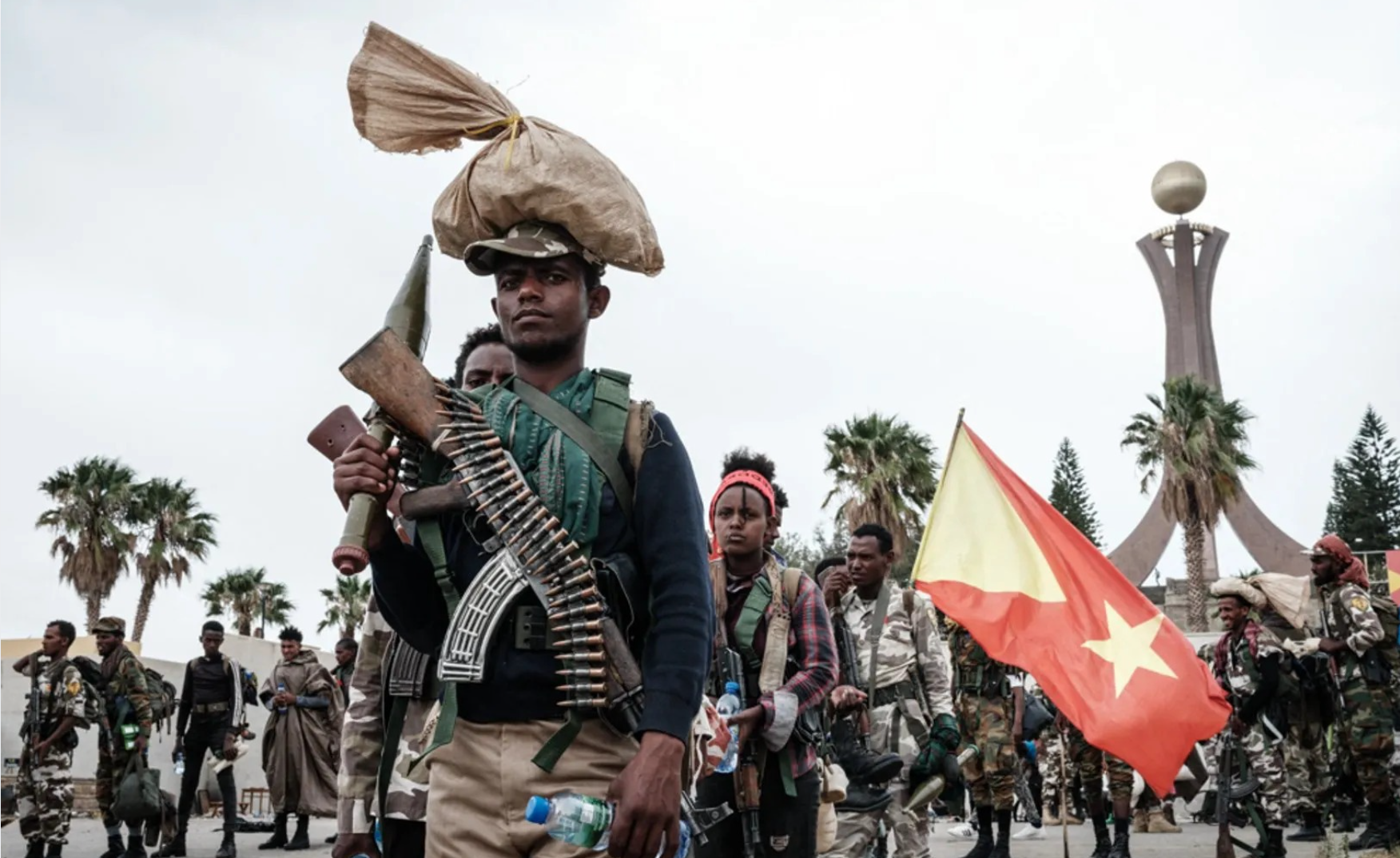
Ethiopia is in a new crisis that could possibly reorder the Horn of Africa, already fractured by several conflicts. The current catastrophe is not merely a resurgence of the civil war in Tigray. The renewed insurgency of this September has brought together seven varied ethnic militias that were often at loggerheads but which have now come together under the name Alliance for Survival with the stated aim of ousting the elected government of Prime Minister Abiy Ahmed in Addis Ababa.[1] They challenge the government’s efforts at centralisation and complain of the lack of resolution of their political, territorial and ethnic rivalries within the Ethiopian state.
The impact of this conflict, which Ethiopians describe as existential,[2] could extend well beyond Ethiopia. Sudan is already in the midst of a civil war. Somalia faces continuing insecurity and is pleading with Ethiopia not to withdraw its troops from the African Union (AU) mission. Relations between Eritrea and Addis Ababa have deteriorated, while the longstanding Egypt-Ethiopia rivalry over the waters of the Nile could take on a new dimension. All these could be affected by renewed armed conflict in Ethiopia.[3]
The domestic and international issues are interconnected knots. Unresolved issues from the 2020–22 Tigray civil war remain, despite the Pretoria Agreement,[4] which created a tenuous peace but failed to adjudicate some basic political questions. Western Tigray remains contested between Tigray and Amhara in northern Ethiopia, while displaced Tigrayans cannot return home. The Tigray People’s Liberation Front (TPLF) has abandoned its earlier posture of accommodation and is again challenging the Abiy Ahmed government by assuming control in the region’s capital of Mekelle.
Eritrea, which joined Ethiopia in fighting the TPLF during the earlier civil war, was not part of the Pretoria process and felt ignored by Addis Ababa. It is now hostile to the Ethiopian government, which fears that Eritrea is working towards the Balkanisation of Ethiopia. The TPLF, in turn, finds itself aligned, at least indirectly, with its former arch-enemy Eritrea because it believes Addis Ababa seeks to weaken or even eliminate it after the civil war.
The 2026 general elections did little to resolve these political tensions. Elections could not be held in Tigray and parts of Oromia and Amhara because of a lack of security. The TPLF had been denied party status and therefore could not contest. The Oromo Liberation Front and the Ogaden National Liberation Front, now in the Alliance for Survival, faced splits and restrictions. In Amhara, the militia that had fought alongside the government against the TPLF disrupted elections and has now joined the Alliance forces.[5]
The AU noted that voting did not take place in Tigray and parts of Amhara and Oromia, casting a shadow over the ruling Prosperity Party’s massive victory elsewhere in the country. Consequently, the election could not provide the political space that Ethiopia so urgently required. Instead, it further cemented the perception among politically mobilised groups in Tigray, Oromia and Amhara that their political voices were being militarily curtailed.[6]
These grievances are now embedded in the renewed TPLF control of Tigray and in the wider debate over Ethiopia’s system of ethno-federalism, which many of its opponents feel has run its course.
September has therefore been a significant month. The emergence of the Alliance[7]has brought together s bitter enemies despite their very different objectives, competing conceptions of nationalism and divergent ideas about Ethiopia’s future. These could make the Alliance difficult to sustain, but for now, their shared objective is to open multiple fronts and disrupt state control, including connectivity to the main port of Djibouti.[8]
The deeper problem is that unresolved political issues were pushed towards military solutions. The determination of both Addis Ababa and its opponents to seek military rather than political answers represents a failure of preventive diplomacy, despite the efforts of AU special envoy Olusegun Obasanjo and the engagement of the UN, EU, and U.S., all of which have their own competing preoccupations in this region.
The regional implications of this emerging situation are considerable. Eritrea and access to the Red Sea are the first major issues.
Although Ethiopia aligned with its old enemy, Eritrea, to suppress the TPLF between 2020 and 2022, subsequent Ethiopian statements about seeking access to the Red Sea have complicated relations with Eritrea, which believes Ethiopia has designs on its port of Assab on the Red Sea. Somalia, meanwhile, sees Ethiopian efforts to engage Somaliland for access to the port of Berbera as detrimental to its sovereignty.
Landlocked Ethiopia is dependent on Djibouti for most of its external trade, and believes that, for a country of its size and ambition, it must have its own access to the sea. Somalia and Eritrea are apprehensive about Ethiopia’s ambitions and want them curtailed if Ethiopia gains sea access at their expense.
The partnership between Abiy Ahmed and Eritrea’s President Isaias Afwerki, which followed the extraordinary rapprochement of 2018 and led to Abiy’s Nobel Peace Prize, is now in a deep cleft. Egypt has consequently developed a closer partnership with Eritrea, including around the Red Sea ports of Assab and Massawa.
This leads to the second major issue: the Nile waters. The Grand Ethiopian Renaissance Dam has severely strained Ethiopia’s relationship with Egypt and Sudan.[9] Ethiopia sees the dam primarily as a developmental project. Egypt sees the Nile as an existential issue. The unresolved GERD dispute[2], particularly over the dam’s filling and operation, has contributed to closer Egyptian-Eritrean ties and could make both more assertive in countering Ethiopia’s Red Sea ambitions.
The third uncertainty is Sudan. Ethiopia and Sudan have always had a tenuous relationship because of their porous border, and both are now increasingly enmeshed in each other’s civil wars. The Sudanese army in Khartoum believes that Ethiopia supports the Rapid Support Forces, while Ethiopia believes Sudan is helping the TPLF. Both sides use logistical networks through western Ethiopia.
The rivalries within Ethiopia could now easily acquire a Sudanese dimension. The border areas of Ethiopia, Sudan and Eritrea could transform into adjoining conflicts that begin to overrun one another.
South Sudan, comparatively less central to the immediate crisis but itself vulnerable, is again experiencing civil conflict and a surge in internally displaced people. Many refugees cross into Gambella in southern Ethiopia. Instability in Ethiopia could therefore transform Gambella from a refugee centre into a contested borderland. Gambellan rebels have not, for the moment, joined the TPLF-led alliance. The situation could widen the humanitarian consequences of the growing conflict.
Somalia remains another critical part of this strategic conundrum. It has been unable to resolve its internal problems despite the presence of an AU mission. The question of Somaliland’s independence, with support from the UAE, Taiwan and Ethiopia, among others, remains a major distraction. At the same time, Egypt has enhanced its security partnership with Somalia, even though Ethiopia has been Somalia’s principal security partner through AU missions against the jihadist group al-Shabab. The U.S. accuses al-Shabab of linking with the Houthis in Yemen, thus aggravating the Gulf crisis.
Any reduction in the Ethiopian military presence in Somalia could create additional space for al-Shabab. Somalia is therefore walking a tightrope between confronting al-Shabab and managing its difficult relationship with Ethiopia. Its president’s recent visit to Addis Ababa, followed by one to Egypt, illustrates the delicacy of that balancing act.
At the same time, Somalia sits at the intersection of a wider Red Sea rivalry involving Egypt, Turkey, the UAE and Saudi Arabia, and to some extent Qatar. The Horn of Africa is consequently beginning to look less like a collage of separate conflicts and more like an intermeshed strategic conundrum.
In this simmering conflagration, four BRICS members are involved. Ethiopia is a direct participant; Egypt, the UAE, and Saudi Arabia are indirect but influential participants.[10]
The humanitarian consequences of a renewed Ethiopian civil war are particularly frightening. Ethiopia is home to more than 130 million people, with about 4.2 million internally displaced people and more than 800,000 refugees and asylum seekers. UNICEF has warned that further conflict and displacement could greatly increase disease and destruction, particularly affecting women and children. An estimated 6.3 million children would require humanitarian assistance in 2026.
The last Tigray war had devastating consequences. Estimates that around 600,000 people perished include those who died from famine, disease, and the lack of health services, as well as those killed directly in the conflict. Sexual violence against women and the displacement of children created additional humanitarian crises. These problems have not disappeared with the Pretoria Agreement. Gender-based violence and malnutrition remain serious problems in conflict-affected areas.
A renewed war could therefore multiply this tragedy, not only within Ethiopia but across the region. The UN Secretary-General has cautioned that the Tigray crisis could lead to an even more devastating humanitarian crisis across the Horn.
Saudi Arabia and the UAE are pursuing competing interests in the Red Sea.[11] Saudi Arabia is working with the Khartoum government and supports Eritrea, while the UAE has sought access and influence through different Red Sea and Horn partners, including Somaliland. Egypt is also playing a role, essentially seeking to counter Ethiopian influence in Somalia, Eritrea, and elsewhere.
These alliances are fluid and often shift with the crisis and the geography involved. That makes the present situation particularly difficult to fathom.
The larger point is clear. Ethiopia’s internal conflict can no longer be viewed in isolation.[12] The country sits at the intersection of the Red Sea, the Nile, Sudan, South Sudan and Somalia, while Gulf powers and other external actors pursue their own strategic interests. What begins as an internal Ethiopian struggle could therefore become a regional conflict system. The Horn of Africa may be approaching a point where its discrete crises cease to be so.
Gurjit Singh is a former Indian Ambassador to Germany and author of The Durian Flavour: India, ASEAN and the Act East Policy. He is currently promoting the impact investment movement for implementing SDGs in Africa.
This article was exclusively written for Gateway House: Indian Council on Global Relations. You can read more exclusive content here.
Support our work here.
For permission to republish, please contact outreach@gatewayhouse.in
© Copyright 2026 Gateway House: Indian Council on Global Relations. All rights reserved. Any unauthorised copying or reproduction is strictly prohibited.
References:
[1] “Seven Ethiopian armed groups formally announce formation of a coalition,” Addis Standard, 20 September 2026, https://addisstandard.com/seven-ethiopian-armed-groups-formally-announce-formation-of-a-coalition/.
[2] Andrea Korybko, “Top Ethiopian Officials Confirmed the Existential Stakes of Their Country’s Latest Conflict,” The AltWorld, 29 September 2026. https://thealtworld.com/andrew_korybko/top-ethiopian-officials-confirmed-the-existential-stakes-of-their-countrys-latest-conflict.
[3] “Ethiopia’s army promises restraint amid fears of new civil war,” Hiiraan Online, 27 September 2026. https://www.hiiraan.com/world4/2026/Sep/206370/ethiopias_army_promises_restraint_amid_fears_of_new_civil_war.aspx.
[4] “Cessation of Hostilities Agreement between the Government of the Federal Democratic Republic of Ethiopia and the Tigray Peoples’ Liberation Front (TPLF), “African Union, 2 November 2022. https://www.peaceau.org/en/article/cessation-of-hostilities-agreement-between-the-government-of-the-federal-democratic-republic-of-ethiopia-and-the-tigray-peoples-liberation-front-tplf.
[5] Tigray has allied itself with six other movements that are pledged to remove Prime Minister Abiy and form a new Ethiopian government. The allies are: Amhara Fano National Movement (AFNM), Oromo Liberation Army (OLF-OLA), Tigray People’s Liberation Front (TPLF), Ogaden National Liberation Front (ONLF), Afar National Unity Revolutionary Front (Ugugumo), Benishangul People’s Liberation Movement (BPLM), Gumuz People’s Democratic Movement (GPDM)
[6] “AUC Chairperson Calls for Utmost Restraint and Immediate De-Escalation in Northern Ethiopia,” African Union, 26 September 2026. https://au.int/en/pressreleases/20260923/chairperson-calls-restraint-and-immediate-de-escalation-northern-ethiopia.
[7] The Alliance for Survival comprises seven armed militias, including the TPLF, the Amhara Fano National Movement, the Oromo Liberation Army and representatives from the Benishangul-Gumuz, Afar and Somali regions. Their stated aim is to remove the government in Addis Ababa and establish transitional arrangements for a new political consensus.
[8] “Afar Regional President: The Ongoing War in the Region Aims to Cut Ethiopia Off from the Red Sea,” Al Jazeera Arabic, 29 September 2026. https://www.youtube.com/watch?v=EcAUFi8SWX8.
[9] Gurjit Singh, “The politics of the Ethiopian dam,” Gateway House, 26 July 2021. https://www.gatewayhouse.in/the-politics-of-the-ethiopian-dam/.
[10] Gurjit Singh, “The changing face of Ethiopia,” ORF, 25 January 2024. https://www.orfonline.org/expert-speak/the-changing-face-of-ethiopia.
[11] Gurjit Singh, “Crisis in Sudan: Current trigger, old fault lines, and the human cost,” Indian Express, 7 November 2025. https://indianexpress.com/article/explained/explained-global/expert-explains-l-global-crisis-in-sudan-current-trigger-old-faultlines-and-the-human-cost-10350457/.
[12] Martin Plaut, A brief update on Ethiopia’s 2026 war, 28 September 2026. https://martinplaut.com/2026/09/28/a-brief-summary-of-ethiopias-2026-war/.