

 Introduction
Chinese civilisation is said to be 5000 years old, as per calcinations found. Archaeological and written records place the Chinese civilisation to be approximately 3500-4000 years old. Notwithstanding the debate about the origin of the Chinese civilisation, any country with such a long history will develop civilisational characteristics based on its early habitat and life, rulers and their influence, external factors such as wars fought, practices of life that traders who travelled far brought back, agricultural habits and religious influences that developed within the country and also that came from other countries. Similarly, China has developed a number of civilisational roots. Traditionally, such civilisational roots get displayed in the behaviour of people and that country’s decision-making. Further, in China’s case, they have contributed towards building nationalism.
The aim of this paper is to analyse how civilisational roots have contributed to building nationalism in China. In this paper, 12 attributes of the civilisational roots and their contribution to developing nationalism in China are discussed.
The Attributes
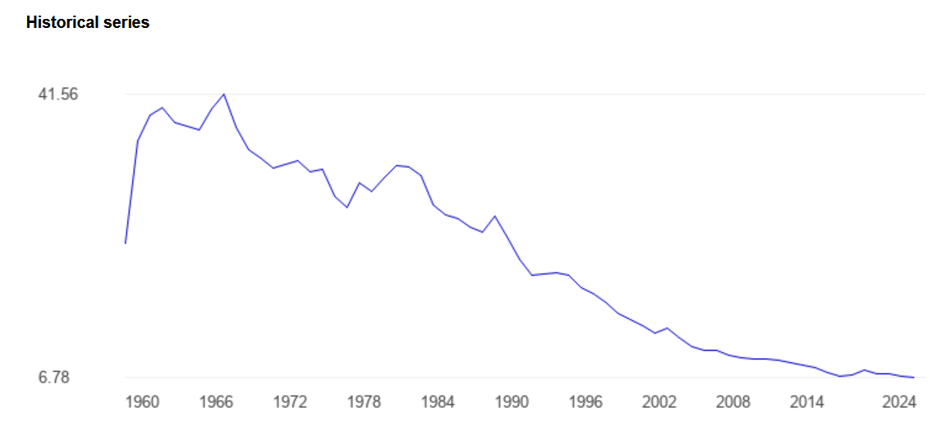
When one goes through the history of China, there are many aspects of life that one can come across that contribute towards the civilisational roots. Like all old civilisations, agriculture is the first phenomenon that comes to one’s mind. Like India, China has also been an agrarian economy till recently. In ancient times, agriculture contributed to above 60% of the country’s economy. In the 1960s, agriculture contributed to approximately 20% of China’s economy. In 1978, China embarked on a four modernisations programme, due to which it took to manufacturing in a big way, even though agriculture was part of the four modernisations. Because of that, China’s GDP grew tremendously, and hence the share of agriculture in it came down to 6.78% in 2024.
Figure 1: Share of agriculture in China’s GDP over the years
Source: The Global Economy
First, the hardworking nature of people involved in agriculture is the first civilisational root that one gets to see. Chinese, like Indians, are very hardworking, and that shows. They pride themselves on making things Chinese. One can see the result. Every market in the world has items produced in China and they feel nationalistic about it. An anecdote will substantiate this. When this author was posted in China, the domestic help who was helping in setting up the house asked him why he had brought so many shirts. The reason was that she felt that the Chinese made better shirts at a cheaper cost, and she said it with pride. The agriculture, manufacturing and the hard work that came out of it has given Chinese nationalism a strong push.
Second is trade. Chinese silk was very famous and popular, and China monopolised that commodity. Chinese traders did not travel the entire Silk Route. They did trade by establishing several trading points. This trade through the Silk Route resulted in the transfer of knowledge, technologies, and scientific innovations, such as papermaking, compasses, and gunpowder, contributing to advancements in various fields. Today, China is looking for markets everywhere, and it is willing to adapt to any nation’s market. Chinese students studying in any foreign university come back to China with the knowledge they acquired, and they would like to see their country leading in the economy and technology by making products that are world-class. The nationalistic spirit that they have imbibed is motivating them to do this.
The next phenomenon is the hereditary system of succession. In ancient times, because kingdoms dominated the territory of China, the hereditary system of succession was adopted. Later, in this paper, the fratricide that used to take place to retain power is discussed. In modern times, taizi (太子)[1], a predominant group has been holding powerful positions. During the present regime, many leaders from the other two groups[2] have been purged. However, the tussle for power between the three groups may erupt again in the next change of leadership. The princelings also have undergone hardships during the period of the Cultural Revolution. That has instilled a strong nationalism in them. They are determined to see China become a superpower in the world. This is not to say that the other two groups are any less inclined towards that goal. The historical connection of the hereditary system and princelings wanting to do well for their country due to national fervour is to be noted.
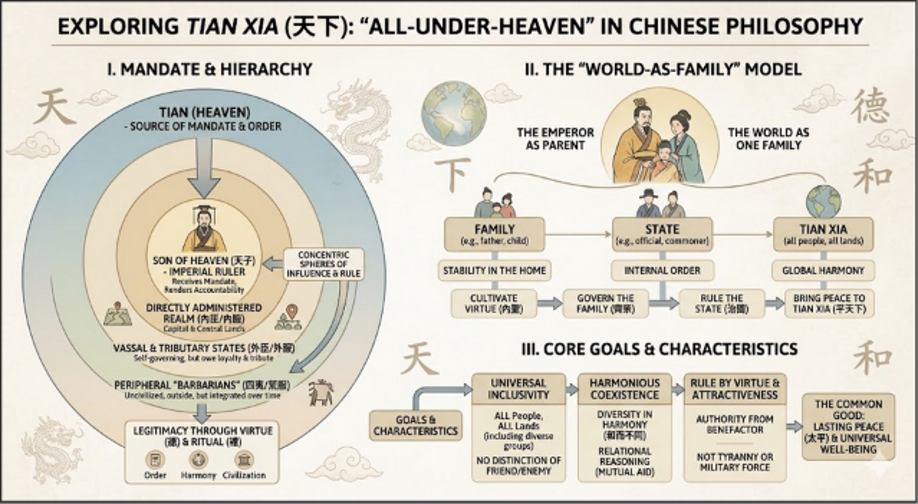
Fourth, the concept of Tian Xia (天下). This concept was crystallised during the Zhou Dynasty, which ruled China from 1046-256 BCE. Tian Xia literally means all under the heaven. The traditional concept of Tian Xia was structured around four concentric circles starting from the centre. The emperor was considered to be a descendant from heaven and occupied the centre. China’s capital and the plains in the centre of the country (中原) represented the high point of China’s culture and administration. The inner ring comprised feudal lords, tributary states and areas that accepted China’s control. Regions outside the inner ring were considered periphery (埸) dominated by barbarians. Another aspect of Tian Xia is the hierarchical model. Confucius gave the hierarchical model not only in statecraft and administration but also in the family. It comprises of five relationships namely Ruler- Citizen, Father- Son, Husband-Wife, Elder brother – Younger Brother, Friend – Friend. The first four have a superior – inferior relationship. The superior is expected to be benevolent, and the junior is expected to defer to the senior in that relationship. The same is captured in the diagram below. Zhao Tingyang, a Chinese scholar, has extended this concept to be a panacea to the world’s problems.
Figure 2: Exploring the Tian Xia in Chinese philosophy
Source: Created by the author with the help of AI
In the present day, too, China works on four concentric circles. The theory of four concentric circles through which China is expected to increase its influence is now in play. The first and inner circle is the internal stability of China. The second is China’s immediate neighbourhood, involving territories that it considers to be its. Examples of these are the South China Sea, Taiwan and China’s claims on India’s territory. The third circle is the extended neighbourhood like the Asia-Pacific. The last, outermost circle is the entire world. China’s second centenary goal of being a major power by 2049 corresponds to the fourth concentric circle. This outlook of China gives it the motivation to build nationalism.
Fifth is the early centralisation of power. Starting from the Qin Dynasty (221-206 BC) till the Qing Dynasty (1644-1911 AD), all of them strove to concentrate power. Before the Qin dynasty, a feudal system existed in China. Many of the dynasties wanted to concentrate the power in the initial stages of their reign. This also resulted in territory of China waxing and waning directly proportional to the power of the regime. In the present day, the Communist Party of China has centralised power, and so has Mr Xi Jinping. With the Comprehensive National Power of China growing exponentially, its penchant for expanding its power may come into play. China increasing its influence in the South China Sea and looking to extend its reach further by creating overseas bases like Djibouti and Ream in Cambodia point towards this. China’s increasing CNP will invariably force it to increase its centralised control to ensure that dissipation of power does not take place. This centralisation of power that induced a national identity then manifests itself now as an instrument to foster nationalism in China today.
Sixth, and a very important phenomenon is the defensive nature of the behaviour. While there were many wars and battles fought within China and with external powers, there was no intention of going outward. As mentioned above, when the power of the government in the capital increased, the territory expanded to the periphery, where they contested with the Xiongnu (匈 奴), (nomadic tribes) that dominated the steppes. That is as far as the Chinese empire managed to expand. It also contracted when the power of the ruling dynasty waned. The defensive mentality also expressed itself in the construction of the main part of the Great Wall, that took almost 600 years to build and is claimed to be 10000 “li” long Great Wall (万里长城). Various dynasties made efforts to join the disconnected parts of the wall. The people of China are told constantly that China only counterattacks, meaning thereby the adversary is the aggressor always. This induces nationalism in the population that they are defending the sovereignty of the country against an aggressor. For example, even though China was the aggressor in 1962 against India, they call it a counterattack. Even in the recent Galwan Valley incident, the Chinese blamed the Indian armed forces for the incident.
Seventh is memory. Earlier Chinese teachings were done by memorising and reciting. Later on, the teachings were restricted to four books and five classics[3]. Schools seem to have commenced with the Xia Dynasty (2070-1600BC) and were more formalised in the Zhou Dynasty (1045-376BC). Confucius started the first private school in China. During the Qing Dynasty (1685), seven academic regulations were formulated by an academy, and they were devoted to moral character, diligent reading, clear and rational thinking, humility and eagerness to learn, practicality in affairs, fairness in evaluating others and collaborative learning. Because of this tradition and the institutionalised system of selecting the bureaucracy (being covered later), the Chinese system has a good institutional memory. An example of this is the Century of Humiliation. The period from 1839 to 1949 AD is termed the Century of Humiliation. Starting from the first (1839-42) and second (1856-60) Opium Wars, to the Sino-Japanese wars (1894-95 and 1937-45) and to Nanjing Massacre (1937), this was a period when China was at its nadir. This Century of Humiliation was a major factor in shaping Chinese nationalism. As Alison Kaufman said in a deposition to U.S.-China Economic and Security Review Commission, “in the minds of many Chinese, (Century of Humiliation) must be rectified before China’s recovery will be considered complete”. China feels that it should get back the glorious past that it had before the Century of Humiliation. This is a huge motivating factor for building nationalism in the people of China.
Eighth is the philosophy of Chinese governance. Ancient philosophy of Chinese governance emanated from the understanding that the state is an extension of the family and the emperor had the mandate of heaven (天命), and that mandate was for just governance. There were three important concepts of governance that were followed for centuries. First was “Confucianism”, a western terminology to denote the teachings of Confucius. This philosophy comprised of ren (仁), Yi (义), Li (礼), Zhi (智) and Xin (信), meaning benevolence, righteousness, propriety, wisdom and integrity, respectively. The second was based on the premise that because of selfish nature of human beings, governing them needed strict laws and control. The control needed to govern the people of China was the reason for the Qin dynasty to unify China. Third was Daoism, based on the teachings of Laozi, which questioned the rigidity in both the concepts given above. Least governance (无为), lowering taxes, and reduced forced labour were the tenets of Daoism. Later dynasties followed a concept that was a mix of all three mentioned above. In the present day, the Communist Party’s social contract with the people is that the party gives prosperity to the people and in return, people give the party implicit obedience. This is an extension of the philosophy of just governance. China’s people feel (while some may feel otherwise) that party will look after the country and their welfare. This builds a feeling of oneness and nationalism. Xi Jinping’s contract before the people is a promise of the great rejuvenation of the Chinese nation. Governance under this contract has contributed immensely towards nationalism in China.
Ninth is the efficient bureaucracy. The earliest bureaucracy existed in the Western Zhou Dynasty (1045-771) BC. Later on in 124 BC, based on the teachings of Confucius (551-479 BC), a university was established to train and test officials in the techniques of governance during the reign of the Han emperor Wudi. In earlier times, the bureaucrats were expected to get a degree called Jinshi (进士). Jinshi, that meant advanced scholar, was the way one could get to high ranks in the government. Later on, during the Sui dynasty, an exam called Keju (科举) was introduced in 605 AD. This exam was terminated in 1905 AD. Both Jinshi and Keju were based on Confucian classics. Now, bureaucrats of China are selected through a National Civil Service Examination formalised in 1993, called Guokao (国考). There are four phenomena that became prominent due to this. One, the bureaucracy thus recruited based on a common exam shared the same values and succeeded in binding diverse regions that existed then, under a single cultural, political and historical identity. This brought in a strong nationalism that is seen even today. China today propagates a unified national identity by blending Confucian ideology that advocated social harmony with its current political philosophy. Two, in the process of improving the administration, the erstwhile Chinese bureaucracy adopted a Prefecture and county system(郡县制) to administer the country and overcome the feudal structure. Since bureaucrats were appointed centrally and rotated after a few tenures, it negated the aspect of regionalism and contributed to unification. Cut to the present, and it manifests in a deeply entrenched Chinese nationalism that is based on sovereignty and territorial integrity. Third, the bureaucracy had meticulously implemented the practice of maintaining records initially about the dynasties, which led to the narrative of Chinese civilisation gaining momentum. Four, the ancient bureaucracy initiated a system of maintaining household registration system called hukou (户口) which holds good even today. This has given the country enormous capability to mobilise people and resources towards national requirements, invoking nationalism.
Tenth is fratricide. There are innumerable instances of fratricide in the royal families that China’s history reveals. The killing of Gao Bainian by his uncle, Emperor Gao Yan of the Northern Qi Dynasty, 31 siblings by Emperor Qin er Shi of the Qin dynasty are glaring examples of this. There are also examples of such fratricide in the Song and Tang Dynasties. In present-day China, the kind of purges that have taken place is no less than the fratricide of yesteryear. Both friend and foe, tigers and flies, meaning thereby senior officials and low-level cadres respectively, have all been the targets for purging. A third category of people called foxes, that refers to corrupt individuals who have fled overseas, are also targeted. Ruthlessness that was visible in ancient times is visible today. How does that contribute towards nationalism? A section of the people of China, who were affected adversely by the corrupt practices of the people who have been purged, are happy and feel that it will do good to the nation. A sense of righteousness makes the people proud, and that builds nationalism.
Eleventh is rule of law. Emperor Taizong of the Tang dynasty brought out a penal code in 653 AD. Its predecessors were the laws that existed during the Qin, Han and Sui dynasties. It contained 502 articles that included 10 abominations that were the most serious crimes. This penal code was the predecessor to the legal codes of dynasties that followed. While the legal system in China may be of questionable repute, the Supreme People’s Court and the Procuratorate are the ones that are the guardians of the law in China. Rule of law is what the Chinese government claims as the basis for governance of the country and that is also something that people in China adhere to even today. In a specific anecdote, when this author was visiting Tiananmen Square in Beijing, an individual was trying to cross into an area that was barricaded. The security person posted there said “gui ding” (规定) which means regulation. The individual who was trying to cross into that area simply walked away. A fair portion of the people in China respect the rule of law and believe that China is a law-abiding country. And if any news comes contradicting that view it binds them in opposing it and helps in building nationalism.
Lastly is the mindset of rebellion. Initially starting as peasant uprisings, there were many rebellions and revolts that overthrew the regimes. There were also communal uprisings like the Dungan revolt by Hui muslims. Xinhai revolution in 1911 put an end to Qing dynasty and became the start point for the establishment of the People’s Republic of China. The phenomenon of rebelling against a system that does not favour China can be attributed to this. China has initiated a number of global initiatives starting from the Global Initiative of Data Security to Global Governance Initiative and all of them culminating in Global Community of Shared Future. This is because China feels that the present world order does not suit its requirements for achieving its second centenary goal[4]. It would like to change the world in order to suit its requirements. Chinese people feel that China has arrived in the international scene and that gives them a sense of national pride.
Conclusion
These twelve pointers are not exhaustive. There are more that can be analysed. The long civilisation of China has given its government and people some characteristics that contributed towards building nationalism then and now. These are deep-rooted and will continue to impact China and its behaviour domestically and in international affairs. If one analyses China’s history and the behavioural patterns thereof, one can fairly assume that the nationalism that we see in China and its youth today will only continue to grow. How this nationalism manifests will determine the role that China will play in the international order.
Lt Gen S L Narasimhan is the Distinguished Fellow for China and National Security Studies at Gateway House.
This chapter is taken from The Long Shadow of the Dragon Power, Politics and Ambition, a book published by the Centre for Aerospace Power and Strategic Studies (CAPPS).
References
[1] Taizi means princeling. It means children of erstwhile senior communist party leaders. This has been a major group competing for power in the People’s Republic of China. Mr Xi Jinping is a taizi, as his father, Xi Zhongxun, was one of the eight elders of China and a deputy Premier.
[2]The other two groups are the Communist Youth League and the Shanghai Clique.
[3] The four books (四书) are Confucian Analects, Mencius, The Great Learning and The Doctrine of the Mean. The Five Classics (五经) are the Classic of Poetry, the Book of Documents, the Book of Rites, the Book of Changes (I Ching) and the Spring and Autumn Annals.
[4] China’s second centenary goal is to become a major power in the world by 2049, the year when China turns 100 years of becoming a people’s republic. The first centenary goal was to become a moderately well-off society by 2021, the 100th year of the establishment of the Communist Party of China.