

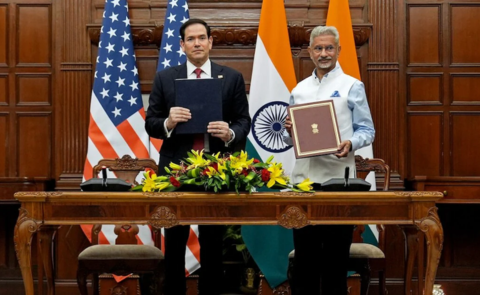
The Quad foreign ministers’ meeting held in New Delhi on May 26, 2026, and the parallel meetings of the U.S. Secretary of State Marco Rubio in India shared a salient feature: the initiative to promote critical rare minerals and their use. This has resulted in the creation of a new Quad Critical Minerals Initiative (QCMI)[1] as also a separate India-U.S. bilateral framework called India-U.S. Framework on “Securing of Supply in the Mining and Processing of Critical Minerals and Rare Earths”[2]. Together, these have provided a significant evolution of the partnership between the Quad and its individual members. India already has critical mineral engagements with Japan[3] and Australia.[4]
The initiatives taken during and around the Quad foreign ministers’ meeting manifest the increasing anxiety among Australia, India, Japan, and the U.S. regarding the aggregation of the world’s critical mineral supply chains in China and the resultant weakness that it generates for green energy evolution, defense productivity, and manufacturing of advanced materials for all the Quad member countries. While earlier copper, coal, oil, and gas were the favoured extractive
industries, now critical minerals, including lithium, cobalt, nickel, graphite, and rare earth elements, have become important due to their role in EV batteries, semiconductor supply chains, production of wind turbines, new telecom systems, technologies for space exploration and the growing requirements of the modern platforms for the conduct of war. China’s seemingly unassailable domination over large parts of the world’s value chains for these minerals, including their refining and processing, is a cause for anxiety. In several critical minerals, China has acquired mines as well as the downstream production chains, including magnets and industrial applications. [5]
The Quad countries, which have had a network of supply chains with the Chinese economy, now seek a decoupling and separate supply chains for at least some of their requirements. Since China has weaponised its controls over critical minerals and rare earths to the detriment of Quad economies, the QCMI seeks to diversify and provide resilience to those supply chains within the Quad.
As per the framework,[6] the QCMI encourages cooperation through the full spectrum of critical minerals supply chains by promising to look at mineral exploration, mining processes, midstream processing, refining, and downstream recycling from used electronic matter. The QCMI seeks better coordination among technologically empowered private companies among Quad countries and their partners to attract FDI in both mining and processing structures. To this end, the QCMI indicates that it will support investment and project development by attempting to raise about $20 billion through public and private financial institutions, which will aggregate current and future investments. The contribution from each Quad member will vary, possibly depending on their relative economic strength. India could contribute 10-15% of the total $20 billion, strengthening the critical minerals value chain.[7]
This will require listing projects in the Quad countries that may have evolved with support from their prospective Quad partners. If the parent company is registered in a Quad member country, that country or its partners would provide critical access to Quad markets, which would reduce the anxiety on those supply chains. Those projects which have strategic value will be further supported through their respective export credit agencies, DFIs, private equity, and public finance facilities for equity, debt, credit guarantees, insurance, and buyback or purchase agreements.
The framework indicates that the Quad will explore various ideas to raise capital from private sources, thereby enhancing critical mineral supply chains within the Quad, its partner countries, and the Indo-Pacific region. Each Quad member can be linked to a preferred partner beyond the Quad.
The QCMI is important because each Quad partner brings distinct capabilities. Australia holds major reserves of lithium and rare earths and is an exporter of several critical minerals; the U.S. has advanced technologies, capital, and demand, particularly in the military-industrial complex. Japan has modern processing and manufacturing technologies, particularly in the electronics and battery segments, as well as financing prowess. India is seen as a country with a growing industrial base, rising demand for green energy, and skilled human capital with immense potential to establish downstream and midstream processing facilities. The QCMI seeks to aggregate these varied capabilities into a creative Indo-Pacific supply chain structure.
For India, the QCMI is important to its national development goals. India understands that the transition to green and renewable energy, electric vehicles, and the semiconductor manufacturing chain requires a dependable supply of critical minerals. Presently, India is import-dependent for lithium, cobalt, and several rare earths. To address this situation, India announced its National Critical Mineral Mission (NCMM) in April 2025, with the objective of enhancing exploration, processing, refining, and recycling capacities. The mission, however, needs a large dose of vitality to leapfrog India into the current rush of activity. This requires clear financing arrangements and a focused emphasis on mid- and downstream processing rather than solely pursuing mineral assets.
The QCMI has the capacity to support India’s ambitions to overcome its technological and financial shortfalls and ensure a smooth critical mineral supply chain. The QCMI will provide opportunities for India to access upstream facilities and investment from Australia and the U.S., while securing downstream processing from Japan. Processing is integrated into the renewed Japanese push to double its FDI in India over the next five years. If these ideas work, India could well evolve into a critical rare minerals processing and refining hub and create a successful China Plus One facility. This is particularly likely for EV battery and electronic manufacturing supply chains; these efforts of the Quad initiative and the partnership with the U.S. are complemented by other efforts, such as the Mineral Security Partnership and the evolving semiconductor cooperation arrangement among several countries.
The Quad framework indicates that Quad members are desirous of recycling critical rare minerals so that these can be reused and contribute to an effective supply chain at an early date. To achieve this, the framework encourages FDI into critical rare minerals recycling technologies with private sector initiatives in Quad countries. They also intend to collaborate to increase the recovery potential of CRM by supporting the creation of stronger collection of e-waste and recycling facilities. They would promote innovation in such recovery methods and try to smooth trade procedures for related waste and scrap among the Quad countries by bringing domestic laws and rules in alignment with their international obligations.
The Quad framework was further strengthened by a bilateral India-U.S. framework agreement to secure supply chains in the mining and processing of critical minerals and rare earths. This enhances Indo-U.S. efforts to cooperate in the sectors of mining, processing, refining, and technology collaboration. It builds on the existing India-U.S. cooperation for strengthening supply chain security in critical sectors: On February 20, 2026, India became a signatory to the U.S.-Pax Silica initiative that aims to secure the global supply chains that underpin artificial intelligence (AI), semiconductors, advanced manufacturing, and critical minerals.[8]
Yet several hurdles remain to be crossed for these initiatives and frameworks to bear fruit. Trying to create China plus one supply chains requires long-term investments. China’s controls are not only over the mines but also cover refining, chemical conversion, logistics and manufacturing systems. The Quad members will take time and energy to attain a competitive size and scale. China can disregard and overcome environmental protection requirements – a significant advantage that which Quad countries will not have due to their own commitments. These have, in the past, led to delayed investments and the rise of strategic risks when third-country locations of their projects require responsibility for rights and environmental concerns, as in DRC.
Is the Quad capable of continuous economic cooperation with their varying economic priorities? India has so far been weak in engaging with major supply chain integration, and the US suffers from a see-sawing of policy depending on the economic priorities linked to its domestic political preferences. The Quad will have to accommodate these compulsions in order to convert strategic intentions into economically successful projects for critical minerals. It will be a major test of the grouping’s resolve.
The Quad is moving from maritime to economic security. These agreements provide an important transition in Indo-Pacific engagement, the Quad is not now seen as a maritime security dialogue, though those aspects are also increasingly being covered. The Quad is transitioning into an economic security partnership emphasising technology, energy and industrial resilience for India in particular, these agreements are an opportunity to convert their large market and become an important participant in emerging global supply chains for technologies that would determine the future of the current century.
Gurjit Singh is a former Indian Ambassador to Germany and author of The Durian Flavour: India, ASEAN and the Act East Policy. He is currently promoting the impact investment movement for implementing SDGs in Africa.
This article was exclusively written for Gateway House: Indian Council on Global Relations. You can read more exclusive content here.
Support our work here.
For permission to republish, please contact outreach@gatewayhouse.in
©Copyright 2026 Gateway House: Indian Council on Global Relations. All rights reserved. Any unauthorised copying or reproduction is strictly prohibited.
References:
[1] Quad Critical Minerals Initiative Framework Among India, Australia, Japan And The United States, MEA, 26 May, 2026,https://www.mea.gov.in/bilateral-documents.htm?dtl/41235/Quad_Critical_Minerals_Initiative_Framework_Among_India_Australia_Japan_And_The_United_States
[2] India-US Framework on “Securing of Supply in the Mining and Processing of Critical Minerals and Rare Earths” MEA, 26 May 2026, https://www.mea.gov.in/press-releases.htm?dtl/41236/IndiaUS_Framework_on_Securing_of_Supply_in_the_Mining_and_Processing_of_Critical_Minerals_and_Rare_Earths
[3] Fact Sheet : India-Japan Economic Security Cooperation, MEA, 29 August 2025, https://www.mea.gov.in/bilateral-documents.htm?dtl/40066/Fact+Sheet++IndiaJapan+Economic+Security+Cooperation
[4] Anindita Sinh, India-Australia Critical Minerals Investment Partnership, CSEP, 17 April 2026,https://csep.org/blog/india-australia-cooperation-critical-minerals-for-economic-security/
[5] Tae-Yoon Kim, Shobhan Dhir, Amrita Dasgupta, Alessio Scanziani,
With new export controls on critical minerals, supply concentration risks become reality,
IEA Commentary — 23 October 2025, https://www.iea.org/commentaries/with-new-export-controls-on-critical-minerals-supply-concentration-risks-become-reality
[6] Transcript of Special briefing by MEA on Quad Foreign Ministers’ Meeting, MEA, May 26, 2026, https://www.mea.gov.in/media-briefings.htm?dtl/41239/Transcript_of_Special_briefing_by_MEA_on_Quad_Foreign_Ministers_Meeting_May_26_2026
[7] Quad Countries Join Hands to Mobilise $20 Billion for Critical Minerals Supply Chains, Angel One , 26 May,https://www.angelone.in/news/economy/quad-countries-join-hands-to-mobilise-20-billion-for-critical-minerals-supply-chains
[8] India Joins Pax Silica at India AI Impact Summit 2026, PIB, 20 February 2026, https://www.pib.gov.in/PressReleaseDetail.aspx?PRID=2230648®=3&lang=1