

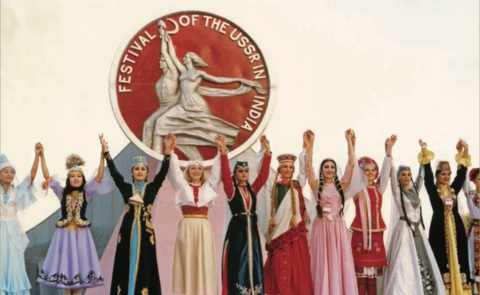
Source: Russian Embassy in India
During the Second World War, sections of the Indian intelligentsia expressed solidarity with the Union of Soviet Socialist Republics (USSR).
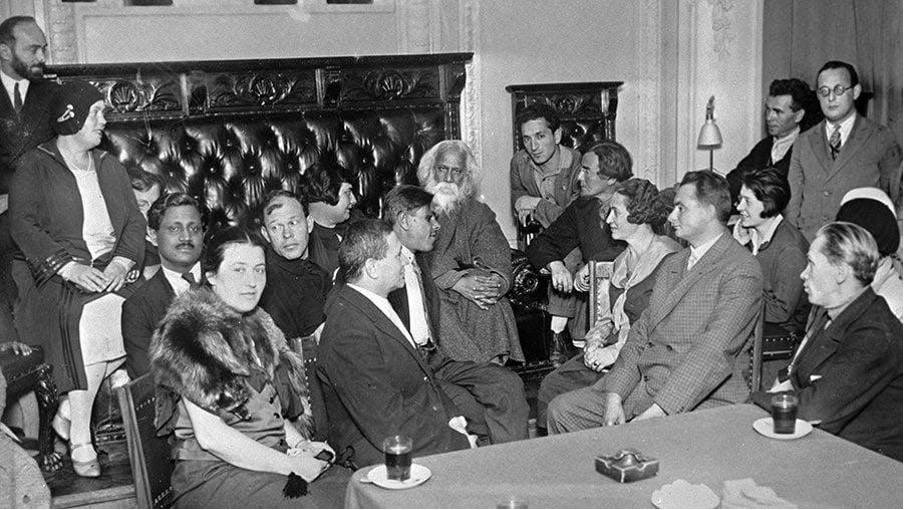
This was manifest in the establishment of the Friends of the Soviet Union (FSU), which was set up in West Bengal on June 22, 1941, the day Nazi Germany invaded the USSR. It aimed to show solidarity with the Soviet people’s resistance, to support the global fight against fascism and, eventually, to foster cultural ties and people-to-people contacts between British India and the Soviet Union. The FSU’s patron was Rabindranath Tagore, India’s poet laureate, who had visited the USSR in 1930 and remains popular in present-day Russia.
Source: Russian Embassy in India/FB
Encouraged by this support, in the 1940s Moscow began reaching out to the Indian public. The FSU was reconstituted into the Indo-Soviet Cultural Society (ISCUS) in Bombay in 1952, with renowned surgeon Dr. A.V. Baliga as its first chairman.[1] Over the next few decades its eminent members included India’s most illustrious diplomats, such as T.N. Kaul and K.P.S. Menon. ISCUS focussed on the exchange of art, culture and literature between India and the Soviet Union, while also facilitating cultural delegations.
Other institutions were blended into these efforts, such as the All-Union Society for Cultural Relations with Foreign Countries (VOKS), established in 1925, to promote scientific and cultural relations with the world.[2] VOKS worked directly with societies such as ISCUS. In 1954 it sent a Soviet cultural delegation to India and arranged for a reciprocal ISCUS group to visit the USSR a year later.[3]
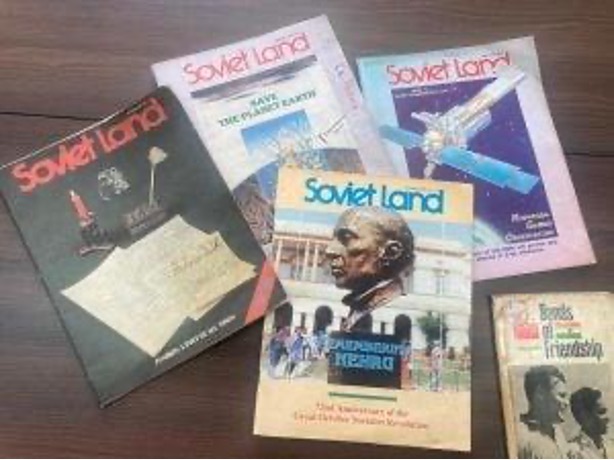
The 1950s were active years when the seeds of the intellectual efforts began to flower. The Soviet Embassy in New Delhi worked closely with ISCUS to expand its reach to the Indian public. The embassy enlisted the USSR’s state news agency TASS,[4] which ran a separate section called the Publications Department. Besides daily bulletins, the department distributed journals such as Soviet Land and News and Views from the Soviet Union.[5] These journals published articles that highlighted economic, industrial, social and cultural achievements of the USSR, as well as features about Indo-Soviet projects and developments in bilateral ties.
Source: Vandana Menon, ThePrint
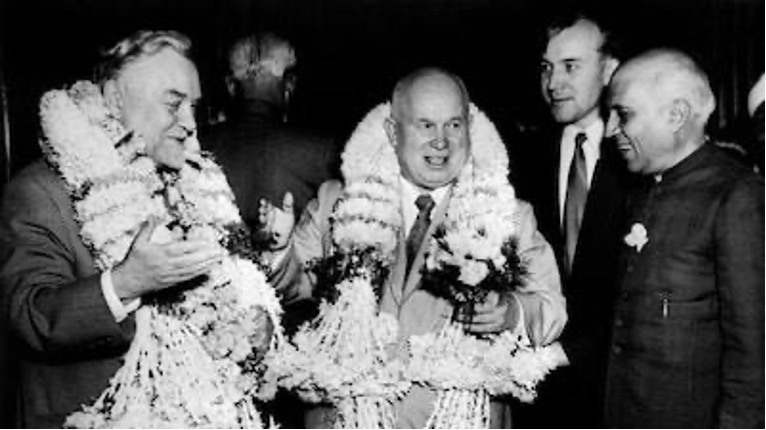
In 1955, during the visit of Nikita Khrushchev, First Secretary of the Communist Party of the Soviet Union, and Nikolai Bulganin, Premier of the Soviet Union to India, the two countries agreed to step up cultural cooperation and exchanges. In a joint statement,[6] they said: “…The leaders of both countries have noted with satisfaction the increasing opportunities afforded to the peoples of two countries to get to know each other by the regular exchange of visits by scientists, technicians, economists, parliamentarians, writers and others engaged in cultural pursuits. They hope that there will be a steady expansion of such opportunities for mutual…”
Source: Intercontinentale/AFP
In December 1956, the Soviet Embassy set up its own information department, which handled magazines like Soviet Land that soon had editions in Hindi, Marathi, Bengali and other Indian languages. Around the same time V/O Mezhdunarodnaya Kniga,[7] the state-run exporter of Soviet publications, signed agency agreements with booksellers in India such as the People’s Publishing House.[8] Initially, books by writers such as Leo Tolstoy and Maxim Gorky, and Russian fairy tales translated into English were sold at heavily subsidised prices. Eager to expand their reach, the Soviet Ministry of Culture, with the help of the Indian Ministry of External Affairs (MEA) and Education ministries, recruited 90 Indian language translators to translate Russian books.[9]
As was the case with the British and American missions in India, there was a degree of suspicion over Soviet motives for expanding its cultural presence. There were rumours that profits from the sale of Russian books in India went to the Communist Party of India (CPI), but the Indian government understood that the Soviets made no money from the subsidised books. The MEA memo noted that “… the contracts for the printing of their publications are generally given by the Soviet embassy to firms owned by CPI sympathisers… [and] provide employment to CPI members. The MEA added that a close watch was being kept on how the sale proceeds were being distributed.”
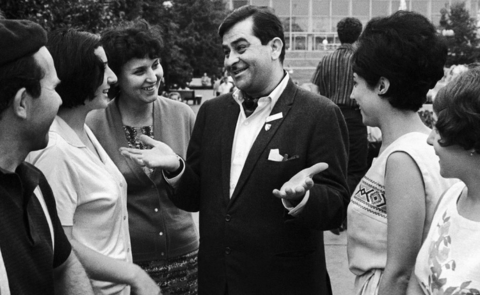
It was also in the 1950s that the Soviets extended their influence in India through cinema. By 1954 V/O Sovexportfilm[10] had established an office in Bombay and branches in Madras and Calcutta. The MEA insisted that the branches be staffed entirely by Indian personnel. Under an agreement with the state-owned Soviet film export monopoly, only 12 programmes could be imported into India in a year. A programme consisted of a feature film and one or two supporting documentaries. The films would be distributed through private agencies. The influence was not one way. Indian films too found a vast audience in the USSR, beginning with an Indian film festival in Moscow in 1954,[11] where Raj Kapoor’s Awara and Shree 420 were huge hits. Kapoor was dubbed “India’s Charlie Chaplin”.[12]
Source: Yoda Press/The Scroll
In 1958, VOKS was transformed into an umbrella body, the Union of Soviet Societies of Friendship and Cultural Relations with Foreign Countries (SSOD). The main aim was to focus on public diplomacy and managing global friendship societies like ISCUS.
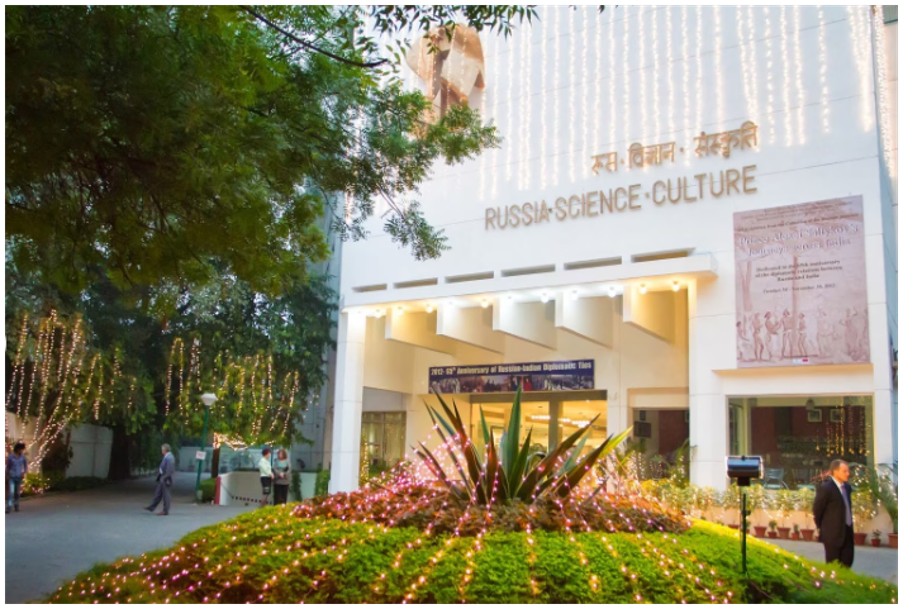
Until the early 1960s, Soviet organisations like SSOD and Sovexportfilm coordinated cultural activities in India, while the Americans, French and British ran proper cultural centres in the country. It was only in 1965 that the first House of Soviet Culture was opened in New Delhi’s iconic Mandi House area.
Source: Russian House
The modernist-style building with strict geometric forms, a flat roof, and extensive glazing resembles many works of Soviet public architecture from the sixties and seventies. The design emphasis was on functionalism and minimalism, and it was adapted to the Indian climate, with spacious shaded areas and covered galleries to protect from the sun.
The New Delhi centre, with its auditorium, exhibition galleries and library, became the model for the centres subsequently built in Madras (1972), Calcutta’s Gorky Sadan (1974) and Bombay (1975). The Russian government owns a property in Thiruvananthapuram that functions as a cultural centre.
The Soviets invested in language too. Right until the late 1980s, Russian language courses were popular in India. Students often used the centres’ courses as a springboard to learn Russian before going to the USSR for longer programs largely in medicine and engineering, as well as language and literature. The libraries were well-stocked with not just books but also records and music from across the former Soviet Union. The first director of the centre in Bombay was from Uzbekistan, and the centres often arranged for cultural troupes of musicians, dancers and other performing artists from Central Asia.
At the peak of Indo-Soviet bonhomie, the intellectual elite of Indian metros thronged the centre for cultural events. Long-term visitors to the New Delhi centre talk about watching Sergey Bondarchuk’s Oscar-winning four-part film adaptation of Tolstoy’s War and Peace over a weekend. This was de rigueur, to screen Soviet films and classics at the centres.
After the USSR was dissolved in 1991, the centres faced financial difficulties on account of Russia’s economic collapse. But a dedicated local staff kept things going. Among the most fondly remembered Russian teachers was the late Suniti Deshpande, the first Indian to earn a doctorate in the Russian language from the prestigious Pushkin Institute.
It took over a decade after the collapse of the USSR before the rechristened Russian Centres of Science and Culture in India started to function at the level they did in the Soviet era.
The Russian centres now also facilitate cultural programmes such as concerts, ballets and operas in venues like the National Centre for the Performing Arts (NCPA) and Opera House in Mumbai. In December 2025, the Eifman Ballet of St Petersburg held three performances of Tolstoy’s Anna Karenina set to the music of Pyotr Tchaikovsky. In October 2026, the New Chamber Orchestra and the St. Petersburg Philharmonic Orchestra also held a concert at the iconic Mumbai venue.
While the centres organise a good number of high-quality events, they feel like a relic of the Soviet days. Russia has clearly moved on from that period and has undergone a major cultural awakening over the last 20 years. However, a visitor to the Russian Houses in Indian metros would get little sense of how much the country has changed.
Centres operated by other foreign cultural giants such as the Alliance française and Goethe-Institut have hired young, talented and energetic Indian employees who not only work as unofficial diplomats but also help produce excellent social media content and outreach campaigns. Given Russia’s new geopolitical shift and positioning in the world, Moscow will do well to formulate a new strategy to revamp these centres and bring in fresh blood, including local Russian speakers to popularise the rich and diverse culture of Russia to a new generation of Indians. This requires larger budgets and a more targeted strategy that is in line with Russia’s renewed focus since 2022[13] on further developing economic and cultural ties with India – the year India refused to join U.S. sanctions against Russia and reiterated its ‘time-tested’ friendship.
Ajay Kamalakaran is a writer with a special interest in Russia and the former Soviet Union.
This article was exclusively written for Gateway House: Indian Council on Global Relations. You can read more exclusive content here.
For permission to republish, please contact outreach@gatewayhouse.in
©Copyright 2026 Gateway House: Indian Council on Global Relations. All rights reserved. Any unauthorised copying or reproduction is strictly prohibited.
References
[1] ‘Indian Friendship Movement: Short Historical Background – ISCUF -Indian Society for Cultural Co-Operation and Friendship’. 30 September 2020. https://web.archive.org/web/20200930063347/http:/iscuf.com/indian-friendship-movement-short-historical-background/.
[2] Presidential Library. ‘All-Union Society for Cultural Relations with Foreign Countries (VOKS) Was Established.’ 5 April 1925. https://www.prlib.ru/en/history/2047582.
[3] Ministry of External Affairs, Europe (East) Section, File No: 8-207-EM-E-57, 1957
[4] Ministry of External Affairs, Europe (East) Section, File No: 8-207-EM-E-57, 1957
[5] Ministry of External Affairs, Europe (East) Section, File No: 8-207-EM-E-57, 1957
[6] “The Indian-Soviet Joint Declaration.” Current History, vol. 30, no. 174, 1956, pp. 109–11. JSTOR, http://www.jstor.org/stable/45308868. Accessed 16 Oct. 2026.
[7] V/O stands for Vsesoyuznoye Obyedineniye, which translates to “All-Union Association” or “All-Union Enterpris”, a prefix used for state-owned foreign trade organizations in the Soviet Union that operated under the Ministry of Foreign Trade.
[8] Gupta, Anukriti. ‘People’s Publishing House, New Delhi’. Zikr-e-Dilli, 4 April 2021. https://zikredilli.com/f/peoples-publishing-house-new-delhi.
[9] Ministry of External Affairs, Europe (East) Section, File No: 8-207-EM-E-57, 1957
[10] Sovexportfilm was the official Soviet state organisation responsible for importing and exporting films, functioning as the primary international distributor for Soviet cinema.
[11] Rajagopalan, Sudha. ‘Emblematic of the Thaw’. South Asian Popular Culture, 20 November 2006. https://www.tandfonline.com/doi/full/10.1080/14746680600796972.
[12] Thakur, Charu. ‘70 Years of Indian Cinema in Russia: A Timeless Love Story’. The Global Indian, 13 March 2025. https://www.globalindian.com/story/art-culture/70-years-of-indian-cinema-in-russia-raj-kapoor-mithun-chakraborty-srk/.
[13]‘India-Russia Bilateral Brief’. Ministry of External Affairs, December 2022. https://www.mea.gov.in/Portal/ForeignRelation/India-Russia_Dec_2022.pdf.