

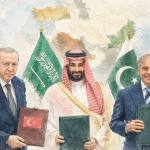

The recent attacks in Saudi Arabia, allegedly carried out by non-state actors in Iraq and Yemen aligned with the Iranians, failed to trigger the much-touted “Article 5″ of the newly signed Mecca Accord and did not result in Pakistan and Türkiye coming to the aid of Saudi Arabia to defend against the outside military aggression.
Sceptics of the Mecca Accord have been quick to dismiss the Mecca Accord itself, in light of these recent developments, as being completely ineffective and worthless. The right conclusion that must be drawn at this point is more nuanced. What has been made absolutely clear now is that the scope of the Accord does not include actions of non-state actors, irrespective of their real or perceived allegiance or alignment with other state actors. The Accord is a deterrent to direct military action from state actors, and its validity has in no way been compromised by the recent events. If anything, there is more clarity on what the Accord covers and what it does not.
The Mecca Accord, or the Mecca Joint Defense Agreement, signed on August 7, 2026, by the Kingdom of Saudi Arabia, the Republic of Türkiye, and the Islamic Republic of Pakistan, represents a structural turning point in regional security. Its dimensions go beyond the boundaries of emerging traditional military alliances, expressing a deep cognitive and strategic shift among regional powers regarding the concepts of security and deterrence.
This agreement has crystallised in a security environment marked by the growing fragility of existing arrangements and the rising role of non-conventional threats — ballistic missiles, drones, and hybrid maritime threats. These have moved threats of conflict directly into the strategic depth of states, turning critical infrastructure, energy facilities, ports, and international shipping lanes into core targets in the equations of regional competition.
Amid this complex geopolitical approach, conventional defence partnerships and reliance on unilateral security guarantees from major powers have receded. This thus imposes an urgent need to re-engineer the security architecture of states through a strategy of “diversifying and managing risk” so as to free states from confining the cost of defensive deterrence to the decision of a single external party.
From this analytical perspective, the significance of the Mecca Agreement is its strategic endeavour to move from a model of centralised security guarantees to a formula of multilateral networked deterrence. This strategic shift does not entail Saudi Arabia abandoning its powerful traditional partnerships with the U.S. or strategic engagements with countries like India, nor does it mean Türkiye detaches from its Atlantic commitments, nor does it present Pakistan as a substitute for strategic axes with major powers.
Instead, this geopolitical triangle establishes a new structural layer in the architecture of regional security, resting on the internationalisation of mutual security interests and the broadening of their scope. Accordingly, the strategic value of the agreement is not measured quantitatively by the size of military mobilisation or material capabilities deployed, but is measured strategically by its capacity to maximise the adversary’s “state of uncertainty” — by obscuring the determinants of a possible response (its nature, scale, and timing).
This dynamic intersects with the deeper structural dilemma facing the concept of the “security guarantee” in the Middle East, where successive crises and security threats over the past decade, and most recently with the U.S.-Iran war, have exposed the inadequacy of traditional external protection arrangements in curbing the repercussions of regional conflicts or neutralising their fallout on partner states’ territories and vital interests.
Current data indicate that the escalating intensity of cyber threats and asymmetric attacks, alongside overlapping theatres of operations and the exposure of maritime chokepoints and critical energy networks, has reshaped the concept of regional national security into an inseparable part of the region’s overall security environment. From this standpoint, the strategic standard has shifted from merely activating traditional deterrent capabilities to managing the escalation equation and preserving strategic ambiguity regarding the limits and scope of any response. It is here that the Mecca Agreement becomes a fundamental shift in regional strategic thought — a transition from the “unilateral security umbrella” approach to a model of “solidarity-based security pluralism” aimed at diversifying risk and achieving deterrent balance through a network of mutual commitments that raise the cost of any aggression.
Yet the real test of this security structure’s success lies in its ability to give joint action a practical, field-level form — that is, moving the agreement from its symbolic diplomatic character into the realm of operational application through the drafting of clear protocols for command, control, intelligence coordination, and immediate-response mechanisms.
The changing strategic orientations of some of the U.S.’ traditional allies in the region are being notably welcomed by Moscow, particularly given these states’ efforts to shape an emerging regional security system based on an independent vision and the concept of self-sovereignty, away from structural dependence on the American security umbrella. In this context, Russian decision-makers see in these shifts a ripe opportunity to root and strengthen military and technological partnerships with the Arab Gulf states. This cooperation is evident in joint military manufacturing, missile technology, air defence systems, and electronic warfare technologies, allowing Moscow to expand its arms influence in the region.
On the other side, Beijing adopts a stance marked by cautious diplomacy. Although it has so far refrained from issuing official public positions, media circles and think tanks close to Chinese decision-making circles have devoted intensive research attention to the event. These readings oscillate between strategic endorsement and hedging, with Chinese reports attributing the emergence of this alliance to declining levels of regional confidence in American security guarantees.
This view intersects with China’s political doctrine, which emphasises that Middle Eastern states should shape their own regional security independently, away from external interference. In this framework, official media such as the Xinhua news agency have promoted the Mecca agreement as a practical model of the concept of “common and sustainable security” that Beijing champions, provided it rests on strategic balance and independent self-deterrence. Nevertheless, Chinese circles express concern about the possibility of this alliance sliding toward a direct and open regional confrontation with the Islamic Republic of Iran. This could place Beijing — which maintains a comprehensive strategic partnership with Tehran — under complex political pressures, pushing it toward a forced alignment that could affect the balance of its regional relations.
On the basis of the foregoing, the Mecca Joint Defense Agreement constitutes a telling indicator of a qualitative shift in regional security doctrine. The central question crystallises is this: Can this alliance craft a new security architecture in the region?
From this, several sub-questions arise, namely:
- What are the shared strategic motives and geopolitical interests driving the three parties toward this rapprochement?
- What added value do the military capabilities and geostrategic positions of these states bring to the regional security equation?
- To what extent can the agreement translate political rapprochement into an operationally activatable defence commitment?
- What are the potential repercussions of this security arrangement on the nature of the American role, the calculations of regional powers such as Iran, and the balance of power in the Gulf and Middle East regions?
- Does the Mecca Agreement represent merely a situational response to a mounting crisis of confidence in existing security arrangements, or does it lay the groundwork for a first stage toward restructuring the region’s deterrence architecture?
Axis One: The implications of the Tripartite Alliance and the intersections of power in the Gulf and the Middle East
The signing of the “Mecca Joint Defense Agreement” on August 7, 2026, by Saudi Crown Prince Mohammed bin Salman, Turkish President Recep Tayyip Erdoğan, and Pakistani Prime Minister Shehbaz Sharif marks a telling indicator of a strategic repositioning of three regional powers seeking innovative collective security formulas. The agreement’s provisions reveal a shift in collective security perspective, driven by shared assessments that view the Middle East’s competitive environment as a compound security dilemma that cannot be contained through traditional bilateral cooperation frameworks or singular international sponsorship. The adoption of the principle of “indivisible security” (treating an attack on any one party as an attack on all) forms the hard core of this emerging alliance. According to the official Turkish narrative, this agreement goes beyond symbolic dimensions toward tactical and operational ones, codifying structural coordination mechanisms that bring together the highest political and military levels (foreign affairs, defence, and chiefs of staff), and establishing an advanced stage of mutual dependence through intensified field exercises and developing partnerships in the defence industries sector and localising military technology.
The geopolitical significance of this agreement stems not only from its legal frameworks and contractual provisions but is also clearly manifest in its geostrategic dimensions: the three parties form a geographic triangle stretching from the Arab Gulf to the eastern Mediterranean and South Asia. In this context, Saudi Arabia represents a geoeconomic centre of gravity and a principal axis for energy and geopolitics in the Gulf region, while Türkiye lends this axis advanced military and industrial depth, as well as its strategic position as a bridge linking the Middle East, Europe, and the Black Sea basin. Pakistan, for its part, ensures the system’s extension toward the Arabian Sea and South Asia, drawing on its nuclear deterrent capabilities and accumulated military expertise.
Accordingly, the agreement does not represent a grouping of identical or resource-equivalent powers, but rests on a functional integration linking three distinct types of power: Saudi financial and geoeconomic influence, Turkish military and industrial capabilities, and Pakistani military and deterrent depth. This structural composition gives the agreement its latent strategic value as a flexible network for pooling capabilities and comparative advantages, thereby transcending the classical formulas of traditional military alliances.
Historically and institutionally, the announcement of the agreement on August 7 was not a sudden or unexpected event, but rather the culmination of a multi-stage negotiating process. On January 15, 2026, Pakistan’s Minister for Defense Production, Muhammad Raza Hayat Hiraj, said that Islamabad, Riyadh, and Ankara had already drafted a trilateral defence agreement following consultations that lasted nearly a full year, stressing that this draft was structurally distinct from the Saudi-Pakistani bilateral defence agreement announced in 2025. Hiraj noted at the time that the trilateral scheme required a final consensus among the three capitals before proceeding to a formal conclusion. This information received wide media coverage, including in Pakistan’s Dawn newspaper,[1] providing proof that the agreement was not merely an ad hoc response or tactical reaction to a sudden crisis, but the product of a prior, planned political and strategic process.
The strategic significance of this approach becomes clear when unpacking Riyadh’s defence determinants: Saudi orientations do not reflect a radical shift in its traditional alliances, nor a replacement of the American partner with Turkey and Pakistan, so much as they signal a strategy of “diversifying the deterrence umbrella” and reducing the risks of unilateral security dependence. This vision is driven by current Gulf security experience, which has shown that the defence partnership with Washington does not provide an absolute guarantee of protecting critical infrastructure or shipping lanes and oil facilities from targeting.
As the fluidity of the regional scene grows and the lines between proxy and direct wars blur, the added value of this agreement lies in internationalising the security response to any threat directed at Riyadh, transforming it from a bilateral confrontation into a multilateral crisis. Ankara emerges as a pivotal actor in this equation given its weight within the European security system and its NATO membership, as well as its growing military manufacturing capabilities. Islamabad, in turn, lends the tripartite arrangement a strategic dimension as a nuclear power with field depth and a geopolitical position overlooking the Arabian Sea and the Strait of Hormuz, and contiguous borders with Iran. Thus, Pakistan’s integration helps expand the scope of Saudi security calculations to extend from the Arab Gulf to South Asia and the Indian Ocean.
As for the Turkish approach, this agreement is consistent with a broader Turkish strategic orientation toward diversifying its defence and industrial partnerships and building alliances with regional powers outside traditional Western security frameworks. In an effort to dispel regional concerns, the Turkish leadership took care to give the agreement a cooperative, non-directed character: President Erdoğan affirmed and echoed the stance of the leadership of all three involved parties that the partnership does not target any specific international party, but rests on strengthening security cooperation and developing joint manufacturing capabilities, while keeping flexibility for states wishing to join in support of regional stability. Vice President Cevdet Yılmaz, for his part, noted that the current arrangements integrate three main dimensions: collective security, deterrence, and military-industrial partnership.
Islamabad’s positions, by contrast, reflect a two-dimensional reading that combines strategic opportunities with geopolitical caveats. While Prime Minister Shehbaz Sharif described the agreement as “historic,” Foreign Minister Ishaq Dar focused on the purely defensive character of the alliance, distancing it from any polarisation directed against other parties. The analytical significance of the Pakistani discourse lies in its positioning within three interrelated contexts: shared deterrence, mutual security, and integrative defence cooperation. This structural gradation matters because it shifts the weight of the agreement from a mere traditional commitment to mutual military intervention during crises, toward building a sustainable, proactive deterrence environment based on developing shared capabilities and defence institutions.
Geopolitically, the timing of the agreement’s conclusion is no less significant than its substantive dimensions: the signing came amid a notable escalation in regional tensions and growing threats from missile and drone attacks on the Gulf countries from Iran, which targeted energy facilities, ports, and vital shipping lanes. Saudi Arabia had security concerns over the possible spread of the conflict and its repercussions on its own territory. On August 6 — one day before the agreement was signed — press reports [2] relayed that Riyadh was bracing for possible coordinated attacks by Iran-aligned groups from both north and south, targeting civilian and economic infrastructure and energy and airport facilities. The signing of the Mecca Agreement the following day thus carried deterrent significance at a moment when the risks of the conflict spreading from its traditional theatres into the depth of the Arab Gulf states were rising.
Objective analysis requires avoiding exaggeration in classifying this agreement as a fully formed “Islamic NATO” system. The structural determinant of any effective defence alliance does not stop at political declarations expressing solidarity, but lies in the practical enforceability of its shared commitments. This requires examining the alliance’s institutional indicators: the availability of joint military command, the nature of decision-making mechanisms, the existence of dedicated forces or unified operational plans, as well as how divergences of interest would be managed should one of the signatory states face external aggression. These questions take on fundamental weight given the three states’ lack of an identical threat environment or unified geostrategic priorities. Accordingly, the agreement in its current phase can more accurately be approached as an emerging framework for mutual deterrence and security coordination, rather than yet being an institutional collective-defence system.
Thus, the strategic thesis put forward by the Mecca Agreement transcends the debate over establishing a regional version of “NATO,” touching instead on the essence of the transformation in the concept of collective security in the Middle East. The agreement’s making a unilateral strike against any one party and undermining a shared regional interest system is the hard core of the agreement’s geopolitical significance. It is the primary driver behind the intensive monitoring shown by international and regional decision-making capitals — including Washington, Tehran, Jerusalem, Ankara, Islamabad, New Delhi, Doha and Riyadh — since it represents a signal of the fate of the regional balance of power. The accord, it appears, is looking increasingly attractive to many other countries in the region.
Axis two: from umbrella dependence to deterrence network engineering: how Saudi Arabia, Türkiye, and Pakistan are redrawing the regional security equation outside American monopoly
The current structural shift in the Gulf security system is no longer confined to the traditional dimensions of arms deals or expanding the network of formal alliances; it now reflects a fundamental redefinition of the very concept of “security guarantee” itself.
For decades, the stable security equation in the Arab Gulf rested on a two-part premise: the U.S., as the dominant external power, committed to translating its strategic military superiority into direct field protection for its allies when necessary, in exchange for Gulf states providing military facilities, logistical bases, funding, and shared political positioning, as well as securing energy flows. However, recent geopolitical interactions in the Middle East have exposed a growing functional gap between the superpower’s ability to deter and punish adversaries and its operational inability to repel a “first strike” or provide sustained protection for critical infrastructure.
The Mecca Accord is practically an example of the transition from a “traditional security umbrella” model to a “multilateral deterrence network” model.
The dimensions of such an agreement typically extend beyond the traditional defensive character toward institutionalising the partnership through multiple tracks, including:
- Establishing high-level political and military coordination mechanisms involving defence and foreign ministers and chiefs of staff.
- Launching joint training programmes and cross-domain exercises (land, sea, air, and cyber).
- Developing a strategic partnership in defence manufacturing, technology transfer, developing artificial intelligence algorithms, autonomous systems, and electronic warfare.
This represents a flexible, modular, regionally expandable platform aimed at closing security gaps and building self-sufficient capabilities able to adapt to the new generation of warfare.
Can this agreement craft a new level of regional deterrence that helps reduce Saudi Arabia’s reliance on the security decision of a single central capital without producing a structural break with the U.S.? Riyadh does not plan to replace Washington’s security umbrella with an alliance with Ankara or Islamabad. It just wants to raise the cost of any potential aggression and complicate the strategic calculations of any regional adversary.
A chronological comparison of the alliance track reveals the depth of this shift: on September 17, 2025, Saudi Arabia and Pakistan signed the “Mutual Strategic Defense Agreement” in Riyadh, whose legal formula stipulated activating a joint-defence clause and treating any aggression against either state as a direct attack on the other. Arab News[3] described this agreement in September 2025 as representing a qualitative shift in bilateral defence relations, while the Council on Foreign Relations[4] noted that the agreement reflected the geopolitical repercussions following the Israeli attack on Doha and came amid a comprehensive regional reassessment of the reliability of traditional security arrangements. Turkey’s accession in August 2026 moved the agreement out of its bilateral framework into a three-dimensional alliance space.
The geostrategic value of this space is amplified when analysed in light of current shifts in global energy transit routes. The Strait of Hormuz is no longer merely a Gulf shipping artery but a centre of gravity for the international political economy: oil flows through it in 2025 amounted to roughly 20.9 million barrels per day according to the U.S. Energy Information Administration, equivalent to about one-fifth of global seaborne oil trade. On the other side of the geopolitical picture, the Red Sea and the Bab al-Mandab Strait, alongside strategic ports (Jeddah, Yanbu, and Jazan), form direct pillars of Saudi security calculations. Field data observed in August 2026 show ships linked to the Kingdom disabling tracking devices to evade Houthi threats, while rerouting shipments northward through Egypt’s vital corridors (the Suez Canal and the Sumed pipeline). These behavioural shifts confirm that Saudi strategic security requires a complex system that cannot be reduced to protecting land borders or countering traditional air threats. It represents a “security value chain” that begins at the oil well and the port, passes through air and maritime domains, and intersects with data security and supply chains. Accordingly, diversifying partnerships and building multiple alliances has become an urgent security necessity for Riyadh to manage and neutralise risk, not merely a supplementary diplomatic manoeuvre.
This is attributable to a conceptual shift in Saudi security doctrine, from a strategy of “buying protection” to “engineering interdependence.” Statistical data from the Stockholm International Peace Research Institute for 2024 show Riyadh spending about $80.3 billion on the defence sector, placing it first regionally and sixth globally, alongside a surge in Middle East military spending that reached $243 billion (a 15% increase compared to 2023). These quantitative indicators show that the Saudi security dilemma does not lie in a shortage of financial resources needed to mobilise military power, but in how to convert this spending into self-sufficient, sustainable deterrent and defensive capabilities.
NATO’s Istanbul Cooperation Initiative, launched on June 28, 2004, represents a notable historical milestone for security cooperation between the alliance and Middle Eastern states, with Bahrain, Kuwait, Qatar, and the UAE formally joining, while Saudi Arabia and Oman limited their participation to specific activities without formal membership. This historical data carries analytical significance, reflecting Riyadh’s pursuit, for more than two decades, of benefiting from Western capabilities, standards, and expertise while preserving the plurality of its strategic options and avoiding confining its national security reference to a single international institution. Accordingly, Türkiye in the Mecca Agreement cannot be considered a Saudi gateway toward NATO, but rather embodies a more complex geopolitical phenomenon: a NATO member state deploying its Atlantic expertise to craft security arrangements outside the direct Atlantic structure.
This dynamic reveals Ankara’s ability to operate flexibly within and outside Western institutions simultaneously, exploiting its geostrategic position, military capabilities, and growing defence industries. Its approach has been practically demonstrated in Libya, Syria, and Iraq, where Ankara has proven the efficiency of its operational model based on integrating drones, electronic-warfare tools, intelligence support, and local forces to achieve military and political goals at a lower strategic and economic cost than traditional intervention models.
Nevertheless, Türkiye’s comparative advantage remains constrained by structural determinants: Ankara has its own separate interests in the files of Syria, Iraq, the eastern Mediterranean, and the Caucasus, as well as complex economic relations with Russia, and in its strategic calculations toward Iran, Israel, and the U.S. Accordingly, any Turkish commitment toward Riyadh or Islamabad will remain subject to the Turkish leadership’s assessment of the nature of crises and the requirements of its national interest, reinforcing a well-established fact in international relations: that alliances do not eliminate states’ national interests, but organise their strategic intersections.
As for Pakistan, it lends this triangle different dimensions related to “military depth” and the indirect nuclear determinant. However, this point requires methodological precision: describing the Mecca Agreement as a Pakistani nuclear umbrella for Saudi Arabia would exceed the agreement’s declared terms. While Pakistan’s nuclear power is a standing geostrategic fact, the agreement does not automatically include a formal nuclear commitment to defend the Kingdom.
In this context, there is a fundamental legal and strategic difference between the concepts of ‘alliance with a nuclear state’, ‘extended nuclear deterrence’, and ‘nuclear sharing’. Accordingly, the term “nuclear shadow” becomes more precise and objective than the term “nuclear umbrella”: an adversary’s mere awareness that any critical escalation against Saudi Arabia could trigger a military response from a nuclear power like Pakistan helps raise the cost of an offensive approach, even in the absence of declared mechanisms for activating defensive deterrence. By contrast, codifying this possibility and turning it into an actual security guarantee requires explicit political will, shared command-and-control channels, and precise definition of the nature of existential threats – determinants that still lack sufficient public indicators at present.
India stands out as one of the most significant structural determinants constraining the prospects of expanding Pakistan’s cross-regional military commitments, since Islamabad’s strategic and defence doctrine has historically been shaped under the weight of its security dilemma and geopolitical rivalry with New Delhi, not in the context of Arab Gulf security interactions. Accordingly, Pakistan’s engagement in new regional defence arrangements does not necessarily mean it can transfer its military weight and deploy its operational capabilities in the Middle East – as witnessed by its recent refusal to come to Riyadh’s defence against the Houthi attacks.
This refusal has come before, and offers a telling reference point for the trajectory of Saudi-Pakistani relations: the Pakistani parliament’s 2015 decision to refuse participation in the Riyadh-led military coalition in Yemen, despite the depth of bilateral ties. This episode confirms Islamabad’s ability to structurally separate “commitment to defending Saudi regional sovereignty” from involvement in “regional conflicts subject to Riyadh’s strategic choices.”
These facts necessitate refining the concept of “aggression” rather than relying on the traditional alliance formulas based on the principle of “collective security” (an attack on one member is an attack on all). A series of problematic questions touching the core of the agreement arise here: Would the targeting of critical Saudi facilities by non-state actors be classified as international aggression requiring automatic activation of the alliance? And how would the strategic response unfold if Iran-aligned groups targeted Saudi ports?
Conversely, if military conflict were to resume between Pakistan and India, would Saudi Arabia and Türkiye have a legal obligation to engage in direct confrontation with New Delhi? Similarly, would any Turkish confrontation with regional powers in the Syrian arena automatically turn into a Saudi-Pakistani security crisis? These questions are not minor procedural details but constitute the real test of the agreement’s credibility and sustainability.
In this context, the new Saudi alliance network lies within deterrence efforts aimed at preventing a slide toward comprehensive regional confrontation. Media analysis has seen some divergence, with some[5] noting the strong symbolic dimension of the Mecca Agreement, considering that it has not yet risen to the level of a fully integrated operational system, given the absence of a precise definition of the strategic roles of the three states upon transitioning to an actual state of war. Others[6] believe the agreement contributes to developing mechanisms of cooperation, defence coordination, and shared deterrence, based on the three parties’ affirmations of the alliance’s purely defensive nature and the exclusion of large-scale military-deployment scenarios.
According to deterrence theory literature, the success of alliances does not require their involvement in armed confrontations; rather, their success lies in entrenching adversaries’ conviction that the cost of attacking exceeds any potential strategic gains. Clearly, the arrangement with the U.S. did not fulfil its expectations in this regard, necessitating a further enhancement of the security arrangement. Consequently, any military calculations aimed at targeting Saudi Arabia would now collide with a complex network of interlocking risks, as the attacking party would have to weigh American, Turkish, and Pakistani military capabilities, as well as the possibility of international intervention (European and Asian) conditioned on protecting global energy supplies and vital maritime corridors.
This thesis represents the core of Riyadh’s new strategic doctrine, based on diversifying international partners and crafting a network of mutual interests to ensure the Kingdom’s stability, rather than being tied to traditional unilateral security arrangements. Under this approach, the U.S. retains its pivotal role as a primary military and intelligence partner, while Turkey contributes as a regional power with combat experience and an advanced defence industry, and Pakistan represents strategic and military personnel depth backed by nuclear capabilities. In parallel, the interests of major powers such as China, India, and the European Union are directly tied to the stability of global energy markets and the security of vital maritime corridors.
The structural shift moves Saudi Arabia from the concept of “a state under a protective umbrella” to a centre of gravity or “pivotal node” in a complex network of intertwined international interests.
As for Iran, the equation reshapes deterrence calculations: the cost of any targeting of the Kingdom is no longer confined to the limits of Riyadh’s direct military response, but extends to the risks of direct collision with an international and regional network of interests that includes Ankara, Islamabad, and other global powers. Accordingly, the Mecca Agreement emerges as a preventive deterrence mechanism aimed at preventing conflict from breaking out and de-escalating strategic engagement, more than being a tool for managing an active war.
On the American front, this agreement does not necessarily signal an undermining of Riyadh-Washington ties, so much as it reflects a growing tendency toward “strategic hedging” among regional partners. This strategy rests on sustaining close relations with Washington while diversifying geopolitical alternatives, aiming to enhance political manoeuvring room should American foreign-policy priorities be reshuffled. In this context, Ankara’s insistence on affirming that the Mecca Agreement does not constitute an alternative to, or intersect with, existing alliances is understandable.
Expanding the geographic and political scope of the agreement acquires great strategic importance. According to declared official positions, Türkiye has affirmed the possibility of other regional parties joining, with Egypt emerging as one of the most prominent potential actors in this expansionary track. Cairo’s future accession is likely to bring about a radical transformation in the agreement’s structural and functional nature, given Egypt’s demographic and military weight, as well as its pivotal geostrategic position linking the Arab Gulf region with the Red Sea and the Mediterranean, and its direct oversight of the global shipping corridor of the Suez Canal. Bangladesh expressed a desire to join, and Saudi Arabia has since informally invited it into the Accord – a move, say some analysts[7], that creates a Gulf-South Asia arc and an unprecedented arrangement in and beyond the Bay of Bengal.
Conversely, the possible accession of Gulf states such as the UAE, Qatar, Bahrain, or Kuwait would lend this security or political arrangement a direct Gulf character. Yet this possibility remains fraught with complex sensitivities, given the divergent diplomatic approaches and external alliances of these states in managing their bilateral and multilateral relations with influential regional and international powers – specifically Türkiye, Iran, and the U.S. According to some unofficial Emirati circles, the Mecca Agreement competes directly with the Abraham Accords, with the UAE’s security and military alliance with Israel, and represents a direct threat to it. There is a reservation or unease about this alliance, and fear that it could lead to a reshaping of centres of security influence in the region away from the usual joint Gulf coordination.
On this basis, the central problem posed by the coming phase is not confined to the effectiveness of the Mecca Agreement itself, but extends to the nature of the regional security architecture forming around it. This development is confined to three possible scenarios:
1. The agreement continues as a flexible tripartite arrangement, giving Riyadh, Ankara, and Islamabad wider room for strategic manoeuvre.
2. The agreement gradually evolving into an expanded defence network attracting Egypt and some Gulf states.
3. An agreement serving as a complementary security layer to the American presence, such that the roles of NATO and the U.S. overlap with Asian and regional alliances within a composite structure, without excluding any other system.
Current data suggest the third scenario is more likely than the hypothesis of a break from the American umbrella, since Saudi Arabia lacks the strategic interest that would drive it to forgo superior American advantages in intelligence, early warning, air defence, and space logistics. This is matched by Turkey’s continued NATO membership, and Pakistan’s long historical, extended relationship with Washington’s security system. Accordingly, the ongoing shifts reflect a repositioning and redistribution of security guarantees, not their dismantlement.
The effectiveness of this path depends on Riyadh’s success in moving the agreement’s implications from their symbolic political context into an institutional framework, and translating them into an integrated defence and operational network encompassing intelligence-sharing, early-warning systems, missile air defence, joint military manufacturing, and unifying command, control, and training mechanisms — which would represent a qualitative shift for the Kingdom from a strategy of “arbitrary security dependence” to a pattern of “self and regional deterrence engineering.”
The sustainability of this system remains conditional on passing three structural tests:
First, the ability to place political commitments within an institutional framework, by anchoring them within a flexible vision and translating them into existing military and operational frameworks.
Second, crafting a shared security doctrine that precisely defines what constitutes “aggression,” who the enemy is, the level of threat requiring intervention, and the levels of mutual defence commitment.
Third, managing geopolitical divergences and reconciling the differing strategic interests of the three parties toward complex regional and international powers and files (such as Iran, India, Israel, Yemen, and Syria, in addition to relations with the American and Chinese poles).
Overcoming these challenges would make the Mecca Agreement a nucleus for a rising regional security architecture. Conversely, failure to move beyond symbolic approaches and diplomatic statements will keep the agreement merely a political tool that Riyadh uses to raise the cost of external threats and send crossed strategic messages to Washington, Tehran, and its regional surroundings — signalling that Saudi national security is no longer hostage to traditional bilateral security arrangements, but is moving toward diversifying risk and building a multilateral network of alliances, capabilities, and shared interests.
Axis three: the Mecca Agreement and the re-engineering of regional balances: India, Iran, and Israel testing the limits of Saudi deterrence and strategic independence
The strategic requirements of New Delhi, Tehran, and Tel Aviv each reveal the structural limits facing the Mecca Agreement in its efforts to leverage the tripartite (Saudi-Turkish-Pakistani) defence cooperation as a tool for re-engineering the balance of power in the Middle East and South Asia. Accordingly, the real test of the agreement is not tied to its success in projecting geopolitical symbolism around an emerging Islamic bloc, but lies in its ability to craft a compound strategic equation that ensures the strengthening of Saudi Arabia’s deterrent and defence capabilities without militarising the partnership and turning it into a closed ideological axis, without shackling Ankara and Islamabad with automatic commitments toward Riyadh’s regional conflicts, and while avoiding provoking counter-reactions from the regional powers mentioned that could lead to new security polarisation. From this standpoint, the Mecca Agreement emerges as an applied case study of the constrained security-pluralism model, where regional defence arrangements coexist with the American strategic umbrella within a framework of integration rather than collision.
The security structure was reinforced by the tripartite step held in Mecca on August 7, 2026, whereby Türkiye joined this defence framework. According to Reuters, reporting on the date the agreement was signed, the new arrangement establishes a joint defence-coordination mechanism among Riyadh, Ankara, and Islamabad. In a related context, official Turkish statements issued on August 13 clarified that this framework goes beyond traditional coordination to include establishing high-level political and military mechanisms, expanding the scope of joint exercises (land, sea, air, and cyber), as well as strengthening cooperation in unmanned systems, electronic warfare, artificial intelligence, joint military manufacturing, and technology transfer. This procedural interpretation indicates that the agreement represents a gradual establishment of a sustainable security infrastructure, not merely a transitional political declaration dictated by current circumstances.
India stands out as a pivotal test case for the effectiveness of the principle of “not importing conflicts.” Pakistan’s involvement in the Saudi defence equation lends a South Asian geopolitical dimension that cannot be overlooked, particularly in the wake of the May 2025 military confrontation between New Delhi and Islamabad. The Council on Foreign Relations[8] noted that these emerging dynamics, which followed the military escalation between the two neighbours, are forcing New Delhi into a comprehensive reassessment of its security and regional environment. Indian media reports[9] indicate that the Ministry of External Affairs in New Delhi is assessing the strategic repercussions of the Mecca Agreement on Indian national security and regional stability, which could prompt India to recalibrate its geopolitical calculations. Nevertheless, the geopolitical dimensions of the Indian position go beyond the traditional scope of the Kashmir file or the bilateral rivalry with Pakistan, since the Saudi approach toward India rests on considerations of partnership and integration rather than strategic rivalry, cementing New Delhi’s status as one of the key pillars of the Saudi economy in Asia.
This partnership is reflected in economic and trade indicators: during fiscal year 2024-2025, bilateral trade volume reached about $41.88 billion, with Indian exports contributing $11.76 billion, against imports from the Kingdom worth $30.12 billion, concentrated mainly in the oil, gas, petrochemicals, and fertiliser sectors. On the investment-flow front, data from the Indian embassy in Riyadh show that Saudi investments in India – including investments by the Public Investment Fund and sovereign companies – have reached nearly $10 billion, while Indian investments in the Kingdom stood at about $3 billion, alongside the activity of more than 6,000 Indian companies in the Saudi market and an Indian expatriate community of 2.74 million.
This structural interconnection makes it unlikely that Riyadh will allow its defence ties with Islamabad to undermine its strategic relations with New Delhi. This equation gains further depth given that Saudi-Indian relations have moved beyond the traditional frameworks based on energy security and goods exchange: Just a year ago, in April 2025, the two sides agreed to strengthen joint cooperation in energy, defence, and military manufacturing. This coincided with the second meeting of the Saudi-India Strategic Partnership Council in Jeddah that same month, which resulted in expanding cooperation horizons to include vital sectors such as health, space, postal services, and mutual investment. Accordingly, India occupies an advanced position in the Saudi strategy of diversifying economic and technological partners, moving beyond its traditional role as a consumer market for energy.
The strategic effectiveness of the Mecca Agreement with respect to the Indian case depends on the skilful separation of two levels: securing Saudi defence depth, and neutralising the agreement from the India-Pakistan conflict. Riyadh’s ability to preserve its economic and strategic partnership with New Delhi, alongside diversifying its defence pillars in cooperation with Pakistan and Turkey, reflects the agreement’s success as a tool for achieving strategic hedging and expanding options, not as an alliance imposing mutual commitment in regional conflicts. Conversely, if India were to sense that the security arrangements arising from the agreement give Islamabad political and military leverage in the Gulf against it, the agreement would lose its flexibility and become a catalyst for Asian geopolitical polarisation within the Gulf system.
The Iranian test is of a distinctly different nature, tied to a delicate equation between the concepts of deterrence and containment. In this context, Saudi Arabia’s direct strategic interest centres on raising the political and military cost of any Iranian attack — or one carried out through non-state actors linked to it — targeting its territory or critical facilities. However, turning the Mecca Agreement into a declared military or political alliance against Tehran could impose geopolitical constraints on Riyadh exceeding its anticipated benefits.
From this standpoint, the strategic significance of both Türkiye and Pakistan emerges given their independent and direct relations and interests with Iran. Ankara shares a land border with Tehran, as well as a complex network of commercial, security, and energy interests. Similarly, Islamabad maintains a direct border with Iran, overlapping with it in vital security and economic files linked to Balochistan, the port of Gwadar, and the Arabian Sea corridors. As a result, Ankara and Islamabad’s involvement under the umbrella of the “Mecca Agreement” necessarily places a political ceiling that prevents this strategic arrangement from turning into a strictly anti-Iran alliance.
The geopolitical developments of 2026 underscore the centrality of this thesis: the Iranian variable has grown heavier in Gulf security calculations following the 2026 military escalation, which coincided with direct threats targeting energy security and freedom of maritime navigation through successive missile strikes.
The absence of clear response scenarios from the guarantor parties (Türkiye and Pakistan) toward any aggression against Saudi Arabia would empty the joint-defence clause of its military content and keep it within a symbolic framework. Conversely, excessive precision in defining rules of engagement could carry structural risks, as it raises the likelihood of border skirmishes or proxy attacks escalating into a comprehensive regional conflict directly involving all three states. It is therefore essential that the most rational formula take shape through a gradual strategy: beginning with intelligence-sharing and early-warning programs, integrating air and missile defence systems, alongside cybersecurity and joint training, moving eventually toward drafting automatic military-intervention commitments in later stages.
The Israeli axis represents the most sensitive test in the standard of Saudi-American relations, as its weight extends beyond the military dimension to redrawing the frameworks of the strategic alliance between Riyadh and Washington. For years, American foreign policy has tried to establish an approach combining security guarantees, advanced defence and technological cooperation, and exploring normalisation prospects within the regional approaches emerging from the “Abraham Accords.” According to information from the U.S. Congress [10], Riyadh has continuously demanded firmer security guarantees, while American responses have been limited to defensive assurances without rising to the level of a public commitment to direct military defense along the lines of NATO’s Article 5, except during the first Gulf War. The Saudi dilemma is not tied to a lack of American military presence or a decline in its vital importance in intelligence and armaments, but stems from the risks of “unilateral dependence” on an external partner whose defensive behaviour is linked to its own political calculations and shifts in its domestic environment during crises.
Geopolitical shifts in recent years have repeatedly exposed the limits of the security-dependence approach – beginning with the targeting of the Abqaiq and Khurais oil facilities in September 2019 by the Houthis, through the questions raised about the nature of the American response to Iranian threats, and up to the widening regional conflict in 2026. According to the Center for Strategic and International Studies[11], growing Saudi doubts about the reliability of American security guarantees, alongside concern over the limited American ability to restrain Israeli behaviour, have become decisive variables shaping Riyadh’s security and political calculations, particularly regarding the normalisation file.
This is the framework in which the bilateral agreement between Saudi Arabia and Pakistan emerged in September 2025, which later developed into a tripartite cooperation framework with Türkiye’s accession in the Mecca Declaration of 2026. Objective analysis requires avoiding overstating this rapprochement as an alliance directed specifically against Israel: the documents and official literature associated with the Mecca Agreement point to its defensive nature, without classifying Israel or Iran as direct threats.
However, the indirect strategic impact of this agreement on Israel remains substantively significant beyond its direct military provisions, as it contributes to undermining the “monopolistic advantage” that potential trilateral arrangements (Saudi-American-Israeli) once represented as the sole path for reshaping the regional security architecture.
There is now a need to re-read the “Abraham Accords” and move beyond approaching them as mere normalisation arrangements, understanding them instead as a key building block in a broader regional architecture aimed at building an integrated security and economic network linking Israel with Gulf states such as the UAE and Bahrain, with the possibility of Saudi Arabia joining in the future, under American political and military sponsorship and umbrella.
Riyadh’s crafting of a parallel defence framework with regional powers such as Ankara and Islamabad will bring about a qualitative shift in its negotiating position, granting Saudi decision-makers strategic flexibility that allows them to negotiate with Washington over security guarantees, with Tel Aviv over normalisation and technological cooperation, develop regional defence dimensions with Türkiye and Pakistan, as well as strengthen the partnership with Beijing in investment and infrastructure.
Ultimately, this path is consistent with current Saudi diplomatic doctrine based on “diversifying strategic partnerships” — an approach that crystallised clearly in the Saudi-Chinese rapprochement, and the mediation led by Beijing to reformulate diplomatic relations between Riyadh and Tehran in March 2023.
The sustainability of the Mecca Agreement is determined by its ability to respond to three geopolitical challenges represented by India, Iran, and Israel as independent test circles: the Indian test centres on preventing the export of South Asian conflicts into the Gulf environment, the Iranian test rests on institutionalising sustainable deterrence that goes beyond formulas of perpetual clash, while the Israeli axis tests the mechanisms for reshaping Saudi ties with the American security system and the future of regional normalisation.
Successful Saudi management of these three circles will lead to transcending the narrow military perspective on the agreement, in favour of establishing an “alternative regional security architecture” based on “cross-cutting partnerships.”
Mohamed Ali Chihi is the Executive Director of Global Institute for Strategic Research (GISR), Doha.
This article was exclusively written for Gateway House: Indian Council on Global Relations. You can read more exclusive content here.
Support our work here.
For permission to republish, please contact outreach@gatewayhouse.in
© Copyright 2026 Gateway House: Indian Council on Global Relations. All rights reserved. Any unauthorised copying or reproduction is strictly prohibited.
References:
[1] “Pakistan-Saudi-Turkiye Defence Deal in Pipeline, Minister Confirms,” Dawn, January 15, 2026, https://www.dawn.com/news/1967120.
[2] “Saudi Arabia Braces for Attacks on Ports and Airports by Iraqi Militias Working with Iran-Backed Houthis,” CNN, August 6, 2026, https://www.cnn.com/2026/08/06/middleeast/saudi-houthi-iran-iraq-attack-latam-intl.
[3] Jamal Al Harbi, “New Saudi-Pakistan Defense Deal Will Have Implications for Entire Region,” Arab News Pakistan, September 18, 2025, https://www.arabnews.pk/node/2615737.
[4] “Pakistan-Saudi Arabia Defense Pact,” Daily News Brief, Council on Foreign Relations, September 18, 2025, https://www.cfr.org/articles/pakistan-saudi-arabia-defense-pact.
[5] Reuters, Aug 12, 2026
[6] The Associated Press
[7] Rami Niranjan Desai, “If Bangladesh Joins the Mecca Pact, India Will Have More to Worry About,” ThePrint, August 31, 2026, https://theprint.in/opinion/bangladesh-joins-mecca-pact-india-more-to-worry-about/3029192/.
[8] “Conflict Between India and Pakistan,” Global Conflict Tracker, Council on Foreign Relations, updated August 3, 2026, https://www.cfr.org/global-conflict-tracker/conflict/conflict-between-india-and-pakistan.
[9] The Economic Times
[10] Christopher M. Blanchard, Saudi Arabia: Background and U.S. Relations, CRS Report RL33533 (Washington, DC: Congressional Research Service, updated October 2, 2023), https://www.congress.gov/crs_external_products/RL/PDF/RL33533/RL33533.88.pdf.
[11] Michael Ratney and Abdullah Alhenaki, “How the Iran War Weighs on the U.S.-Saudi Partnership and Prospects for Normalization with Israel,” Commentary, Center for Strategic and International Studies, July 6, 2026, https://www.csis.org/analysis/how-iran-war-weighs-us-saudi-partnership-and-prospects-normalization-israel.