

This chapter deals with the period of the first active commercial engagement between Bombay Port, the city and its Presidency, with Imperial Japan’s port cities. It is a period beginning in the middle of the 19th century and concluding with the outbreak of the Second World War. It underlines the importance of this first modern commercial engagement between the two nations during the latter half of the 19th and the first half of the 20th century, which was the first close interaction between the people of the two nations. By detailing the vibrant economic-social-religious-cultural interactions engendered by trade that occurred between the Indian and Japanese people at port cities, in this case, Bombay, the chapter postulates that the years 1858 to 1939 form the foundations of and add historic and cultural depth to the current India-Japan bilateral relationship. These engagements during the colonial period are well-documented and within living memory, unlike the ancient, shared Buddhist past of both nations. The tangible milestones of these booming trade ties can be found in Japanese and Indian corporate histories and historic sites in the city of Bombay (now Mumbai).
This postulate is broadly based on the following:
One, many of the 19th-century Japanese businesses that had a strong presence in Bombay 100 years ago have re-established themselves in this city. Notable among these are Mitsui Busan, which is the new corporate entity of Mitsui & Co.; Yokohama Specie Bank, which was merged into Bank of Tokyo; and Nippon Yusen Kaisha, which is today part of the Mitsubishi Keiretsu.[1] The early operations of these companies in Bombay have been and are being studied closely by Japanese and Indian scholars because of the expansive scale of their early Bombay operations.
Two, the enormous carrying trade in raw cotton and yarn[2] (Tikekar, 1994: 11-12) from Bombay port to the Japanese ports like Kobe and, to a lesser extent, Yokohama, was the foundation of Japan’s ‘First Industrial Revolution’, which began with its textile mill industry and its ancillary manufacturing and services sectors, like banking, insurance, and shipping. Bombay and its twin city of Karachi, part of the Presidency of Bombay, were key ports for the export of Indian cotton to Japan. By 1935-36, Japanese cloth imports into India surpassed Great Britain’s. These ties, India-Japan’s co-dependency in the pre-Second World War era, were later revived in the 1960s with Indian iron ore exports playing a critical role in the high-growth, heavy industries strategy adopted by post-war Japan.
This forms the first part of this chapter: the pre-1945 trade and commerce between India and Japan and the key role played by Bombay port and its markets in anchoring this trade.
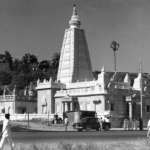
Three, the second part of the chapter is Bombay’s little-known Japanese legacy, which is representative of the social and cultural ecosystem built in the early 20th century because of a sizeable Japanese community in the city. This is still used by the much smaller Japanese expatriate community even today. It includes the Japanese cemetery on Dr E. Moses Road and the Japanese Temple at Worli Junction (Naka).
This built legacy was the result of:
1. A sizeable presence of Japanese expatriates’ resident in Bombay and its hinterland which resulted in building a religious-social-cultural ecosystem like a Japanese Gymkhana and the establishment of a cemetery. The Gymkhana no longer exists, but ample documentary evidence is available about where it was located and it being a place for social activities. There were also Japanese Buddhist priests working for the trading companies, who administered to the ritual and religious needs of this community.
2. The arrival of the Nippozan Myhoji, or ‘Japan Buddha Order’, which aimed at reviving Buddhism in its original homeland by rooting itself first in the expat Japanese community and later in its iconic leader Fuji Guruji’s interactions with Indian nationalists, especially with Mahatma Gandhi at Gandhiji’s Wardha Ashram, in the cotton-growing hinterland of today’s state of Maharashtra, is important. Everyone knows about the Indian National Army and Netaji Subhash Chandra Bose’s recourse to Japanese support to overthrow the British in India, but not a lot is commonly known about Japanese supporters of Indian nationalism who either visited or lived in India.
3. Lastly, the city of Bombay, already a node for international prostitution, was host to the Japanese Karayuki San (Little Miss Gone Overseas), or Japanese women from the impoverished islands of Analusa, part of western Kyushu, who either passed through Bombay or resided in the city and its hinterland. These women sent home their earnings in order to support their impoverished fishing and agricultural families.
Sifra Lentin is Bombay History Fellow at Gateway House.
This an excerpt from the chapter titled ‘Japan in Bombay and its presidency: trade, community, and the Japan Buddha Order (19th to mid-20th century)’ which appears in the book ‘Geographies of Exchange between India and Japan’ edited by Sushila Narasimhan and Parul Bakshi, published by The Kizuna India Japan Study Forum (2025).
You can access the full book here.
It is republished here with permission.
References:
[1] Keiretsu is a Japanese term referring to a business network made up of different companies, including manufacturers, supply chain partners, distributors, and occasionally financiers.
[2] Cotton yarn was initially the main export till Japan began setting up its own spinning mills. The first spinning mill in Japan was the Osaka Spinning Mill established in 1888. Later ginned cotton formed the bulk of exports from India, alongside Chinese and American cotton, all feeding into the Japanese spinning and weaving industry.