
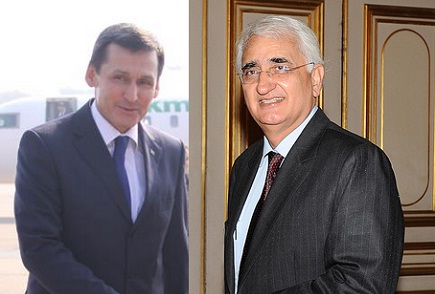
The Deputy Prime Minister and Foreign Minister of Turkmenistan, Rasit Meredow, will visit India from 21-23 January to attend the 4th India-Turkmenistan Inter-Governmental Commission on Trade, Economic, Scientific, Consular and Cultural cooperation. During this three-day visit, he will meet his Indian counterpart-Salman Khurshid, President Pranab Muhkerjee, and Minister of Petroleum and Natural Gas-Verappa Moily, among others.
The two sides are expected to discuss the progress of the troubled 1680 km long transnational Turkmenistan-Afghanistan-Pakistan-India (TAPI) gas pipeline – a project which is expected to be operational in August 2017. Once operational, the TAPI pipeline will have a capacity of carrying 90 million metric standard cubic metres (mmscmd) of gas a day for a 30-year period. India and Pakistan would get 38 mmscmd each, while the remaining 14 will be supplied to Afghanistan.
India and Turkmenistan have shared strong bilateral, historic and political ties for two decades now. The India-Turkmenistan bilateral trade stood at $60.48 million in 2011-2012, with the balance in favour of India. Interestingly, Turkmenistan is the only country in the region which is not a part of the Russia-China alliance on regional security and economic cooperation, and the Shanghai Cooperation Organisation.
Given India’s increasing thirst for hydrocarbon reserves, an enhanced engagement with the Central Asian gas giant – which holds 4% of the world’s natural gas reserves – assumes much significance.
But to find a strategic place in Central Asia, India will have to energetically multiply its efforts. It is just the latest in a long line of countries that have been vying for a presence in, and ultimately influence over, the resource-rich region.
Gateway House’s Katherine Foshko, in her paper, titled ‘India in Central Asia: Time for a New Strategy,’ explains how India, a latecomer to the game and at a disadvantage geographically and financially, can strategize its arrival on the Central Asian scene?