
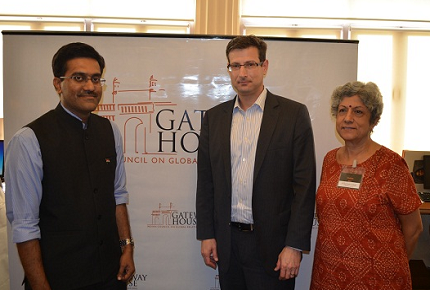
With the military drawdown in Afghanistan, United States continues to face a vast array of challenges in the South Asian region. Despite its apparently smooth political transition, Afghanistan continues to be affected by corruption and a highly divisive polity. Moreover, there are still lingering concerns over the capacity of the Afghan Security Forces to fend off the resurgent Taliban. Afghanistan’s neighbour Pakistan continues to grapple with political instability, rising militancy and extremism that threatens regional stability and relations with India, the fastest growing economy in the region.
Post Prime Minister Narendra Modi’s visit to the U.S, advancing a meaningful bilateral relationship with India, achieving a sustainable and effective policy towards Pakistan, and developing a regional policy for South Asia is of great consequence for the U.S.
Sameer Patil, Associate Fellow, National Security, Ethnic Conflict & Terrorism, Gateway House was in conversation with Daniel Markey, Senior Fellow for India, Pakistan and South Asia, Council on Foreign Relations to discuss the strategy the U.S. is likely to adopt closer to its troop drawdown from Afghanistan. The meeting aimed to answer questions such as – Will the U.S. consider each of the South Asian nations for their own merit or will it be part of the broader Pivot to Asia strategy? How will China influence U.S. policies in Afghanistan, Pakistan and India? Can the U.S. forge a more strategic, cohesive, and successful policy towards South Asia after 2014?
This meeting was the sixth in the Gateway House G20 Series.
Gateway House meetings are off-the-record and not for attribution and are open to members only. To know more about becoming a member, click here.