
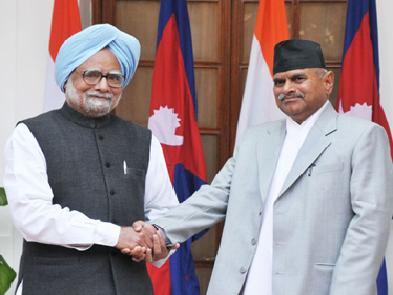
The President of Nepal, Ram Baran Yadav, will visit India from December 24-30, making this his third bilateral visit to India since assuming power in 2008. During this six-day visit, he will meet President Pranab Mukherjee and Prime Minister Manmohan Singh among others in the leadership.
The two sides are expected to discuss the current state-of-affairs of the bilateral relations between the neighbours, and the political chaos in Nepal.
Following his meeting with his Indian counterparts, he will visit the Benaras Hindu University, where he is scheduled to receive an honorary Doctorate of Letters.
This visit comes at a time when the Nepalese leadership is battling a constitutional and political deadlock; it is currently being administrated by a care-taker government headed by former Prime Minister Baburam Bhattarai – ever since their Constituent Assembly was dissolved in May 2012.
The India-Nepal Treaty of Peace and Friendship, signed in 1950, forms the basis of strong bilateral ties between these two neighbours. However, issues involving trade and transit rights have hindered the progress of this relationship since the 1970s. India is Nepal’s largest trading partner, given the open borders, and the fact that 48% of its FDI comes from India. Along with cooperation on mutual security issues, India also supports the institutionalization of multiparty democracy in Nepal through the framing of a new constitution by a duly elected Constituent Assembly.
Given that Nepal is our immediate neighbour, and we share porous borders, it is essential for New Delhi to ensure political and social stability in Kathmandu.