
India-Pakistan relations have turned frosty, after hopes of rapprochement during the early days of the Narendra Modi government. Indian policy makers cite the continuing activities of terrorist groups in Pakistan as a key hindrance to normalising relations, whereas Pakistan has accused India of fomenting instability within Pakistan. The competition between the two countries for influence in volatile Afghanistan has introduced an additional dimension to the bilateral ties.
With India’s security concerns and Pakistan’s attempts to destabilise Kashmir, thwarting any substantial progress on bilateral trade and economic relations, what are the prospects for both the countries to engage co-operatively? What are the varying perceptions of the Indian Army and Pakistani Army of the security situation in Afghanistan? What steps need to be taken by the political leadership in New Delhi and Islamabad to resume dialogue?
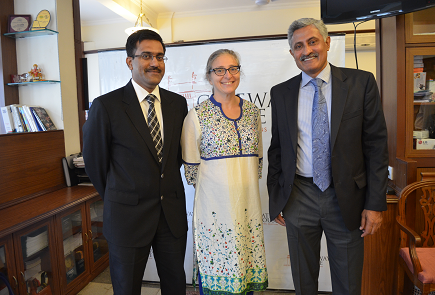
Gateway House held a meeting on ‘Afghanistan-Pakistan-India: Latest developments and projections’ with Lt. General K. Surendranath and Christine Fair moderated by Sameer Patil, providing key insights on this evolving regional security situation and what lies ahead for India and Pakistan.
Lt. General K. Surendranath, Former Chief of Staff, Southern Command, Indian Army
Lt. General K. Surendranath recently retired from the Indian Army after 40 years of service. He graduated from the National Defence Academy in 1975. He has represented India in the Iran Mission of the UN. He has set up the defence cooperation cell for the Indian Army and promoted cooperation with a number of regional & European Countries, for which he was awarded a Sena Medal. His thesis on “Lean Management” in the Indian Army and its implementation won him a Vishisht Seva Medal. Among his many other honours are the Bar to Ati Vishisht Seva Medal, Param Vishisht Seva Medal for his performance as commander of field formations on the Pakistan and Chinese borders and the Sword of Honour and the Silver medal. He has a MSc in Defence Studies and a Masters degree in Global Security & IR from Cranfield University, UK. He is currently a visiting lecturer at military and educational institutions.
Christine Fair Visiting Fellow, Gateway House
Christine Fair obtained her PhD from the University of Chicago, Department of South Asian Languages and Civilizations in 2004 and an MA from the Harris School of Public Policy in 1997. Prior to joining the Security Studies Program (SSP) within Georgetown University’s Edmund A. Walsh School of Foreign Service, she served as a senior political scientist with the RAND Corporation, a political officer to the United Nations Assistance Mission to Afghanistan in Kabul, and as a senior research associate in USIP’s Center for Conflict Analysis and Prevention. Her research focuses upon political and military affairs in South Asia. She has authored, co-authored and co-edited several books including Cops as Counterinsurgents: Policing Insurgencies edited with Sumit Ganguly, Cuisines of the Axis of Evil and Other Irritating States (Lyons Press, 2008); Treading Softly on Sacred Ground: Counterinsurgency Operations on Sacred Space edited with Sumit Ganguly (OUP, 2008); among others and has written numerous peer-reviewed articles covering a range of security issues in Afghanistan, Bangladesh, India, Pakistan, Iran, and Sri Lanka. She is also a senior fellow with the Combating Terrorism Center at West Point.
Sameer Patil, Fellow, National Security, Ethnic Conflict & Terrorism, Gateway House
Sameer Patil is Fellow, National Security, Ethnic Conflict & Terrorism studies, Gateway House. Prior to this, he was Assistant Director at the National Security Council Secretariat in Prime Minister’s Office, New Delhi. Sameer has interned at the Indian Pugwash Society and the M. L. Sondhi Institute of Asia Pacific Affairs. He has written extensively on various aspects of national security including cyber security, fake currency, terrorism, India-Pakistan relations, India-China relations, the Kashmir issue and nuclear proliferation for various magazines, journals and newspapers.