


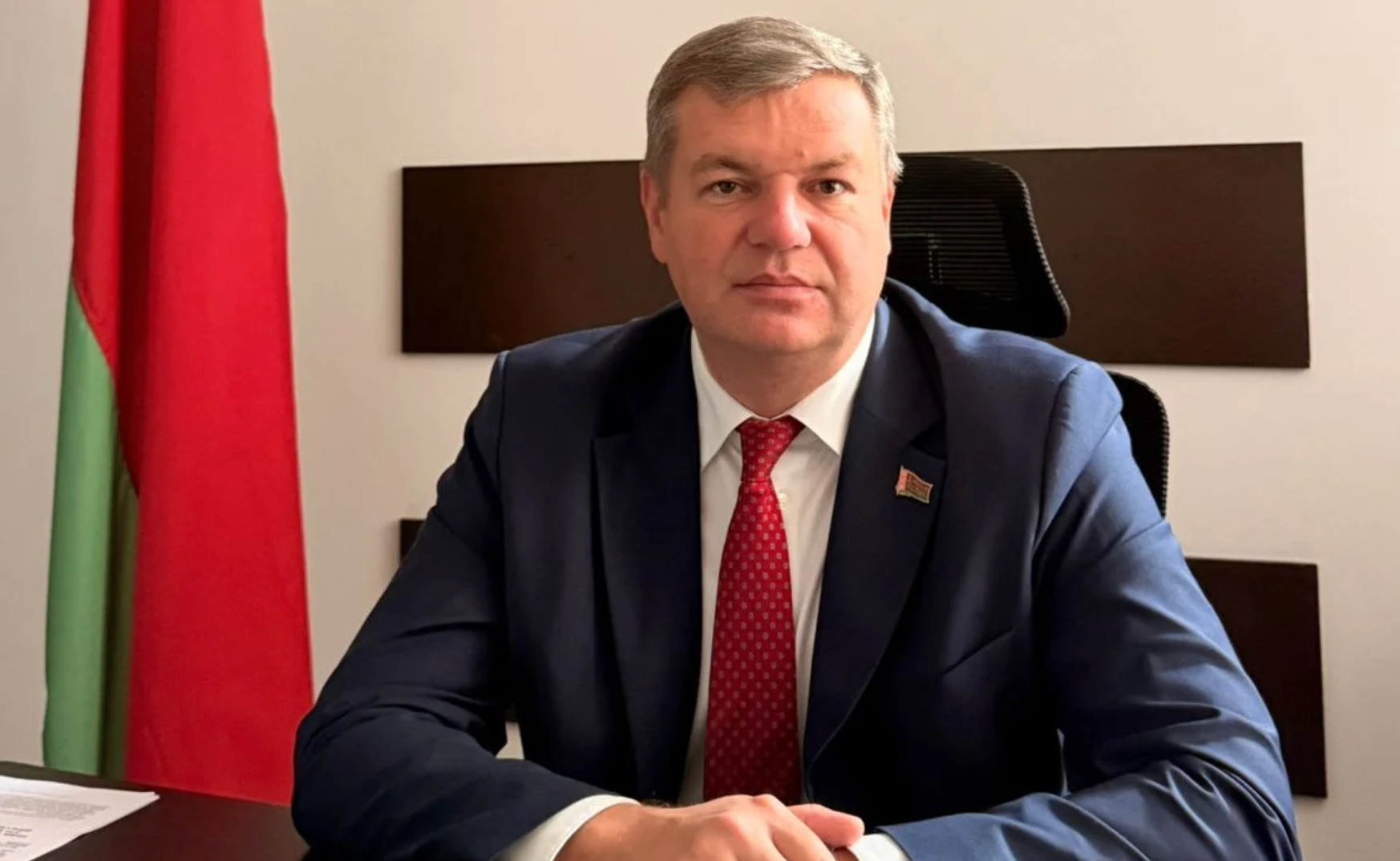
Mikhail Kasko has been Belarus’s Ambassador to India since 2024 and is the non-resident Ambassador to Nepal, Sri Lanka, and Bangladesh.
Ajay Kamalakaran (AK): How does Belarus view its growing partnership with India?
Mikhail Kasko (MK): Belarus is open to cooperation with the entire world. We value each of our foreign trade partners. India as one of the most promising areas in Asia – politically, economically, and culturally. The interest is mutual, and cooperation between our official and business circles has significantly intensified and deepened in recent years.
What is particularly gratifying is the mutual and multifaceted interest in developing relations between our countries.
Since 2025, two high-level meetings have taken place between our leaders – H.E. Mr Aleksandr Lukashenko, President of Belarus, and H.E. Shri Narendra Modi, Prime Minister of India. Belarusian Foreign Minister Maxim Ryzhenkov visited Delhi in September for the 18th BRICS Summit. In 2026, India also hosted the Chairman of Belarus’s Supreme Court, the Chairman of the National Academy of Sciences of Belarus, the Chairman of the Federation of Trade Unions of Belarus, the Minister of Health, and the deputy heads of the Foreign and Culture Ministries. Our foreign ministers regularly meet on the sidelines of the UN, BRICS, the SCO, and the Non-Aligned Movement.
In October 2025, Minsk hosted the 8th round of political consultations at the level of deputy foreign ministers. Ambassador Sibi George, Secretary (West), Ministry of External Affairs, participated in this event and also led the Indian delegation to the Third Eurasian Forum on Security.[1] We are expecting the visit of Indian Chief Justice Surya Kant to Belarus soon, where we hope both the Supreme Courts will sign a memorandum of cooperation.
Together, all these engagements signal to our business and humanitarian communities to step up their work on relevant tracks.
AK: Is there a possibility of regularising the schedule of high-level government meetings, as the bilateral engagements pick up?
MK: I think so. Our leaders met again on the sidelines of the SCO, this time in Bishkek, and there’s a high probability that another meeting could take place as early as early next year in New Delhi between the two leaders. We are actively working to coordinate their schedules.
AK: During the brief India-Pakistan military confrontation in May 2025, Belarus reaffirmed its friendship with both countries and called for an end to hostilities, but some members of the Indian establishment believe Minsk is closer to Islamabad than to New Delhi. Is there any truth to this?
MK: I have already noted that we are open to cooperation with the entire world; this is the main principle in our work with our partners. At the same time, Belarus’s position remains unchanged: we are categorically opposed to resolving conflicts through military means. We have a saying: “A bad peace is better than a good quarrel.” The only sensible way to resolve the conflict between the parties is through peaceful negotiations. There is no change in this position, and none is expected in the future.
As for relations with your neighbours, they are built solely on the principle of non-interference in the affairs of third countries. No country can accuse us of building relationships and friendships against anyone.
Let’s continue to build on these basic principles.
AK: Belarus aspires to become a full member of BRICS and believes it can count on India’s support.
MK: We are certainly interested in full membership. BRICS is one of the most dynamically developing interstate cooperation organisations. Its scale is truly impressive. It is home to nearly half the world’s population, occupies 25 per cent of the world’s land area, 40 per cent of global GDP, 45 per cent of the world’s oil reserves and 30 per cent of its natural gas reserves.
India supported Belarus’ full membership in SCO in 2024 and our candidacy to become a BRICS partner country, for which we are immensely grateful.
These international organisation accessions have opened new opportunities in trade, investment, technology, and joint projects. They have also created opportunities for social and cultural exchanges such as student exchange programmes, research projects, and scientific initiatives. Member countries gain access to these programmes, which will contribute to the advanced training of young people, the development of scientific potential, and integration into the global scientific community. Cultural ties with countries such as India will open new horizons for Belarus in joint projects in the arts and popular culture.
Our positions on many global issues are similar or closely aligned, and our work at various international forums, be it the UN, BRICS, or the SCO, is characterised by constructiveness and mutual support.
We, therefore, sincerely count on our Indian friends’ support for Belarus’ full BRICS membership.
AK: How would you describe the defence and security partnership between our countries?
MK: The India-Belarus defence and security partnership is constructive and trusting and has been steadily developing since Belarus gained independence in 1991. Today, this cooperation encompasses a range of areas in the military-technical and defence spheres.
Our defence ministers hold regular working meetings. Our positions on global and regional security issues and the need to pursue dialogue and diplomacy to resolve international conflicts largely coincide.
The positions of the Belarusian and Indian defence ministries on pressing global and regional security issues largely coincide. Belarus and India agree on the need to pursue dialogue and diplomacy to resolve international conflicts.
One of the most dynamic developing areas of cooperation is military education. Belarusian military personnel regularly train in India, and we hope this will continue, as we highly value the training in India.
In turn, we invite representatives of the Indian armed forces to observe combat training events in Belarus.
AK: Bilateral trade between the countries remains significantly below potential. What can be done to strengthen trade ties, and where does the potential lie?
MK: According to Belarusian statistics, the volume of bilateral trade in goods and services between the countries exceeded $1 billion for the first time in 2025, and the upward trend will continue in 2026.
Cooperation in the pharmaceutical industry is developing very dynamically. Belarus imports significant quantities of medicines and pharmaceutical substances, and Belarusian and Indian companies already jointly produce pharmaceuticals. We want to expand joint pharmaceutical production in Belarus and invest in technology transfer and development of new drugs.
In turn, Belarus can increase the export of trucks and mining equipment for India’s infrastructure projects. I believe we have good growth potential here. Our BELAZ mining dump trucks[2] already operate in Indian coal quarries; they are strong in heavy segments and offer an attractive price-to-quality ratio. We are currently exploring the supply of electric mining dump trucks, which offer fuel efficiency and environmental benefits.
Light-duty dump trucks that are manufactured in India make it difficult for us to compete in this segment, but we are seriously exploring the possibility of establishing an assembly line with Indian partners. Supplies of mechanical engineering products and the establishment of assembly plants in India should drive export growth and strengthen the position of Belarusian goods in the Indian market.
We see a scope in developing cooperation with India on Artificial Intelligence, digital public infrastructure and telecommunications, nanotechnology, new materials, and high-precision engineering as of interest. Belarus has a strong school of applied science, programming, and microelectronics, while India has a developed IT sector with biopharmaceuticals expertise. This work runs through the Joint Commission on Science and Technology, joint research grants, and technology transfer.
To scale trade ties between Belarus and India, a comprehensive approach beyond the traditional “buy and sell” model is required. Given India’s emphasis on the “Make in India” programme, simple exports of finished goods are limited, so a shift to joint production and localisation is essential.
We hope to discuss these opportunities in more detail at the 12th meeting of the Intergovernmental Commission, scheduled for mid-November 2026 in New Delhi.
The early signing of the India-Eurasian Economic Union Free Trade Agreement[3] will significantly ease market access.
It is important that trade turnover grows through new niches, not just traditional positions.
AK: What other areas of bilateral and multilateral cooperation exist?
MK: Education is one. Thousands of Indian students study at Belarusian universities, primarily medical and engineering institutions in Minsk, Vitebsk, and Grodno, drawn by the quality, affordability, and safety.
India, in turn, provides grants for the training of Belarusian specialists under the Indian Technical Economic Cooperation (ITEC) programme. A Joint Commission on Scientific and Technical Cooperation is also active. Joint projects are being implemented in the fields of nanotechnology, optics, laser systems, and materials protection.
Health and recreation programmes for Indian children at the Zubrenok National Children’s Educational and Health Centre are becoming a good tradition. By decision of the President of Belarus, all travel and recreation expenses for the children are covered. Since 2025, two groups of Indian children have completed their health improvement programme at this centre.
For cultural cooperation, we will intensify mutual exchanges of theatre, music, and dance groups. I am also pleased to note the ongoing mutual participation of filmmakers and directors in film festivals held in Belarus and India.
We are pleased to invite leading Indian directors and actors on the jury of our annual Listapad Film Festival.
AK: What is being done to improve people-to-people ties?
MK: Intensifying contacts between our official and business communities, as well as deepening cooperation in various fields, requires appropriate conditions. We are actively working to create a favourable climate for this.
A direct Minsk-Delhi flight was launched in 2023, connecting our capitals. We are currently working on opening two new additional routes: Minsk-Mumbai and Minsk-Goa.
Since September 2026, Indian citizens can apply for an e-visa without travelling to Delhi or Mumbai.
We are also working on raising awareness of Belarus among Indian citizens and businesses.
We have organised two visits by Indian bloggers to Belarus, and Belarusian creative groups are visiting India more often.
AK: Apart from Mumbai, which other Indian cities are key for Belarus?
MK: The sister-city initiative came from the Indian side. After visiting Moscow in May 1985, Indian Prime Minister Rajiv Gandhi visited Minsk and noted its similarities with Bangalore. This year marks the 40th anniversary of the Minsk-Bangalore cooperation agreement. Minsk has a Bangalore Square, and Bangalore has a Minsk Square. This is our happy history.
Additionally, memoranda of understanding between the states of Maharashtra, Gujarat, Madhya Pradesh, and Uttar Pradesh and several Belarusian regions are currently in the final stages.
To deepen cooperation at the regional level, besides, we have a Consulate General in Mumbai and an Honorary Consulate in Kolkata, and we are working to open an Honorary Consulate in Bangalore.
Ajay Kamalakaran is a writer with a special interest in Russia and the former Soviet Union.
This interview was conducted exclusively for Gateway House: Indian Council on Global Relations, and has been edited and abridged for clarity and brevity. You can read more exclusive content here.
For permission to republish, please contact outreach@gatewayhouse.in
©Copyright 2026 Gateway House: Indian Council on Global Relations. All rights reserved. Any unauthorised copying or reproduction is strictly prohibited.
References:
[1] The Minsk International Conference on Eurasian Security is a representative international forum held annually in Minsk, Belarus.
[3] A customs union of five countries, including Belarus, Russia, Kazakhstan, Kyrgyzstan, and Armenia