

The Arctic as a region sits at the crossroads of a shifting world order, exemplified recently by the Trump Administration’s audacious rhetoric about control of Greenland. The politics in the region certainly reflect the logic of both cooperation and competition: Transboundary processes and interconnections necessitate regional coordination across the Arctic. At the same time, national security concerns – such as military positioning across the NATO-Russia divide – necessitate the logic of competition. Rapid environmental alterations, driven by global climate change and likely to precipitate the first ice-free summer day in the Central Arctic Ocean before 2030,[1] continue to reshape both Arctic governance and security.
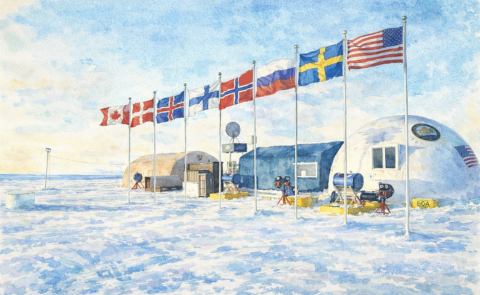
Much of what is understood as the Arctic lies under the sovereignty or jurisdiction of the eight Arctic states – Canada, Denmark (via Greenland/Faroe Islands), Finland, Iceland, Norway, Russia, Sweden, and the U.S. – and overlaps with the interconnected homelands of Arctic Indigenous peoples. Parts of the Central Arctic Ocean, at the top of the world, are designated as ‘high seas’ under the UN Convention on the Law of the Sea—the ‘ocean constitution’ that grants coastal states their exclusive economic zones while also safeguarding the rights of other users.
The Arctic Council has, for three decades, brought together the Arctic states, the Indigenous peoples of the region, and leading scientific expertise to address cross-border environmental and social challenges. India has served as an accredited observer to the Arctic Council since 2013 and is therefore positioned to make regular contributions to Council working group projects. Building on the assessments and outcomes produced by the Arctic Council, several key regional and bilateral binding agreements have been negotiated in recent decades. They address search and rescue, oil spill preparedness and response, and marine traffic management (for example, in the Bering Strait) and establish a precautionary approach to potential future fisheries in the Central Arctic Ocean.
The Arctic Council’s cooperation was impacted by Russia’s invasion of Ukraine in 2022, with the other Arctic states suspending cooperation with Russia while the country held the rotating chairmanship role.[2] Today, under the Kingdom of Denmark (including Greenland and the Faroe Islands), the Arctic Council continues its work on social and environmental issues at a ‘low politics’ level primarily in working groups, with high-level political cooperation still largely on ice as a continuing response to Russia’s war in Ukraine.[3]
Pressing security concerns and abruptly changing economic patterns stress-test these cooperative arrangements. The Arctic has long held strategic significance for all Arctic states.[4] The accession of Finland and Sweden to the North Atlantic Treaty Organization after the Russia-Ukraine war means that seven of eight Arctic states are NATO members. This has given new impetus to security coordination in the Arctic among the NATO states. Statements by the U.S. administration about its “need for Greenland” for strategic purposes, combined with U.S. President Donald Trump’s refusal to rule out the use of military force, certainly have had a chilling effect across the broader transatlantic security community—even as military-level cooperation and coordination within NATO continued uninterrupted.
While the need to stand firmly by the sovereignty of the Kingdom of Denmark continues to be an important foreign policy position for the Nordic countries and Canada, this period of tension has also resulted in a NATO-wide consolidation of Arctic-related military measures in the newly launched Arctic Sentry, which coordinates and synchronises Arctic initiatives carried out by NATO member states.[5]
Growing interest in minerals essential to the green transition and to modern defence systems has also brought heightened attention to the Arctic, as states seek to counterbalance China’s dominance in mining and refining these critical minerals and to “friendshore” key supply chains.[6] Critical minerals were, for example, initially cited as one justification for increased U.S. interest in Greenland. While reserves of important minerals can indeed be found across the Arctic region, with 23 of 34 critical raw materials as defined by the EU to be found in Greenland,[7] the lack of infrastructure to support extraction makes mining a logistically daunting and expensive undertaking, and interest often turns to reserves in more accessible climes. Even as Arctic sea ice patterns continue to change and retreat seasonally in the coming decades, physical distance, prolonged darkness, uneven and shifting ice conditions, and the continued absence of supporting infrastructure will all remain major factors shaping the scope and feasibility of human activity in the region.[8]
The Arctic region is embedded within a global political landscape that is increasingly unpredictable. In such a fragmented world, the ability to stitch together networks across multiple scales and to make effective use of the governance tools already available is essential. One such could be for all states wishing to support a safe, sustainable and governed Arctic to work with private sector actors to increase adherence to international shipping regulations, such as the Polar Code.[9]
The Norwegian playwright Henrik Ibsen wrote that one should never wear one’s best trousers when setting out to address important political challenges. His words are a reminder that the work ahead in Arctic governance, and relatedly in global governance for oceans, ecosystems, and broader planetary challenges, may be incremental and frustrating yet remains indispensable.
Elana Wilson Rowe is an Adjunct Research Professor at the Norwegian Institute of International Affairs and Professor of Global Governance at the Norwegian University of the Life Sciences.
This article was exclusively written for Gateway House: Indian Council on Global Relations. You can read more exclusive content here.
For permission to republish, please contact outreach@gatewayhouse.in.
Support our work here.
©Copyright 2026 Gateway House: Indian Council on Global Relations. All rights reserved. Any unauthorised copying or reproduction is strictly prohibited.
References:
[1] Heuzé, C. & Jahn, A. 2024. The first ice free day in the Arctic Ocean could occur before 2030, Nat Commun 15, 10101, https://doi.org/10.1038/s41467-024 54508-3
[2] Spence, Jennifer, Hannah Chenok, Elana Wilson Rowe, Malgorzata Smieszek-Rice, Margaret Williams and Fran Ulmer. “Arctic Climate Science: A Way Forward for Cooperation through the Arctic Council and Beyond.” Belfer Center for Science and International Affairs and UiT The Arctic University of Norway, March 18, 2024
[3] Balton, David and Stirling Haig. “Revitalizing the Arctic Council.” Belfer Center for Science and International Affairs, February 24, 2026
[4] Friis, Karsten and Elana Wilson Rowe. Keeping Your Cool: Arctic Security Challenges across Time and Space, an Input Memo to the Arctic Security Roundtable at the Munich Security Conference. NUPI. https://www.nupi.no/publikasjoner/cristin-pub/keeping-your-cool-arctic-security-challenges-across-time-and-space, February 2026.
[5]Boulègue, Mathieu. “NATO Awakens in the High North“. CEPA, March 19, 2026
https://cepa.org/article/nato-awakens-in-the-high-north/
[6] IEA (2025), Global Critical Minerals Outlook 2025, IEA, Paris https://www.iea.org/reports/global-critical-minerals-outlook-2025, Licence: CC BY 4.0; Leonard Schütte, “Economics: Trade Off,” in: Tobias Bunde/Sophie Eisentraut/Leonard Schütte (eds.), Munich Security Report 2024: Lose-Lose?, Munich: Munich Security Conference, February 2024, 79-85, https://doi.org/10.47342/BMQK9457.
[7] Government of Greenland, EU and Greenland sign strategic partnership on sustainable raw materials value chains, https://govmin.gl/2023/11/eu-and-greenland-sign-strategic-partnership-on-sustainable-raw-materials-value-chains/
[8] Friis, K, Mike Sfraga & Elana Wilson Rowe. 2025. Memo to the Arctic Security Roundtable: The geopolitics of Arctic economic activities. NUPI Research Paper, 1/2025. https://www.nupi.no/publikasjoner/ cristin-pub/memo-to-the-arctic-security roundtable-the-geopolitics-of-arctic economic-activities
[9] https://www.imo.org/en/mediacentre/hottopics/pages/polar-default.aspx