

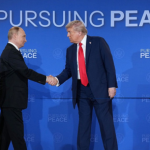
Of various categories of summits – multilateral, plurilateral, regional, and bilateral, nothing triggers greater diplomatic and media frenzy than a wartime summit between the leaders of two great powers. This explains the enormous coverage and debate about the summit between U.S. President Donald Trump and Russian President Vladimir Putin, which took place in Alaska on August 15.
The summit lasted for about three hours. Soon thereafter, the two leaders addressed a joint conference but did not take questions from the media. Clearly, they managed to hold substantive discussions but preferred to keep it between them for the present. The reason is obvious: President Trump, under intense pressure from Ukraine and his European allies, desired to first brief them about the outcome.
But several aspects were notable from the leaders’ remarks to the media. There was an apparent divergence between their overall summing up. Putin observed that they reached “an understanding” and cautioned Europe not to “torpedo the nascent progress.” On the other hand, Trump downplayed the result, saying they did not reach a deal to end the war. However, he added, “Many points were agreed to. There are just a few that are left. Some are not that important. One is probably the most significant, but we have a very good chance of getting there.”
The stakes are high. The only major war in Europe since World War II is now three and a half years old. Since its commencement on February 24, 2022, there has been no dearth of mediators, negotiations, and secret initiatives to end the Russia-Ukraine conflict. The combatants, Europe, and the rest of the world are tired of this long war of attrition; all want it to end soon. Trump, who proclaimed that he would end the war in 24 hours – “it won’t take even that long” – has been struggling in his diplomatic efforts for the past six months. Is he now getting close to a breakthrough?
The objective and reliable answer lies in four key locales: the Kremlin, Washington, Chevening House in Kent and Anchorage.
On August 6, U.S. special envoy Steve Witcoff met Putin in the Kremlin. This was their fifth meeting. It took place amidst U.S. warnings that if by August 8 Moscow did not agree to end the war, it would face new financial penalties. Action then shifted to the White House, where Trump announced on August 8 that he would have a summit meeting with Putin on August 15.
Several venues were considered and abandoned, like the UAE, before Alaska was finalised. There was also speculation whether Ukraine’s President Volodymyr Zelenskyy would participate in the summit, but it was ruled out. Clearly, Putin was opposed to it, whereas Trump tried to arrange it in some form but failed.
Meanwhile at Chevening House, where U.S. Vice President J.D. Vance is residing on a busman’s holiday, held a meeting with the European officials. Prior to that, select European leaders (of France, Germany, Italy, Poland, Britain, Finland, and the EU as an institution) articulated their position on August 10 through a joint statement. “The path to peace in Ukraine cannot be decided without Ukraine,” it insisted, even while welcoming Trump’s work to stop the war and seek peace.
Finally, Alaska, the venue of the summit, fascinating for its remoteness and aura of adventure, whose location and history (Alaska was part of Russia until Moscow sold it to the U.S. in 1867 for $ 7.2 million.) that makes the U.S. and Russia immediate neighbours, was significant. At the summit’s end, Putin announced that “thorough negotiations” took place, and Trump called it “a productive meeting.” Putin confirmed Trump’s repeated claims that had the latter been the U.S. president in 2022, the Russia-Ukraine war would not have started.
This convergence is welcome. Prior to the summit, a wide gulf existed between the sides on the issues of substance. Primarily on the border issue, Ukraine and Europe stated they were “committed” to the principle that international borders must not be changed by force. In contrast, Russia asserted its claim on part of the Russian-speaking Ukrainian border regions of Donetsk, Luhansk, Zaporizhia and Kherson. The U.S. President, in his dual role as the highest representative of the West and the mediator, said there would be “swapping of territories for the betterment of both sides.” Other contentious issues included the question of a ceasefire, followed by detailed negotiations, security guarantees against future invasions, and the protection of the security interests of Ukraine and Europe.
From Chevening, Vice President Vance said that the U.S. was aiming for a settlement that both sides could accept but in a moment of candour, admitted that no side would be “super happy,” that a negotiated settlement between Russia and Ukraine was unlikely to satisfy either side. Given the heavy political investment made by both Trump and Putin, the Alaska summit may result in making some progress.
A response by Zelenskyy through social media platform X reaffirmed Ukraine’s “readiness to work with maximum effort to achieve peace.” He expressed support for Trump’s proposal for a trilateral meeting between Ukraine, the U.S., and Russia. Zelenskyy will be visiting Washington on August 18, accompanied by several European leaders to ensure against a repeat possible fiasco like the previous Trump-Zelensky encounter in the White House.
European leaders of ‘the Coalition of the Willing’ articulated support for U.S. efforts, expressing their preference for a quadrilateral meeting – “a trilateral summit with European support” – and the need for “ironclad security guarantees” for Ukraine’s sovereignty and territorial integrity.
Several other nations have commented positively on the Alaska outcome. India and China have publicly expressed support for the direct meeting between the U.S. and Russia. Prior to the summit, Prime Minister Narendra Modi held telephonic conversations with both Putin and Zelenskyy, emphasising his advocacy for an early diplomatic settlement. The summit was welcomed as “commendable,” reflecting New Delhi’s long-held view that the only way forward was through “dialogue and diplomacy.”
The stakes for India are particularly high, given the threat of an additional 25% tariffs on India post August 27, if the country does not stop buying Russian oil. A resolution will give India’s diplomacy and economy much-needed breathing space and a chance to resume talks on an India-U.S. trade agreement.
China too has a stake in a positive outcome, for another significant summit will be held on August 31 – the meeting of the heads of state of the Shanghai Cooperation Organisation, which China as the rotating President, will host at Tianjin. The Alaska and Tianjin connection? If the Alaska meeting is viewed to have achieved solid progress, the assembly of leaders in China may contribute to further easing of East-West tensions. On the other hand, if Alaska is judged as a failure, the spectacle of Putin, Modi, and Xi Jinping holding hands together with a large group of leaders may be viewed somewhat negatively in Western capitals, especially Washington.
The Alaska summit has started something significant and valuable – a serious effort to resolve the Ukraine conflict. However, a positive end of the process is, by no means, guaranteed. The road ahead will be difficult and torturous. But if the parties concerned are willing to undertake a fair ‘give and take’, this is the time for them to pursue it with diligence.
The U.S. President is working for international peace and his nation’s interests. To claim that his sole motivation is to win the Nobel Peace Prize is to betray bias and an inadequate understanding of a highly complex and complicated matter.
Rajiv Bhatia is the Distinguished Fellow for Foreign Policy Studies, and a former ambassador.
For permission to republish, please contact outreach@gatewayhouse.in.
Support our work here.
©Copyright 2025 Gateway House: Indian Council on Global Relations. All rights reserved. Any unauthorised copying or reproduction is strictly prohibited.