

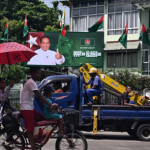
On December 28, Myanmar is heading to the polls – the first to be held since 2021 when the Tatmadaw (Myanmar military) overthrew an elected government, and plunged the country into a complex, multi-faceted civil war.[1] Several parties are in the fray: the Tatmadaw-proxy Union Solidarity and Development Party (USDP), the National Unity Party (NUP), the People’s Pioneer Party, the Myanmar Framers Development Party, and the Shan and Nationalities Democratic Party (White Tiger), will contest, among 61 others.
The first phase of the upcoming elections will begin on December 28, 2025. The second and third phases are scheduled for January 11 and 25, 2026, including townships where multiple anti-junta people’s defence forces (PDFs), ethnic armed organisations (EAOs) and ethnic revolutionary organisations (EROs) operate with varying degrees of autonomy and alternative governance structures.[2] Elections are proposed to be held for representation in the national and seven state and seven regional legislatures.[3] According to the military-drafted 2008 Constitution, additional seats in the combined upper and lower house are reserved for defence services personnel nominated by the Commander-in-Chief.[4][5][6][7]
The outcome seems foretold: military-proxy and affiliated parties will secure victory, even though its administration, the State Administration Council (SAC) controls just half of the country’s 330 townships, with the rest in control of anti-junta and pro-military forces. Since the Operation 1027 offensive in October 2023 by rebel groups which seized several key towns and military posts, the balance of power has been titling in their favour, based on their increasing territorial control. The exiled National Unity Government (NUG), whose 80-year-old pro-democracy icon Aung San Suu Kyi, has been detained at home since the coup, has been gradually improving its control at home. Internationally its recognition has grown particularly among Western nations, which are pressurising the Tatmadaw to release her. Yet, the resistance could not turn its battleground momentum into political achievements,[8] and the NUG has been unable to secure diplomatic superiority over the SAC, to determine the course of a feasible power-transition.
More broadly, international support for Myanmar is mixed. The region’s inter-governmental organisation, the Association of Southeast Asian Nations (ASEAN), has been working on internal consensus-building for Myanmar since the 2021 leaders’ meeting under Brunei’s chairmanship, when the Five Point Consensus (5PC) on Myanmar was adopted. It called for the immediate cessation of violence and constructive multiparty dialogue’,[9] but successive ASEAN chairs have not been able to unify member-states’ positions on it. Member states like Thailand, Laos and Singapore engage directly or indirectly with the SAC through bilateral and sub-regional forums.[10]
Myanmar’s immediate neighbours have continued to work in tandem with the country’s junta. This is particularly true for China, which is deeply embedded in the country across sectors with $22.7 billion in investment and $8 billion in trade. It supports both the Tatmadaw and the EAOs in this conflict, with arms and financial assistance. It mediates ceasefires internally for the junta, while providing diplomatic protection to Myanmar through the use of veto, blockage and abstention of United Nations (UN) resolutions, as in 2007, 2017 and 2022. India too, has followed suit, notably on the UNHRC Res 34/22 and the UNSC Res 2669 on the situation in Myanmar in 2017 and 2022 respectively. Thailand tactfully addresses its domestic labour shortage with incoming Myanmar refugees, while also providing political asylum to the resistance groups. Bangladesh, a comparatively less important neighbour, is plagued by its own political crisis while also hosting a 1.2 million externally displaced Rohingya community from Myanmar, which it aims to repatriate at the earliest.[11]
In the Asia-Pacific, Australia and Japan expectedly lend their moral support to democratisation primarily through declaration of principles. The EU is more pragmatic: despite strict regulations and sanctions, the EU’s democracies continue to import Myanmar’s famous teak,[12] effectively circumventing their own sanctions. Equally realistic is Russia, which in its geopolitical turn towards Southeast Asia, has increased its engagement with the Tatmadaw, investing $406 million in the defence and energy sectors in 2024-25.
The U.S bipartisan Congressional Caucus on Burma has remained largely silent.[13] In a confusing twist, on July 24, 2025, the second Trump administration relaxed several junta-targeted sanctions implemented by the U.S. department of treasury and previous U.S. presidential executive orders. More recent is the termination of the temporary protection status for Myanmar nationals, justified by claims that “the situation in (Burma) has improved enough” for citizens to return home.[14] It signals the incoherence of U.S. foreign policy towards Myanmar and a changing attitude toward the junta.
On its part, the SAC has strengthened its partnership with China, while diversifying relationships with Russia, India, and several regional actors. The U.S. and EU, too fatigued by conflict in Ukraine and West Asia, have not constructively intervened in Myanmar.
Meanwhile, Myanmar remains mired in the polycrisis: the bloody civil war continues, with a direct fallout on its borders with India; political prisoners[15] including Aung San Suu Kyi remain detained; mass displacement persists and press freedom is severely curtailed.[16] ASEAN has been unable to summon its heft and, along with the broader international community, vocalises its worry about the legitimacy of the upcoming elections under such circumstances.
Regardless, this election is about putting the derailed train of ‘limited democracy’ back on track. The restored system will stay strictly within the limits set by the 2008 Constitution and the junta will be in the lead. The opposition’s alternative vision of federal democracy remains frozen and abandoned. Can the post-election governance of Myanmar bring order, stability and freedom to create a viable basis for stability and economic growth? It depends entirely on the people of Myanmar and their genuine well-wishers in the world.
Dr. Dipannita Maria Bagh is a Senior Researcher, Southeast Asia Studies Programme.
This article was exclusively written for Gateway House: Indian Council on Global Relations. You can read more exclusive content here.
For permission to republish, please contact outreach@gatewayhouse.in
©Copyright 2025 Gateway House: Indian Council on Global Relations. All rights reserved. Any unauthorised copying or reproduction is strictly prohibited.
References:
[1] Anders Kirsten Moeller, “ISEAS Perspective 2022/65: The International Community Needs to Prepare for a Post-Tatmadaw Myanmar, June 17, 2022, https://www.iseas.edu.sg/articles-commentaries/iseas-perspective/2022-65-the-international-community-needs-to-prepare-for-a-post-tatmadaw-myanmar-by-anders-kirstein-moeller/.
[2] Dipannita Maria Bagh, “Myanmar’s multiple stakeholders for aid,” April 3, 2025, https://www.gatewayhouse.in/myanmars-multiple-stakeholders-for-aid/.
[3] Up for election are 330 Pyithu Hluttaw (People’s Assembly or lower house)[3] seats and 110 Amyotha Hluttaw (National Assembly or upper house)[3] seats.
[4] Art 14 provides power to the Commander-in-Chief of the defence services to nominate service personnel in stipulated numbers to the Pyidaungsu Hluttaw (Union Assembly) consisting of the Pyithu and Amyotha Hluttaw.
[5] Art 161(d) provides the Commander-in-Chief of the defence services, the power to nominate service personnel for a total of one-third of the representatives of the region and state Hluttaw.
[6] Art 109 (b) provides the Commander-in-Chief of the defence services, the power to nominate service personnel for a total of one-fourth, or 110 seats, of the representatives of the Pyithu Hluttaw.
[7] Art 141 (b) provides the Commander-in-Chief of the defence services, the power to nominate service personnel for a total of one-fourth, or 56 seats, of the representatives of the Amyotha Hluttaw.
[8] ISP-Myanmar, “Armed Struggle – Will It Lead to Political Resolution?,” September 16, 2025, https://ispmyanmar.com/armed-struggle-will-it-lead-to-political-resolution/
[9] Association of Southeast Asian Nations, “Chairman’s Statement on the ASEAN Leaders’ Meeting,” April 24, 2201, https://asean.org/wp-content/uploads/Chairmans-Statement-on-ALM-Five-Point-Consensus-24-April-2021-FINAL-a-1.pdf
[10] Vu Lam, “Myanmar and ASEAN’s parallel diplomacy trap,” June 20, 2025, https://www.lowyinstitute.org/the-interpreter/myanmar-asean-s-parallel-diplomacy-trap.
[11] Dipannita Maria Bagh, “Quid pro quo for Myanmar’s humanitarian corridor,” May 28, 2025, https://www.gatewayhouse.in/quid-pro-quo-for-myanmars-humanitarian-corridor/.
[12]European Parliament, “Parliamentary question – E-004101/2021: Teak imports from Myanmar and EU restrictions on the yachting industry,” September 7, 2021, https://www.europarl.europa.eu/doceo/document/E-9-2021-004101_EN.html#.
[13] U.S. Representative Young Kim (Youtube), “Rep. Young Kim Pushes Bipartisan Bill, No New Funds for Burma Act,” July 25, 2025, https://www.youtube.com/watch?v=9vs4jTjXyuM&t=24s.
[14] U.S. Citizenship and Immigration Services, “DHS Terminating Temporary Protected Status for Burma,” November 24, 2025, https://www.uscis.gov/newsroom/news-releases/dhs-terminating-temporary-protected-status-for-burma.
[15] Assistance Association for Political Prisoners (Burma): As of November 28, 2025, the total number of political prisoners are 300,45 with 22,704 still detailed under sentence, and 7500 confirmed killings, https://aappb.org/?p=35266.
[16] Rajiv Bhatia, “Myanmar, four years on,” February 6, 2025, https://www.gatewayhouse.in/myanmar-four-years/.