

In a rare development, U.S. Secretary of State Marco Rubio visited India from October 20 to 22, the second visit this year after his earlier trip in May. This time, however, it was in a different geography of India: Mumbai and Jamnagar, compared to Kolkata and Delhi previously.
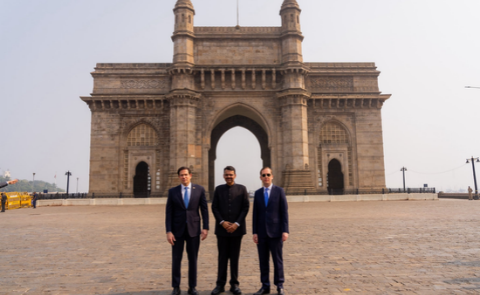
Two photographs defined the contours of the second visit – one showing Rubio and U.S. Ambassador to India Sergio Gor with India’s external affairs minister and foreign secretary in Mumbai, and the other showing the U.S. duo with Mukesh and Anant Ambani, Chief Managing Director and Executive Director, respectively, of Reliance Industries Limited, in Jamnagar. The second photo seemed to have drawn greater attention. This visit was no doubt about conventional diplomacy, but it was perhaps more about public diplomacy and economic diplomacy.
The visit was important because Rubio, besides being the secretary of state, is also the national security adviser and a potential Republican candidate for president or vice president in the 2028 elections. This time his meetings in India presented a chance to evaluate the trajectory of India-U.S. relations since the Trump administration began its second innings in January 2025.
In the background of steady bipartisan support for a strong India-U.S. partnership during the previous 25 years, optimism prevailed. Even before the second term began, India’s External Affairs Minister S. Jaishankar confidently stated in November 2024 that while many countries were nervous about (a Trump-led) U.S., “India was not one of them.” Prime Minister Narendra Modi’s visit to Washington in February 2025 raised hopes that a natural convergence between ‘Make America Great Again’ (Maga) and ‘Make India Great Again’ (Miga) would bring the two countries closer together.
However, circumstances changed quickly. In the subsequent year-and-a-half, Washington and New Delhi drifted apart. They did not find themselves on the same page on a long list of issues, comprising the Pakistan, China, and Ukraine war; the Iran conflict; tariffs and trade deals; the visa question; Russian oil; the G20; BRICS; and the Global South-related issues.
Rubio’s visit in May 2026 helped somewhat in expanding mutual understanding on some of these issues. But since then, Washington and Beijing deepened their proximity, as exemplified by the Trump-Xi summit in September. Besides, the Graham Act 2026, additional restrictive measures on H-1B visas, and Trump’s continuing claim of ‘mediation’ that ended the India–Pakistan conflict, aggravated bilateral tensions.
The U.S. Embassy in Delhi must have been tired of frequent criticism in the Indian media in recent months and acted to counter it. The result: Indian experts had begun pointing to the glaring gulf between the Embassy’s positive projection of the relationship and Washington’s actions that seemed to hurt India. A good counter was to bring a familiar political heavyweight from the U.S. capital. And it so happened that Rubio was willing to find time, especially because the U.S. national interest dictated that deeper energy cooperation be developed between India and the U.S.
By choosing Mumbai and Jamnagar for his itinerary, the U.S. side succeeded in focusing attention on a whole range of issues relating to trade, investment and energy cooperation. In addition, by making himself available for several full-fledged interviews and other interactions with media persons, Rubio leveraged the opportunity to put across the U.S. perspective in a clear and candid manner, with primarily Indian audiences in mind.
On China, for example, he countered the impression that the U.S. had turned “soft”. Rubio observed that the U.S. aimed to attain “a level of strategic stability” with China and to avoid a U.S.-China trade war that would be devastating to the rest of the world.
On Pakistan, he was not defensive. Without referring to close personal chemistry between President Trump and General Asif Munir, Rubio insisted that the U.S. needed “to have a relationship with Pakistan”, while reiterating the traditional position that it was not at the expense of India.
On H-1B visa issues, he clarified that the US was in the midst of “fixing” its visa system and that India was not specifically targeted in this context.
To those who bemoaned the slow death of the Quad due to the changed U.S. policy approach towards China, Rubio expressed support and enthusiasm for the Quad framework, adding that a leaders’ summit was planned to take place in November, on the sidelines of the ASEAN summit in Manila. He expected the summit to produce deliverable results.
However, the timing for the Manila summit is yet to be finalised. Besides, with China’s leader sitting in the main conference room, possibly confabulating with ASEAN leaders, participants in the Quad summit – if it takes place – will need to choose their collective pronouncements with utmost care. Washington may be unwilling to wreck the ongoing progress in strengthening its ties with Beijing.
On the U.S.-India trade agreement, Rubio assured that it was “incredibly close” and that it was only a matter of weeks, not months, before it was signed. Optimists were happy to hear this, while sceptics recalled that U.S. officials had given similar assurance just a few months ago.
Pragmatists argued that India must observe patience, noting that without an agreement, the duty on Indian exports to the U.S. that is currently 10% would increase to 18% after the trade agreement is concluded.
The central issue was energy, with global energy trends impacting the U.S. and others negatively, especially at a time when midterm elections for Congress are imminent. Washington’s decision to hold back on enforcing the Graham Act and conclude a diesel agreement with Russia needs to be viewed in this context.
Rubio’s brief for the Jamnagar leg of the visit was to explore and urge that India, through Reliance and other companies, buy more Venezuelan crude in the future. Very few countries in the world have refineries that process high-sulphur crude, but India is one of them. Linked to this, is the other U.S. request to India: end or reduce the import of Russian oil. This is a complex matter. Subject to technical and price factors, India can increase the intake of Venezuelan oil, but it will be unwilling to oblige the U.S. on the second request.
Regardless of immediate outcomes, Rubio’s visit to Jamnagar was a major plus for Reliance Industries, the world’s largest refiner of crude, and India. He termed the country “a refining superpower”, which was gladly accepted by Indians. Explaining the rationale of his visit to Jamnagar, Rubio stressed that energy was clearly a national security issue.
Asked how he saw the India relationship, Rubio emphasised that it was “positive, and in many ways”. Analysts are less sanguine and point to the paradox of overt coldness in ties, mixed with optimism for progress.
Mukesh Aaghi, president and CEO of the U.S.-India Strategic Partnership Forum, noted that the politics of Trump and Modi may be different, but there is “a sense of maturity and stability between them, and (therefore) a special relationship continues.” If so, the forthcoming meetings between the two leaders in Manila and Miami are potentially significant opportunities for the two governments to stabilise and strengthen bilateral relations. They can ill afford a rocky ride in 2027.
Secretary Rubio’s second visit to India has already made a constructive contribution to this process.
Rajiv Bhatia is the Distinguished Fellow for Foreign Policy Studies and a former diplomat who served as the High Commissioner to Kenya, South Africa and Lesotho.
This article was first published in Firstpost.