

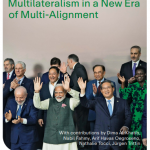
The world is facing profound and overlapping crises that shake the foundations of multilateral cooperation. A climate once shaped by collaboration is increasingly giving way to aggressive geopolitical competition, zero-sum politics and neo-imperialist tendencies. The global rise of authoritarianism – including in Western democracies – aggravates this trend, undermining trust and legitimacy in international institutions.
The multilateral structures created by the West are faltering in the face of new realities. Of course, since its founding, this often-lamented declining order suffered from dysfunctionality, double standards, and asymmetrical power relations and benefit distribution. It has essentially been selective rather than comprehensive, transformative and sustainable for the majority of societies.
But the need for effective, equitable and sustainable international cooperation has never been greater than it is today. From climate change to global health, migration and peacebuilding, cross-border challenges demand collective responses. To meet that demand, multilateralism must change by becoming more inclusive, resilient, fair and locally rooted in its structures and outcomes.
Germany, as a long-standing advocate and beneficiary of multilateralism, is called upon to play a constructive role. However, it faces growing credibility challenges due to its selective application of international law as well as to its own internal and external uncertainties. This moment calls for reflection, renewal and bold leadership.
In today’s context of new forms of imperialism, power asymmetries and systemic inequality, the legacies of the Bandung Conference and the Non-Aligned Movement offer timely inspiration. They further valuable thinking related to collective advocacy and agency, sovereignty, equitable cooperation, unity despite divergence and South-South cooperation. The Bandung experience also raises central questions around political will for principled policies, institutional design and accountability.

You can download the Bandung at 70: Multilateralism in a New Era of Multi-Alignment here.
Manjeet Kripalani is the Executive Director, Gateway House.
Florian Bigge is the Programme Director History Forum, Körber-Stiftung.
Julia Ganter is the Programme Director International Affairs, Körber-Stiftung.
Leona Harting is the Programme Manager, Körber-Stiftung.
Carlos Frederico de Souza Coelho is a researcher, BRICS Policy Center.
Paulo Esteves is a member of the Academic Council, BRICS Policy Center.
Galip Dalay is the Senior Consulting Fellow, Turkey Initiative, Middle East and North Africa Programme, Chatham House.
Dino Patti Djalal is the Founder of Foreign Policy Community of Indonesia FPCI.
Faisal Devji is a Professor of Indian History, Oxford University.
Steven Gruzd is the Head of African Governance and Diplomacy Programme, South African Institute of International Affairs (SAIIA).
Support our work here.
For interview requests or for permission to republish, please contact outreach@gatewayhouse.in.