Prime Minister Tarique Rahman-led Bangladesh Nationalist Party (BNP) will complete six months in office in August. Rahman assumed charge on February 17 after winning a landslide victory in Bangladesh, which underwent a massive transformation following the ouster of former Prime Minister Sheikh Hasina and her party, Awami League, in July 2024. The BNP, which won the next election, was faced with a double crisis, with the West Asia war causing shortages in Bangladesh’s dwindling economy. Meanwhile, in a sharp departure from previous practice, Rahman chose to make China his first state visit abroad even as anti-India rhetoric continued in the streets of Dhaka.
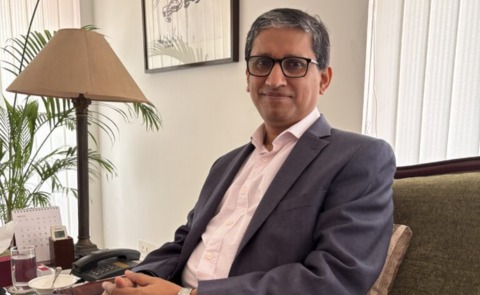
On its part, Bangladesh sent M. Riaz Hamidullah, one of its top diplomats, to New Delhi to iron out the creases. After 1.5 years, Hamidullah, High Commissioner of Bangladesh to India, is heading to Geneva. He spoke exclusively to Nayanima Basu on the future of Delhi-Dhaka ties.
Nayanima Basu (NB): Which direction is Bangladesh’s foreign policy headed? After his first foreign trip to China, will Prime Minister Tarique Rahman visit India this year?
Riaz Hamidullah (RH): It will not be correct to say X country or Y country has been given priority. In the past also, Bangladesh’s head of state has undertaken early visits (to China). In PM Rahman’s case, China has been his first visit abroad for several economic necessities. That has happened because of symbolism and substance and also for the ground realities. Early visits are planned after careful calibration. In our case, it’s no surprise. Yes, the first visit could have been here (in India), but one also needs to appreciate that there are sensitive issues pertaining to the current state of affairs between Bangladesh and India.
The government of the day has to be mindful of the popular expectations. There are still cases of men, women and children lying in the hospital suffering from, two years on, the bullets they took or the way they have been impaired for the rest of their lives. Then there have been cases of enforced disappearances; we call it Aynaghor… These are not simply symbolism; these are not simply numbers in terms of how many thousands have been affected, but these have left large and deep wounds in the minds of a generation … The ground reality, the current expectation of the current demographic in Bangladesh, and the politics there not being understood in Delhi are making it difficult for the prime minister to come.
There have to be some signals, some gestures, that must come from our closest neighbour, India. India is one country with which we share an organic relationship.
NB: Is former PM Sheikh Hasina the problem? In a recent interview[1] with Gateway House, she has said she is willing to return to Bangladesh.
RH: As long as Sheikh Hasina is here, she keeps making statements, which by every measure can be called anti-Bangladesh. Then how can the PM come here, or how can we call it an organic relationship? Besides, there has been constant rhetoric against Bangladesh going on for the past five-six months. These have become embedded in the mindscape of Bangladeshis. I have been saying constantly since I came to India that when such statements are made or when statements on “illegal immigration” are made, it hurts the ordinary people in Bangladesh.
Today, Sheikh Hasina’s presence, her activities, and her statements against Bangladesh have created disturbance there. India needs to see what is being hurled at Bangladesh. This looks like India has no respect or regard for Bangladesh. Not just in politics, even the common man in Bangladesh today is shocked at what comes out of India.
NB: Is Bangladesh willing to take her back?
RH: If she (Sheikh Hasina) opts to come back, then she definitely can. But then she will have to be in acceptance of facing the law and the verdict given by the courts there. She has to decide and understand (since she is facing the death penalty)… The death penalty stands. We are also constantly pushing for the bilateral extradition treaty to be moved. And that is not just for her but also for some other leaders of the Awami League party who were involved in the July 2024 massacre.
NB: How is Bangladesh addressing the issues concerning illegal immigration and border management under the new dispensation?
RH: In the lead up to the elections in eastern India (Assam and West Bengal), many statements were made against Bangladesh. We thought, at that time, when the campaigns were going on, that this was some kind of political expediency and the rhetoric would come down eventually. But we saw that the opposite happened (even after State Assembly elections). These things have literally shut the door for any form of engagement with Bangladesh.
We have a porous border, and it has been so since the border was drawn in certain ways back in 1947. I have travelled to Northeastern parts of India and have witnessed how people there are aware of the border. But they don’t feel inhibited in terms of their interaction (with kin across the border). This is a border where trading of goods takes place and is important, but more important than that is trading of emotions.
NB: What about border management? There had been a two-day border coordination conference in June between India’s Border Security Force (BSF) and Border Guard Bangladesh (BGB). Was the issue of border killings addressed?
RH: I do not think securitisation or dehumanisation of the border in terms of border management can be the answer toward resolving the border issues. Border killing is an issue that we have raised with India. I am fully mindful of the fact that the Indian government will do what it can to address its own concerns. But we should be careful of the sentiments and emotions of the people on both sides of the border.
The issue of border management comes under the India-Bangladesh Consular Dialogue. We have been repeatedly urging India to convene it so that issues concerning the border can be addressed forthwith. Our request has been lying with the Indian government since June. We have been telling India to put all issues on the table and resolve them one by one.
NB: India says Bangladesh indirectly allows illegal immigration, even under the new administration.
RH: We do not allow people to infiltrate and we do not push people inside India. Yes, human smuggling and human trafficking take place. Therefore, we need the border mechanism talks that happen under the Consular Dialogue. Our position is that if people cross the border illegally, they reach far-flung areas of Kashmir, Gujarat, and even the south of India. This means, within India, a certain ecosystem works to facilitate. How do they buy the tickets to travel to these areas? How do they get jobs? What kind of verification takes place? So both sides would need to dismantle the ecosystem at work.
This is in our shared interest. We are ready to cooperate in addressing this issue, but politicisation of this matter is not going to work. Therefore, blaming Bangladesh will not help. This would end up damaging ties on both sides (in the longer haul). It is one of the reasons why many Bangladeshis today are not as excited as they used to be to travel to India. Despite resuming the visa services, people are obtaining the visas, but then they are also apprehensive to come here; they are increasingly hesitant to come to India.
NB: Recently, the Ministry of External Affairs said India has asked Bangladesh to verify the nationality of over 2,680 individuals staying illegally in this country.
RH: The illegal immigration numbers mentioned by the MEA recently have been there since 2020. But, now that it has been raised by the MEA, to me particularly, since the summer of 2025, we are steadfastly analysing the numbers one by one. We found out that there are cases of duplicates; some are Rohingyas, and some are in detention centres. We have since been working on addressing all cases of individuals. These things need to be handled beyond the public spectacle.
NB: The BNP will complete six months in office. How would you assess these past months?
RH: When the government came to power, within two weeks the Iran war started. The government was then just settling in. BNP has come to power after nearly 17 years. The government had to go for firefighting in terms of getting diesel right and fertiliser right. I think like many other countries, we are learning how to grapple with these disruptions, especially in the energy segment. In the meantime, dialogue with India has steadily taken place. In fact, Indian Foreign Secretary Vikram Misri, when he visited Dhaka, even met the Leader of the Opposition Shafiqur Rahman of the Jamaat-e-Islami party (on the sidelines of Rahman’s swearing-in ceremony in Dhaka on February 17).
Meanwhile, on 26 February, a warm, positive, pragmatic, and future-orientated letter came from Prime Minister Tarique Rahman addressed to Prime Minister Modi. The biggest takeaway in that letter was PM Rahman’s mention to “reinvigorate our cooperative engagements”. There was also a reference in his letter of ‘Viksit Bharat’. Since then, a lot of engagements have taken place. PM Rahman has made it clear that Bangladesh will move according to its own interest and not hurt other countries.
NB: What have been the achievements of BNP domestically?
RH: The government has been focused on two primary objectives since February – repair and reset. Repair was more important because when the government took charge, it realised that institutions had been botched up – be it political or electoral. Plundering was carried out under the previous (Sheikh Hasina) regime. The world only witnessed the killings, but in parallel, looting has been carried out. Looting of banks had taken place; the banking system has collapsed. If local investments do not come into the system, then foreign investments will remain a far cry. So, restoring public confidence was a challenge.
Restoring confidence in the police was a task. Bringing values back in society was also essential. The governance style has been like our late former President Zia-Ur-Rahman. He believed that whatever people might throw at him, his personal honesty was never questioned. Likewise, we see PM Rahman has been doing everything possible for him to do from digging canals to other things. Denying security protocols, he has gone inside people’s homes and tried to connect with them at the grassroots level. There was a gap that had emerged that needed to be restored.
The challenge was also to create a spontaneous public discourse, cutting across socio-political ideologies, restoring what was important. During the political upheaval that happened in Bangladesh in 2024, press freedom took a big hit. That had to be brought back. The government has taken active measures to also address widespread corruption. The government has passed the first budget. There are now concerns over revenue mobilisation, depending less on external or domestic borrowing. It had to be a growth-inducing budget and not to placate the oligarchs.
NB: What is happening to the July Charter that was drawn up so assiduously? What happened to the referendum that secured a 68% ‘Yes’ vote?
RH: It is under discussion in the Parliament – the contents of the referendum and the approach to the July Charter. We are speaking in the month of July, five months since Parliament has been convened. So, it would be early to say anything on the final shape of the July Charter.
NB: But the opposition parties there, especially Jamaat-e-Islami, say that by not giving priority to the referendum, the government is failing to meet people’s aspirations?
RH: Aspiration is almost like an open pit where the sky’s the limit. Aspiration would come with two legs – one is that you can aspire for anything, but how much do you or how much wherewithal do you have to redeem that? Second is to deliver on the aspiration.
Bangladesh not only has a younger demography but also very open, liberal-minded people who have a tendency to question. I don’t think it is unfair to have that tendency because everyone has their sovereign choice. But one would also need to be mindful of the ability to deliver and the things in the command of the state to deliver on people’s diverse aspirations.
Nayanima Basu is the Adjunct Fellow at Gateway House and an author.
This interview was exclusively recorded for Gateway House: Indian Council on Global Relations. You can read more exclusive content here.
For permission to republish, please contact outreach@gatewayhouse.in.
Support our work here.
© Copyright 2026 Gateway House: Indian Council on Global Relations. All rights reserved. Any unauthorised copying or reproduction is strictly prohibited.
References:
[1] Gateway House, “Threats Never Deterred Me. I’ll Be Back in Bangladesh”, November 24, 2025. https://www.gatewayhouse.in/threats-never-deterred-me-ill-be-back-in-bangladesh/