Indian cinema has transformed from a means of mere entertainment to a tool of cultural diplomacy. From its vivid imagery, lively colours and stories, Indian cinema has transcended language and geographical barriers to form emotional connections across the globe. From Moscow to Morocco, Jakarta to Tokyo, Indian films create lasting impressions, serving as cultural ambassadors and economic catalysts. The popularity of Indian cinema is correlated with bilateral trade – the more popular the cinema, the bigger the boost to trade.
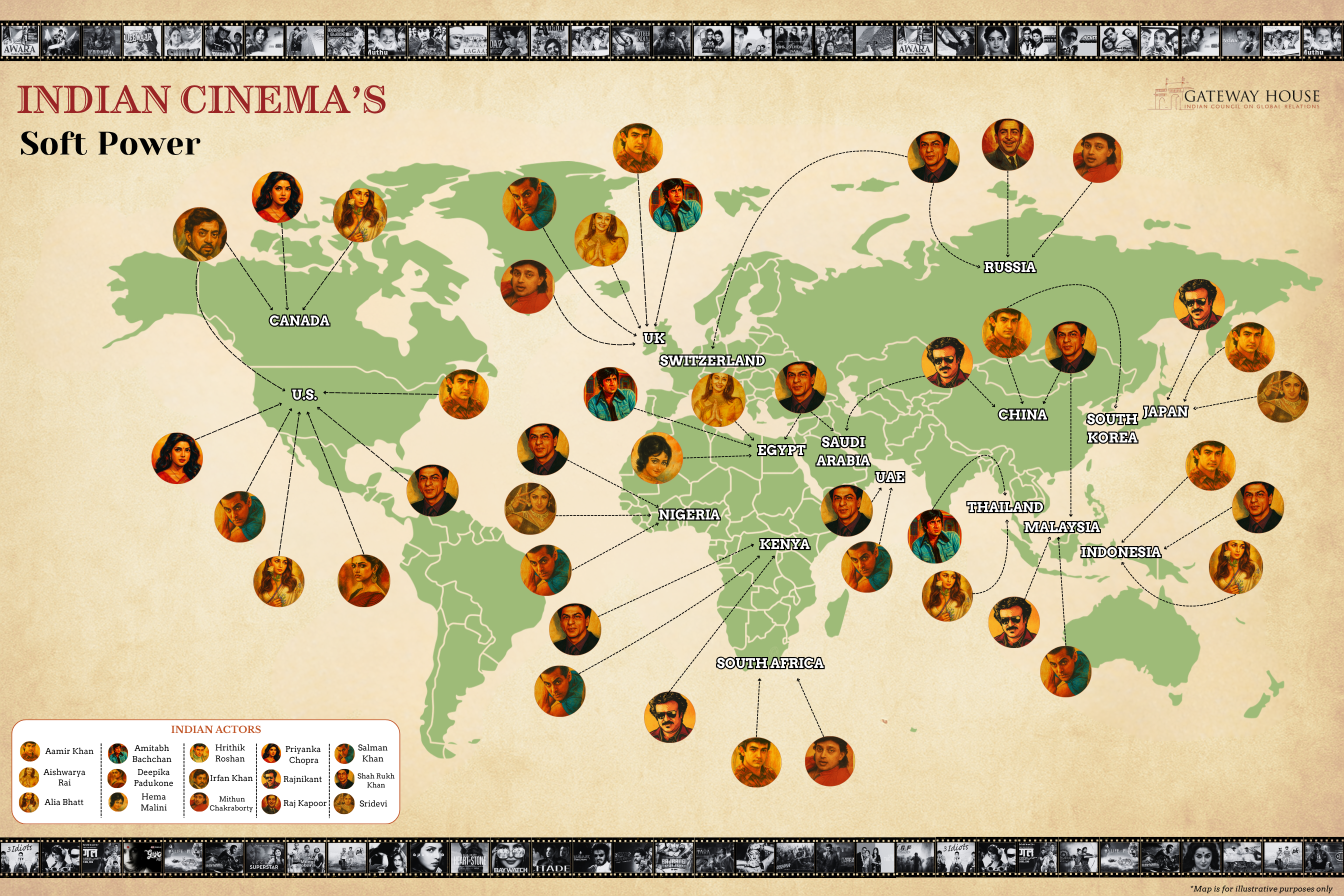
A case in point is Indonesia. Bilateral trade between India and Indonesia was $93 million in 1988, which increased significantly to $14 billion by 2010 and $28 billion in 2024-25. During this time, Indian films like Kuch Kuch Hota Hai (KKHH) struck a deep chord with Indonesians. Released in theatres in 2001, three years after its Indian debut, KKHH was a bigger box office success than Titanic in Indonesia. The film went on to become an even bigger phenomenon through repeated TV broadcasts and pirated VCDs circulation.
Bollywood has influenced Indonesian folk music—Dangdut singers adapted KKHH’s theme song in local languages.[1] Fan clubs like the Bollywood Mania Club Indonesia, with 36,000 members, showcase the scale of this cultural phenomenon. Other similar groups of varying sizes include the Bollymania Fans Club at Bens Radio 106.2 FM and Komunitas Fans Bollywood Indonesia on Facebook. There are also fan clubs dedicated to specific Bollywood stars, such as Aamir Khan and Rani Mukherjee.
The private television broadcasting channels such as Televisi Pendidikan Indonesia (TPI), Indosiar, broadcast the Ramayana and Mahabharata in the nineties. Their target were film fans who had traditionally watched Indian films in B or C-grade cinema halls (A grade was reserved for Hollywood films).[2]
These connections run deep. When Indonesian President Prabowo Subianto came to New Delhi as the chief guest for India’s Republic Day on January 26, 2025, a member of his delegation serenaded their hosts with the theme song of Kuch Kuch Hota Hai.[3] It was more than nostalgia. It was a reminder of the deep emotional bond Indian cinema continues to foster. Not surprisingly, India-Indonesia trade is today $28 billion, with the goal of reaching $50 billion by 2030.[4]
In Russia, the legacy of Indian cinema runs even deeper. India enjoyed strong trade with the USSR, totalling $39 billion between 1981 and 1990. Though trade fell to $12 billion after the dissolution, it regained momentum and now stands at $68 billion[5], making Russia India’s 5th largest trading partner.[6] Running in parallel is Bollywood, which has been part of Russian life for over 70 years.
Raj Kapoor’s Awara and Shree 420 struck a chord with the Soviets; the song Awaara Hoon became an anthem across socialist states.[7] Kapoor was even called India’s Charlie Chaplin by ordinary Russians who grew up with his films. Later, Mithun Chakraborty’s Disco Dancer grossed $75 million, selling 120 million tickets and becoming the biggest foreign hit in Soviet history.[8]
This reverence transcends generations—whether in their 60s or 20s, Russians fondly recall Raj Kapoor and humm Awaara Hoon as if it were their own cultural song. President Vladimir Putin himself has acknowledged this bond, noting that Indian films are the most popular among BRICS nations and are shown on dedicated Russian TV channels around the clock.
The U.S., India’s largest trading partner[9] at $128 billion (2024–25), has also embraced Indian films. Collections once capped at $5–$6 million, grew after 3 Idiots alone grossed $6.5 million in 2009. Baahubali: The Conclusion, released in 2017 grossed $13 million[10], and played across hundreds of IMAX and standard screens. Notably, it isn’t just Bollywood—regional films in Telugu, Tamil, Malayalam, and Punjabi thrive in U.S. theatres.
West Asia, home to a massive Indian diaspora, has been another hub of influence. The UAE, India’s 3rd largest trading partner with non-oil trade at $65.4 billion in 2024–25, is also the second-largest host of Indian expatriates (4.3 million)[11] or 35% of total émigrés. Shah Rukh Khan, now the face of Dubai Tourism,[12] has had his films promoted in lights on the Burj Khalifa, with his birthdays celebrated on its facade. Bollywood Parks Dubai, featuring attractions based on Indian films, underscores the scale of this influence.[13]
The three Khans ruled the industry in the 90s – Shah Rukh Khan, Salman Khan and Aamir Khan. This was around the time of Dil Toh Pagal Hai, Mohabattein, Raja Hindustani, Kaho Na Pyaar Hai and Hum Dil De Chuke Sanam, when the Bollywood craze was at its peak. India-UAE trade in 2024-25 was $98 billion, and the Comprehensive Economic Partnership Agreement signed in 2022aims to reach $100 billion by 2030.
Saudi Arabia is India’s 4th largest trading partner after the UAE, accounting for $43 billion in current trade. The country had a 35-year cinema ban from 1983 to 2018, making it difficult to trace which Indian films were being watched during these years. However, cassettes and VHS were thriving, and Salman Khan and Shah Rukh Khan were the most watched actors on pirated Bollywood films.
The strong Indian diaspora comprising 21.8% per Saudi Arabia,[14] mostly from South India, have made Tamil, Telugu and Malayali films popular in the Kingdom. In 2022, Kannada KGF 2 was the second largest grossing film.[15] Other South Indian blockbusters like RRR, Pushpa, KGF, and Jailer also have been hits.[16]
In Iran, Indian cinema has been a cultural mainstay for decades. Despite political restrictions and limited foreign media, films from Mother India to Dangal found devoted audiences. Their universal themes of family, justice, and resilience resonate deeply, making Bollywood a lasting cultural presence. Trade with Iran has slowed due to the U.S. sanctions against Tehran, but the popularity of Hindi cinema remains.
East Asia is also a Bollywood fan. While K-pop has just begun to get an audience with younger Indians, Indian films like 3 Idiots, Taare Zameen Par, Dangal, and My Name is Khan are household names[17] in South Korea, despite a small Indian diaspora of just 17,001.[18] In an interview, popular Korean boy band BTS lead Kim Nam-joon once remarked that the most famous Indian song in South Korea is Daler Mehndi’s Tunak Tunak Tun.[19] The song was also featured in 2017 K-drama Strong Woman Bong Soon (now running on Netflix), where it was a ringtone of one of the characters. South Korean girl band Mamamoo’s leader Solar, says Dangal is her favourite movie and even recommended it to her fans in one of her YouTube videos. Predictably, India-South Korea trade has towered, going from $16 billion in 2020-21 to $26 billion in 2024-25.
In China, Aamir Khan’s 3 Idiots and Dangal broke barriers, and along with Tamil hit Maharaja (2025), became the highest-grossing Indian film there in five years, at $3.13 million – a milestone for Indian cinema in China.[20]
While diplomatic and political relations with China have been up and down, trade has been vibrant, from $140 million in 1988 to $124 billion 2024-25. The popularity of Bollywood may not have matched the trade numbers here, but it has certainly exposed Chinese audiences to India’s ways, positively.
The first Indian film shown in China was Raj Kapoor’s 1951 Awaara, which became a massive success, resonating with audiences due to its universal themes and Chaplinesque appeal. The 1955 Chinese release was dubbed into Mandarin, and the film’s title song, Awaara Hoon, became an anthem during the 50s, symbolising a cultural connection between the two nations.
This cultural connection goes beyond the 1990s, with deep ancient and mythological roots. Chinese films also found success in India. The mythological animated film Ne Zha: Demon Child Conquers the Sea (Ne Zha 2) was released in India this April, coinciding with the 75th anniversary of India–China diplomatic ties. The film’s protagonist, Ne Zha, has parallels in Indian culture and religion, with heroes like Arjuna, Rama, and Krishna.[21]
Japan, meanwhile, adores Rajinikanth—Muthu ran for 23 weeks in 1995, grossing over $1.6 million, cementing him as a cult hero.[22] Apart from his older films -like Padayappa and Sivaji, his recent films too have tasted success in the Japanese market. In July 2021, for example, Rajnikanth’s Darbar released in Japan and became a major box-office success,[23] collecting more than $1.5 million.[24]
Rajnikant is the most popular Indian actor in Malaysia, where Indians (2.7 million) are one of the country’s three main ethnicities. The anticipation for his 2025 movie Coolie was so high that when the trailer premiered on the big screen at NU Sentral, Kuala Lumpur, all seats were fully booked. Malik Streams (Malaysian broadcasting and media production company) hosted the largest hot-air balloon launch at Dataran Merdeka, Kuala Lumpur for Coolie — a first for a Tamil film in Malaysia. Coolie made history even before its official release.[25] When Rajinikanth visited Malaysia in 2023, he received a warm welcome from Prime Minister Mr. Anwar Ibrahim who greeted the superstar in his iconic style from the film Shivaji the Boss.
Shahrukh Khan was honoured with the title Datuk by the state of Malacca in 2008, for popularising that beautiful World Heritage Site and boosting tourism through his movies One 2 ka 4 and Don. Trade between the two countries has always been strong, but with Bollywood and a deepening bilateral, it has grown from $633 million in 1988 to $20 billion in 2024-25.
Thailand, a popular tourist destination for many Indians (2.1 million in 2024 or 7% of all tourists)[26] found unexpected Bollywood resonance in the Alia Bhatt-starrer Gangubai. After its release in 2022, Instagram and TikTok in Thailand were full of reels of Thai women dressing up as Alia Bhatt’s character Gangubai from the film, who they related to.[27] The storyline about a sex worker who ruled Mumbai’s biggest red-light district, Kamathipura, for years, and worked to make it an ‘acceptable’ profession, found plangency in Thailand.
The film, which began streaming on Netflix from April 2022, became the No. 1 non-English film on the platform globally in a short span of time. It featured in the Top 10 list of films in Thailand for seven consecutive weeks, according to Netflix.[28]
Indian cinema has similarly left its mark on the continent of Africa. Nigeria’s trade with India has grown steadily from $52 million in 1988 to $8 billion in 2024-25, as has its Bollywood affiliation. It hit a cultural milestone with Namaste Wahala in 2020, a cross-cultural Netflix romance. Older generations still celebrate Amitabh Bachchan, Dharmendra and Rishi Kapoor, who are so beloved that they have earned affectionate nicknames in Nigeria, such as Sarkin Karfi (King of Strength) for Dharmendra and Mace (Woman) for Rishi Kapoor. [29]
The Egyptians were in love with Amitabh Bachchan, the Angry Young Man of Hindi cinema and pirated VHS tapes carried his charisma into Egyptian homes. In the early 1990s crowds once gathered at Cairo airport simply because Bachchan’s plane was stopping to refuel.[30] Then came Shah Rukh Khan’s Pathaan which broke box office records for an Indian film screened in Egypt, earning $31,152.[31] Bachchan and Shah Rukh Khan are household names in Egypt. Javed Akhtar, acclaimed poet, lyricist, and screenwriter, says “If an Indian goes to Egypt or Germany and tell people I am an Indian, they immediately ask if you know Shah Rukh Khan.”[32]
These emotional connections extend beyond cinema—they translate into tangible diplomatic and economic outcomes such as boosting tourism in Switzerland through Shah Rukh Khan’s films, for instance.

bilateral trade (Figure 1)

bilateral trade (Figure 2)
India already possesses raw power through its cinema. What it needs now is a cohesive cultural export strategy—one that treats cinema not just as an industry but as a strategic asset. This means incentivising co-productions, supporting film tourism, creating global soft power treaties, and forging stronger partnerships between the government and private studios.
As India seeks to lead in a multipolar world, cultural credibility will be as vital as economic clout. Cinema gives India a unique edge—a way to build emotional equity, shift narratives, tell wholesome stories and foster mutual understanding in a world increasingly marked by polarisation.
Grishma Shah is one of India’s leading celebrity managers. She currently works with Eternal Sunshine Productions, a boutique production house founded in collaboration with Alia Bhatt.
Research assistance and infographics by Raveena Shivashankar, Gateway House.
This infographic was exclusively designed for Gateway House: Indian Council on Global Relations. You can read more exclusive content here
Support our work here.
For permission to republish, please contact outreach@gatewayhouse.in
©Copyright 2025 Gateway House: Indian Council on Global Relations. All rights reserved. Any unauthorised copying or reproduction is strictly prohibited.
Note:
[1] Bilateral trade data from 1983-1987 are sourced from Direction of Trade Statistics Yearbook, 1990 Edition. Washington, DC: International Monetary Fund. https://www.elibrary.imf.org/display/book/9781451981308/9781451981308.xml
[2] Bilateral trade data from 1987-2022 are sourced from “India Trade Profile — Imports of All Products, 1988–2022.” World Integrated Trade Solution (WITS). World Bank. https://wits.worldbank.org/
[3] Bilateral trade data from 2022-June 2025 are sourced from Government of India, Ministry of Commerce and Industry, Department of Commerce. Export Import Data Bank (Monthly). https://www.dgft.gov.in/CP/
References:
[1] The Revolver Club. “Dangdut: The Indonesian Folk Pop Genre Influenced by Bollywood.” Accessed October 1, 2025. https://www.therevolverclub.com/blogs/the-revolver-club/dangdut-the-indonesian-folk-pop-genre-influenced-by-bollywood.
[2] The Weekend Leader. “Bollywood Ripples.” Accessed October 1, 2025. https://www.theweekendleader.com/Culture/1468/bollywood-ripples.html.
[3] ANI. “Indonesian Delegation Captures Hearts Singing Shah Rukh Khan’s ‘Kuch Kuch Hota Hai.'” X, January 25, 2025. https://x.com/ANI/status/1883331910073807140.
[4] ASEAN Briefing. “India-Indonesia Bilateral Trade.” Accessed October 1, 2025. https://www.aseanbriefing.com/news/india-indonesia-bilateral-trade/.
[5] Indian Embassy, Moscow. “Overview.” Accessed October 1, 2025. https://indianembassy-moscow.gov.in/overview.php.
[6] Export Import Data. “Top Trading Partners of India.” Accessed October 1, 2025. https://www.exportimportdata.in/blogs/top-trading-partners-of-india.aspx.
[7] CNBC TV18. “Raj Kapoor at 100: A Tribute to the Showman Who Bridged Borders with Timeless Appeal.” Accessed October 1, 2025. https://www.cnbctv18.com/entertainment/raj-kapoor-at-100-a-tribute-to-the-showman-who-bridged-borders-with-timeless-appeal-19524171.htm.
[8] Global Indian. “70 Years of Indian Cinema in Russia: Raj Kapoor, Mithun Chakraborty, SRK.” Accessed October 1, 2025. https://www.globalindian.com/story/art-culture/70-years-of-indian-cinema-in-russia-raj-kapoor-mithun-chakraborty-srk/.
[9] Export Import Data. “Top Trading Partners of India.” Accessed October 1, 2025. https://www.exportimportdata.in/blogs/top-trading-partners-of-india.aspx.
[10]Cain, Rob. “These Are the Best of Times for Indian Movies in America.” Forbes, May 5, 2017. https://www.forbes.com/sites/robcain/2017/05/05/these-are-the-best-of-times-for-indian-movies-in-america/.
[11] Indian Embassy, UAE. “Indian Community in UAE.” Accessed October 1, 2025. https://www.indembassyuae.gov.in/indian-com-in-uae.php.
[12] Business Outreach. “Brands Endorsed by Shah Rukh Khan.” Accessed October 1, 2025. https://www.businessoutreach.in/brands-endorsed-by-shah-rukh-khan/.
[13] Ibid.
[14]Kerala State Planning Board. “Economic Review 2016.” Accessed October 1, 2025. https://spb.kerala.gov.in/economic-review/ER2016/chapter06_03.php.
[15] YouTube. Video. Accessed October 1, 2025. https://www.youtube.com/watch?v=o2y37xScAU0.
[16] Filmfare Middle East. “Rewriting the Script: Why South Indian Films Are Leading Global Charts.” Accessed October 1, 2025. https://filmfaremiddleeast.com/rewriting-the-script-why-south-indian-films-are-leading-global-charts/.
[17] Annyeong India. “Indian Culture.” Accessed October 1, 2025. https://annyeongindia.com/indian-culture/.
[18] Ministry of External Affairs, Government of India. “Population of Overseas Indians.” Accessed October 1, 2025. https://www.mea.gov.in/population-of-overseas-indians.htm.
[19] Rolling Stone India. “Bangtan.” Accessed October 1, 2025. https://rollingstoneindia.com/bangtan/.
[20] India Today. “Vijay Sethupathi’s Maharaja Breaks Box Office Records in China, Enters Rs 100 Crore Club.” January 5, 2025. https://www.indiatoday.in/movies/regional-cinema/story/vijay-sethupathi-maharaja-breaks-box-office-records-china-rs-100-crore-club-26
[21] China-India Dialogue, vol. 43, no. 3 (2025).
[22] Radii. “Indian Movies in China and Japan.” Accessed October 1, 2025. https://radii.co/article/indian-movies-in-china-and-japan.
[23] Sacnilk. “Superstar Rajinikanth’s Darbar Is a Smash Hit in Japan.” Accessed October 1, 2025. https://boxoffice.sacnilk.com/news/Superstar_Rajinikanths_Darbar_Is_A_Smash_Hit_In_Japan.
[24] Khaleeji Times. “Why Does Rajinikanth Have a Cult Following in Japan?” Accessed October 1, 2025. https://www.khaleejtimes.com/entertainment/why-does-rajinikanth-have-a-cult-following-in-japan.
[25] Varnam. “Superstar Rajinikanth’s Coolie Creates History in Malaysia; Anirudh Says the Film Blends Star Power with Intelligence.” Accessed October 1, 2025. https://varnam.my/109249/superstar-rajinikanths-coolie-creates-history-in-malaysia-anirudh-says-the-film-blends-star-power-with-intelligence/.
[26] Economic Times. “Shahrukh Agreed to Accept Malaysian Honour of Datukship.” Accessed October 1, 2025. https://economictimes.indiatimes.com/shahrukh-agreed-to-accept-malaysian-honour-of-datukship/articleshow/3624503.cms.
[27]. Gateway House. “Thailand’s Unexplored History.” Accessed October 1, 2025. https://www.gatewayhouse.in/thailands-unexplored-history/.
[28] The Print. “Gangubai Kathiawadi Is a Hit in Thailand: Reels, Netflix, Sex Work Industry Helped.” Accessed October 1, 2025. https://theprint.in/feature/gangubai-kathiawadi-is-a-hit-in-thailand-reels-netflix-sex-work-industry-helped/1041267/.
[29] Financial Express. “The Popularity of Bollywood in Brazil, Nigeria and Guyana: A Cultural Bridge.” Accessed October 1, 2025. https://www.financialexpress.com/india-news/the-popularity-of-bollywood-in-brazil-nigeria-and-guyana-a-cultural-bridge/3666459/.
[30] ETV Bharat. “Egypt’s Love Affair with Bollywood.” January 24, 2023. https://www.etvbharat.com/english/entertainment/movie/egypts-love-affair-with-bollywood/na20230124171214609609232.
[31] Financial Express. “Bollywood Weaves Magic on the Nile.” Accessed October 1, 2025. https://www.financialexpress.com/life/entertainment-bollywood-weaves-magic-on-the-nile-3363951/.
[32] The Print. “‘Stories in Our DNA': Respect Indian Films, Javed Akhtar on #BoycottBollywood Trend.” Accessed October 1, 2025. https://theprint.in/feature/stories-in-our-dna-respect-indian-films-javed-akhtar-on-boycottbollywood-trend/1326573/