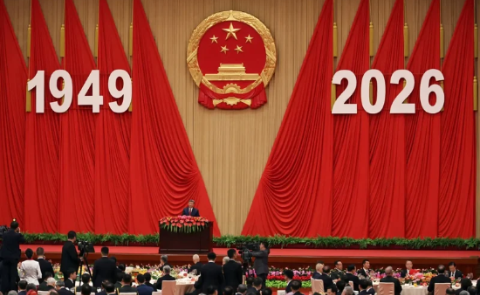
On October 26-29, 2026, China’s 20th Party Congress held its Fifth Plenum. A plenum is a meeting of the entire Central Committee of the Communist Party of China (CPC), which includes the members and alternate (elected but non-voting) members, to deliberate on issues.
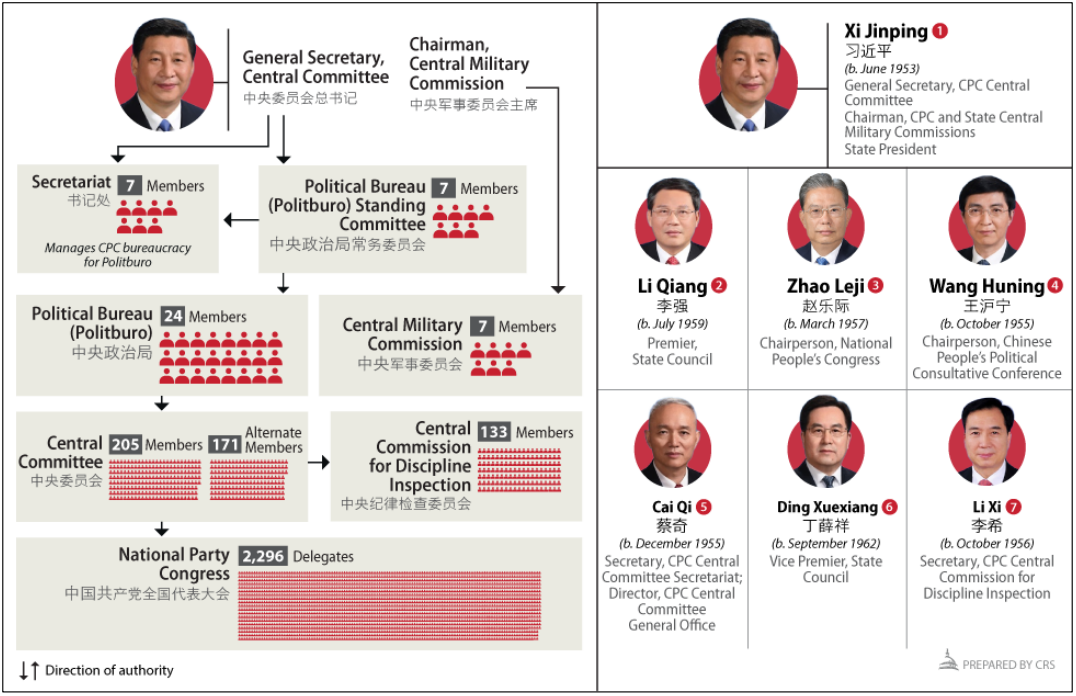
Figure 1: Chinese Political System
Source: U.S. Naval Institute[1]
Everything the party does is on behalf of the Central Committee of the CPC. The Politburo and its seven-member Standing Committee are from among Central Committee members.
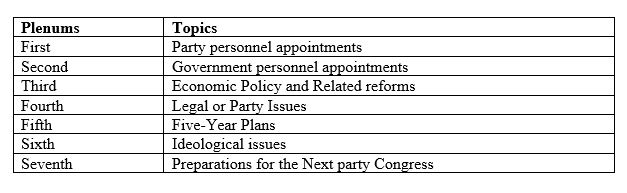
The Central Committee holds seven plenums during its five-year term. Each usually has a customary, standard agenda (see figure no. 2).
Figure 2: Types and topics of Plenums
 Source: Centre for Naval Analysis[2]
There have been variations in timings and the subjects of the plenums. For example, the third plenum was supposed to be held in October 2023 but was held in July 2024, the delay due to China’s post-COVID economic struggles. The Third Plenum addresses economic concerns and policy measures, and the real estate bubble which burst in 2021 further aggravated the economic condition. Similarly, the recent Fifth Plenum, which was expected to take up the next Five-Year Plan, focused on party governance instead, because the Fourth Plenum, held in October
Consequently, in January 2026, a meeting between select party leaders was held to nominate a drafting group for the resolution of the Fifth Plenum. President Xi Jinping was the chairman of the group, and Wang Huning, Chairman of the Chinese People’s Political Consultative Conference, Cai Qi, Secretary of the Secretariat; and Li Xi, Secretary of the Central Commission for Discipline Inspection, were the Vice Chairmen. Xi set the topic, “Studying the question of persistently advancing comprehensive and strict Party self-governance”, for the plenum and asked the group to examine 39 major issues in eight areas in depth. Sixteen organisations were assigned to research 23 topics for the resolution.[4]
Shortly thereafter, the party moved into fast action mode. On January 31, 2026, the Central Committee of the CPC began soliciting views and opinions on the topic. The drafting work was begun on February 6, and by February 28, 112 responses had come in. On May 6, Xi heard the views of provincial leaders at a symposium held in Shanghai. On August 3, the draft resolution was circulated to selected party cadres and some senior retirees for soliciting their views. Important issues were obtained from 3,300 pages of documents, compiling them into five registers.
From January to September 2026, the drafting group held 35 meetings on special topics and produced 36 interim drafts. Xi also held a symposium with non-party figures, which yielded 10 responses. In all, 1,076 proposals were considered, and 17.7% of those were incorporated into the Resolution of the Fifth Plenum. On October 19, Xi chaired a meeting to review the draft for the Fifth Plenum. It was debated and finalised after 13 amendments and later adopted on October 29 and released on November 1, 2026.
Two documents were released immediately after the Plenum. One was the Resolution[5] adopted at the Fifth Plenum, and the second was Xi Jinping’s explanation for the resolution.[6] A communique[7] on the Fifth Plenum was also issued.
The documents offer some concrete takeaways. First, 162 of the 205 full members and 117 of the 171 alternate members of the Central Committee attended the session. The 97 absentees point to the scale of the purges.
Second, 24 full and nine alternate members of the Central Committee were expelled from the party, and 10 new members were inducted. General Zhang Shengmin, the only Vice Chairman left on the Central Military Commission (CMC), was elevated to the Politburo since the rest have been removed on the grounds of corruption and violation of party discipline.
Third, the 21st Party Congress will be held in the second half of 2027.
Fourth, action against corruption will continue.
The less tangible observations are more interesting. The Plenum approved the work of the Politburo and praised it for implementing the Five-Sphere Integrated Plan (五位一体)[8] and the Four-Pronged Comprehensive Strategy (四个全面).[9]
In the Resolution, four points related to Xi stood out. First, it reiterated that he is the “core” of the Central Committee and the CPC.
Second, Xi Jinping Thought on Socialism with Chinese Characteristics for the New Era found mention.
Third, it credited Xi, as being the core. Xi confronted weak, hollow, and watered-down Party leadership, and lax, superficial, and ineffective self-supervision and self-governance.
Fourth, the Plenum praised Xi Jinping’s Thought on Party Building[10] for saving the party from corruption and violation of party codes. The last two points are a direct indictment of the previous leaderships of the party.
While the resolution applauded the party’s achievements, it also pointed to the Four Tests (四大考验)[11] and Four Dangers (四种危险)[12] that continue to haunt the party. To overcome these, the party is expected to carry out self-governance. There are two differing views on self-governance within the party. The first is Mao Zedong’s, who said that “only under public scrutiny will a government be clean and efficient; only when everyone takes responsibility will good governance prevail”[13] meaning people’s oversight. Xi takes a different view: that the party should reform itself from self-governance.[14] Both, however, agree on one thing: the party must maintain a close bond with the people.
The Plenum also advocated practising democratic centralism. Democratic centralism[15] means that members may speak freely within the party but must obey once the decision is taken. The phrase “seeking truth from the fact”[16] appeared in the Resolution. The phrase dates to the first century CE, appearing in the Book of Han, which Mao Zedong adopted into China’s Marxism. Every leader after Mao has referred to this phrase, and Xi is no exception.[17]
Other takeaways from the Plenum are that there is no clear indication of who might rise to the top leadership at next year’s Party Congress, though the newly-promoted officials are in their fifties. The earlier “seven up, eight down” formula, under which a leader aged 67 can be promoted but one aged 68 has to retire, no longer applies in the Xi era.
It is likely that Xi will continue as General Secretary of the Central Committee for another term of five years. Monitoring of party personnel will remain strict and constant. Xi’s position in the party appears strong as ever, contrary to the belief that the purges may have caused discontent.
All this leads to only one conclusion: China remains focused on its second centenary goal of 2049, to become a leading world power. The Third Plenum’s focus on economic issues, the Fourth Plenum’s approval of the 15th Five-Year Plan, and the Fifth Plenum’s emphasis on Party self-governance must be seen in continuity, as all three are aimed at achieving this goal.
Lt Gen S L Narasimhan is the Distinguished Fellow for China and National Security Studies at Gateway House.
This article was exclusively written for Gateway House: Indian Council on Global Relations. You can read more exclusive content here.
For permission to republish, please contact outreach@gatewayhouse.in.
Support our work here.
© Copyright 2026 Gateway House: Indian Council on Global Relations. All rights reserved. Any unauthorised copying or reproduction is strictly prohibited.
References:
[1] Summary of China’s Political System,” U.S. Naval Institute News, July 2, 2024. https://news.usni.org/2024/07/02/summary-of-chinas-political-system
[2] April Herlevi, “What Is a Chinese Communist Party Plenum?” CNA, June 24, 2024. https://www.cna.org/our-media/indepth/2024/06/what-is-a-chinese-communist-party-plenum; June 24, 2024
[3] After the Third Plenum,” AmCham Hong Kong. https://amchamhk.online/after-the-third-plenum/
[4] China.org.cn, November 3, 2026. http://www.china.org.cn/2026-11/03/content_118759681.shtml
[5] Central Committee of the Communist Party of China, “Resolution of the Central Committee of the Communist Party of China on Certain Major Issues concerning Persevering with Full and Rigorous Party Self-Governance,” Xinhua, November 1, 2026. https://english.news.cn/20261101/16d34cfc97f04b8d925baf68d2963706/c.html
[6] Central Committee of the Communist Party of China, “Explanation of the Resolution of the Central Committee of the Communist Party of China on Certain Major Issues concerning Persevering with Full and Rigorous Party Self-Governance,” Xinhua, November 1, 2026. https://english.news.cn/20261101/80c07f5246e44071ad6de9bcf62af842/c.html
[7] Communique of the Fifth Plenary Session of the 20th Central Committee of the Communist Party of China,” Ministry of Foreign Affairs of the People’s Republic of China, October 29, 2026. https://www.fmprc.gov.cn/mfa_eng/xw/zyxw/202610/t20261029_12049543.html
[8] Integrated Development Plan in Development in Economic, Cultural, Political, Social and Ecological Spheres,” China’s State Council Information Office.
[9] Comprehensively Deepen Reform, Strengthen Party Self-Governance, Govern the Country in Accordance with the Rule of Law and Achieve the Strategic Goal of Building a Well-off Society in an All-Round Way,” China’s State Council Information Office, July 11, 2019. http://english.scio.gov.cn/featured/chinakeywords/2019-07/11/content_74977605.htm
[10] Xi Jinping Thought on Party Building is the official Chinese Communist Party doctrine governing internal party construction and discipline. It was formally established as an official doctrine on June 15, 2026, during the National Conference on Party Building in Beijing.
[11] Four tests are CPC as the ruling party, reform and opening up, market economy and the external environment.
[12] Four Dangers of the Communist Party of China,” Indian Council of World Affairs. www.icwa.in/show_content.php?lang=1&level=3&ls_id=1754&lid=773
[13] National People’s Congress of the People’s Republic of China, December 29, 2021. http://en.npc.gov.cn.cdurl.cn/2021-12/29/c_694674.htm
[14] Breaking the Cycle of Rise and Fall: Xi Jinping Outlines Resolution on Party Self-Governance,” Socialist China, November 5, 2026, https://socialistchina.org/2026/11/05/breaking-the-cycle-of-rise-and-fall-xi-jinping-outlines-resolution-on-party-self-governance/
[15] Democratic Centralism,” Model Diplomat. https://modeldiplomat.com/learn/glossary/democratic-centralism
[16] CATL, June 29, 2026. http://www.catl.org.cn/en/2026-06/29/content_118581673.htm
[17] Seeking Truth from Facts,” China Media Project. https://chinamediaproject.org/the_ccp_dictionary/seeking-truth-from-facts/