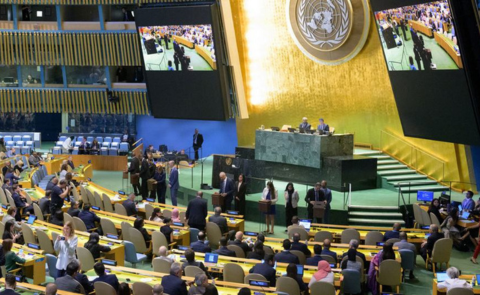
The general view these days disparaging the United Nations is understandable given a war in the Persian Gulf and another in Europe directly involving two of the permanent five (P5) members of the UN Security Council and having two or more in active support of one side. Along with this, the world has witnessed killings on a genocidal scale in Gaza with hardly a whimper from the UN. And even the talks on climate change, said to be the greatest global challenge to humankind, are barely limping along with the issue almost wiped off the agenda of the World Bank.
Little doubt that much of this, in the past year and a half, has much to do with President Donald Trump who wants multilateralism fashioned in his America First-world view with even a willingness to withdraw from agencies and cut contributions to their budgets. There is also the rise of China, seeking to break the Western monopoly on global power by becoming the second-largest economy in the world and now contributing nearly as much (20%) as the U.S. (22%) to the assessed regular budget of the UN.
Regardless of the above, the world needs the institutional global governance provided by the UN. And, contrary to popular belief, it is the powerful that use the UN for their own agendas. It allows legitimising their interests, as witnessed when the UNSC adopted a resolution creating a Board of Peace, supposedly for Gaza, with President Trump as its president. Last year, President Trump spent over 40 minutes addressing the UNGA and had his wife, Melania Trump, preside over a UNSC meeting in the month when the U.S. was holding the UNSC presidency, which rotates every month.
In so far as the “South”, Ambassador Vijay Nambiar, former Permanent Representative of India to the UN and Chef de Cabinet of former UN Secretary General Ban Ki-moon, rightly noted recently that the UN organs, along with their funds, programmes and regional bodies, remain an important source of support and practical benefit in the management of the lives of people in developing countries. The UN matters to the small countries, providing one of the few international platforms they have to express their views and needs. Moreover, with challenges of armed conflict, climate change, food insecurity, unsustainable debt, pandemics, technological disruption and large-scale human displacements, no state, however powerful, can address these interconnected crises alone. Their complexity has strengthened rather than weakened the case for international cooperation and multilateralism.
The UN thus faces expanding responsibilities even as its room for manoeuvre narrows. In such a scenario the UN Secretary General (UNSG)’s office must not only be endowed with diplomatic experience and administrative competence but also political resilience, strategic judgement and the ability to preserve dialogue in an increasingly polarised international system. Indeed, at the best of times, the effectiveness of UNSG has not depended so much on formal authority as on the confidence governments have been willing to place in the office. Of course, in the end, it is the political will of member states that moves the mountain.
The current UNSG’s term expires on Dec. 31, 2026. The UN began the process for choosing the next UNSG last November when the presidents of the General Assembly and Security Council requested member states to suggest candidates for this high position. He/she will assume office on 1 January 2027 for a five-year term.
The appointment of the UNSG is governed by Article 97 of the UN Charter that states that “the Secretary-General shall be appointed by the General Assembly upon the recommendation of the Security Council”.
The primacy of the UNSC in this process is clear, as the practice is for it to forward just one name to the General Assembly for endorsement. This will happen during the forthcoming session of the UN General Assembly starting the third week of September. In keeping with the 15-member UNSC’s rules for adoption of a resolution, the name must garner nine affirmative votes with no P-5 exercising the veto.
The UN’s membership is divided into five geographical groupings – Asia & the Pacific, Africa, Latin America, Eastern Europe and Western Europe and others, a grouping that includes the U.S., Canada, Australia, New Zealand and Israel.
An unwritten tradition at the UN is that the top positions see rotation among these geographical groups, and that is, indeed, the practice for the presidency of the General Assembly (a one-year term). However, the UN’s 80 years of existence have seen four West Europeans as UNSG, two each from Asia and Africa and one from Latin America. In that sense, this time it’s Latin America’s turn and possibly a woman, as none has held this position yet.
In 2016, the expectation was that someone from Eastern Europe would be selected, and several internationally known Eastern Europeans, including women with proven high-level multilateral experience, had thrown their hat into the ring. But it was Antonio Guterres, a former PM of Portugal, who succeeded and became the 9th UNSG. He will complete his second five-year term at the end of this year. No one has held the position for a third term.
The Eastern European grouping reflects Cold War divisions in Europe and gave the then USSR a certain leverage at the time. But now many of its members are part of the EU and/or NATO. It appears that in 2016, the Russians were less unhappy with a West European than one from a country that was earlier part of their bloc but is now on the other side.
This time, seven internationally well-known personalities are at the moment in the fray: (1) Michelle Bachelet, former President of Chile, nominated by Brazil and Mexico; (2) Maria Espinoza, former President of the UNGA and Foreign Minister of Ecuador, nominated by Antigua and Barbuda; (3) Rebeca Grynspan, former Vice President of Costa Rica and head of UNCTAD; (4) Carolyn Birkett, Permanent Representative of Guyana; (5) Rafael Grossi from Argentina, who is presently the Director General of the IAEA; (6) Macky Sall, former President of Senegal; and (7) Olara Otunnu, a former senior UN official from Uganda, who was nominated only days back. Other than Otunnu, all others have had an opportunity to present their vision to the General Assembly.
Every candidate needs to be endorsed by at least one member state of the UN, but this may not be the country of his/her nationality, though, of course, the lack of such a nomination has its own telling political effect. In the case of Michelle Bachelet, a socialist, Chile’s new government, elected in November 2025, withdrew its nomination for her. She was also the UN High Commissioner for Human Rights at a time when a report by her office, critical of the Chinese on their actions in Xinjiang, was issued. Maria Espinsoza also doesn’t have her own country’s formal endorsement.
The UNSC has just held its first straw poll on the seven candidates. The voting slips have the candidate’s name with the option of ‘encourage’, ‘discourage’ or ‘no comment’, but the voting member state’s name is not known. Its results were not announced publicly, though informally it has been noted that Grynspan, Birkett and Rossi have done well.
In the next rounds, the UNSC will use coloured slips for the P5, though in the straw polls there is no disclosure of how particular UNSC members vote. Such draws will be repeated over the coming two to three months (the time between each such round is useful for canvassing or assessing winning or losing chances and hence pulling out of the race) till one candidate obtains nine “encourage” and no coloured slips. This is in keeping with the UNSC rule that for a resolution to be adopted, nine affirmative votes are needed and no veto. He/she will then get formally endorsed by the UNSC.
In the selection process, the P5 really call the shots. Here the main players are the U.S., Russia and China, with the U.S. being the key; indeed, no individual has held the position without the positive endorsement of the U.S. of their candidatures.
All three candidates reported to have done well in the first straw poll from countries with positive ties to the Trump administration. This is, of course, critically important today. Grynspan and Birkett appear to have benefited from a certain support of the developing countries, while Rossi may have had a big push from Western powers but would need to also have Russia and China agree on him. In the end the key standpoint will be overcoming P5 veto vulnerability. Sometimes this can lead to counterintuitive outcomes. India, though not on the UNSC, as a major global player must keep a close eye on the developments, including for securing senior UN positions in the upcoming administration.
Manjeev Puri is an Adjunct Distinguished Fellow and a former diplomat who served in the UN, EU and Nepal as Ambassador.
This article was exclusively written for Gateway House: Indian Council on Global Relations. You can read more exclusive content here.
Support our work here.
For permission to republish, please contact outreach@gatewayhouse.in
© Copyright 2026 Gateway House: Indian Council on Global Relations. All rights reserved. Any unauthorised copying or reproduction is strictly prohibited.