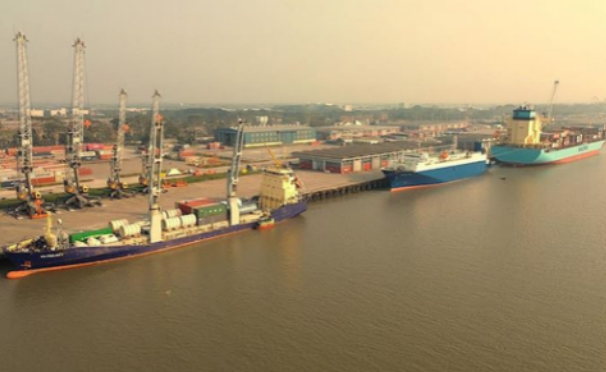
Bangladesh has just signed a loan agreement of $335 million with China’s Exim Bank for modernising its second-largest port, Mongla. Mongla handles 10 million tonnes of cargo a year and has an attached Special Economic Zone (SEZ) with textile and related industries attached to the port. The loan is at a concessional interest rate of 2% and is to be repaid over 20 years.[i]
This is the first significant loan agreement to have been signed between the two countries in the past three years and comes shortly after Prime Minister Tarique Rehman’s first external state visit to Malaysia, followed by China in June 2026. The project itself isn’t new – China first proposed the upgradation of the Mongla Port in 2016,[ii] as a part of a basket of projects. Bangladesh has learned the lessons of its South Asian neighbours. The relatively smaller size of the loan, the concessional interest rate, and existing commercial traffic indicate this is unlikely to go the way of Gwadar or Hambantota Ports.
This development is part of Bangladesh’s attempts to expand its port infrastructure and to reduce its dependence on the port of Chittagong, which handles over 90% of all of Bangladesh’s seaborne trade (see table), and faces chronic congestion issues. Any disruption in Chittagong hits the economy immediately. In February 2026, a strike by the workers of the Chittagong Port forced the interim regime of Chief Advisor Muhammad Yunus to back off from a proposed deal to lease part of the port infrastructure to the UAE’s DP World,[iii] which was to invest in modernising the port’s infrastructure. This was one of the few instances of the Yunus regime stepping down in the face of popular protests. In October 2026, the newly elected Rehman government finally signed a deal with the Emirati port operator to run part of the Chittagong Port for 15 years[iv] – with the government warning the unions against going on strike.[v]
| Table 1: Cargo Handled by Bangladeshi ports | ||||
| Total | Chittagong | Mongla | Share of Chittagong | |
| 2021-22 | 119.3 | 107.9 | 11.4 | 90.4% |
| 2022-23 | 128.2 | 118.3 | 9.9 | 92.3% |
| 2023-24 | 134.1 | 123.3 | 10.9 | 91.9% |
| 2024-25 | 110.6 | 100.1 | 10.5 | 90.5% |
| 2025-26 (9 months) | 114.7 | 104.3 | 10.4 | 90.9% |
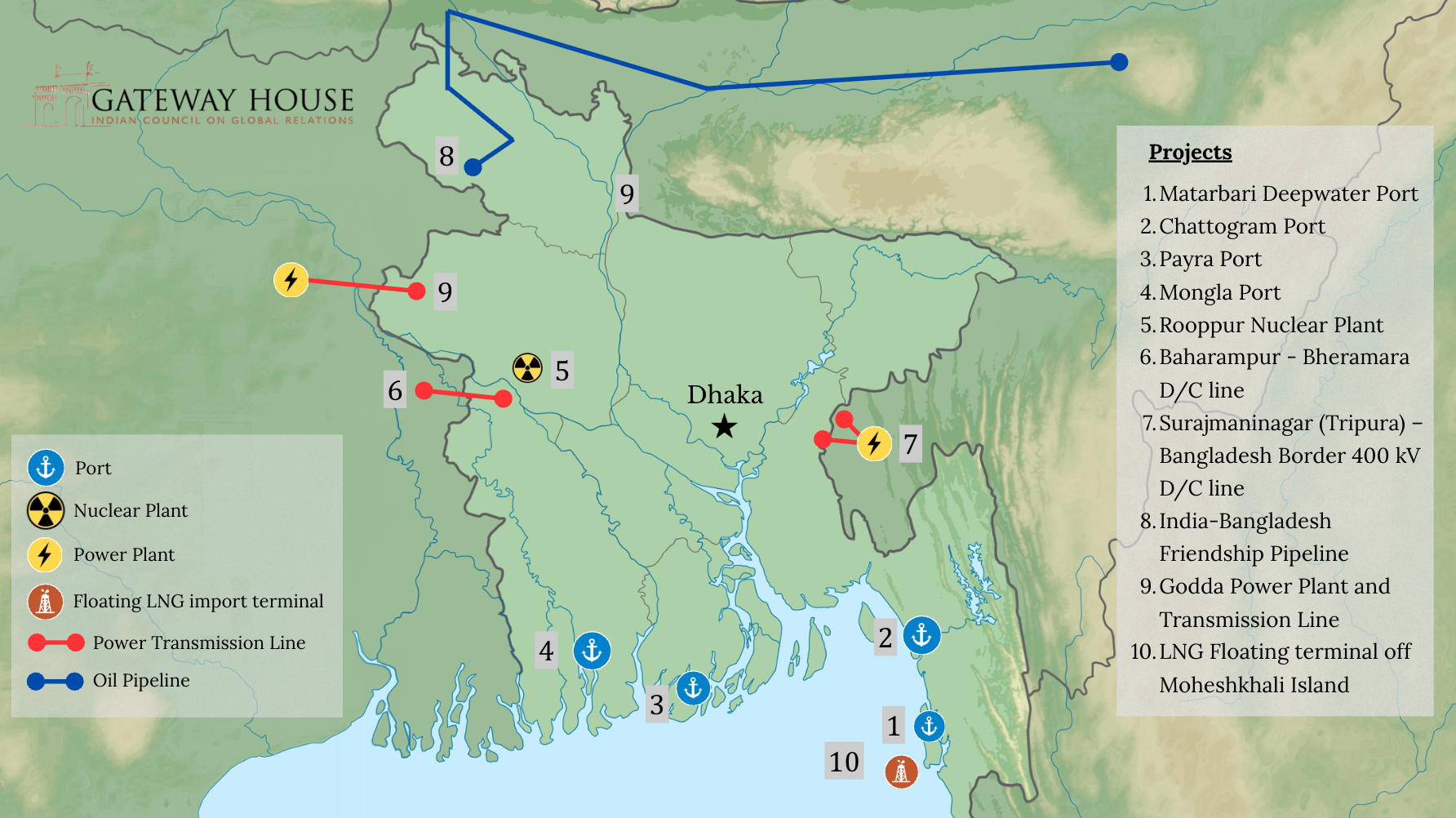
The third port being developed in Bangladesh is to the south of Chittagong, the Matarbari Deepwater Port at Cox’s Bazar. This port will have a deeper draft compared to Mongla and Chittagong, which are both shallow-water ports, and is currently being constructed with Japanese funding. Japan has committed close to $1 billion to the project, which is expected to be operational by 2029-30.
Thus, Bangladesh is spreading its international investment risk. It is working with Japan, DP World, and China, in that order of importance, to upgrade its port infrastructure. This ensures there is not a dependence on a single lender, as Pakistan has with China. Second, the Chittagong and Matarbari ports are much more important than Mongla, in terms of current traffic/future prospects, and these are both being done with non-China players.
A fourth country is supporting another major project in Bangladesh which is close to completion – the Rooppur Nuclear Power Plant built and financed by Russia. The total cost of the project is $11.38 billion, of which Russia has already disbursed over $8 billion. Total Japanese lending to Bangladesh is $13.7 billion. As a bilateral lender, China comes a distant third with outstanding loans of $5.8 billion.
Source: Gateway House Compilation
Bangladesh also depends upon the U.S. and the EU, which are the major markets for its textile exports. Although it has been facing a dollar crunch for several years now, Bangladesh recently signed deals to purchase Boeing[vi] and Airbus[vii] passenger aircraft to keep these two stakeholders happy.
Given its various dependencies, Bangladesh will have to maintain balanced ties with all of these economies. Therefore, despite the Mongla Port Agreement, the risk of Bangladesh becoming dependent on China is low.
Repaying the loans will be harder than anticipated, given the current global economic environment – and Bangladesh’s own economic prospects. The recent growth outlook for Bangladesh, released by the World Bank, has projected its growth for 2025-26 and 2026-27 at a modest 3.4% – well below the 6-7% growth that Dhaka has historically claimed. The high energy prices, especially for natural gas that Bangladesh is increasingly importing, have been a major financial blow and have resulted in electricity and energy shortages. The banking sector is underwater as more than one-third of outstanding loans have gone bad.
What does this mean for the Delhi-Dhaka relationship? Given these factors, Bangladesh will have to mend fences with India – and go easy on bonhomie with a bankrupt Pakistan that is facing internal unrest. India has to play the patient game till the newly elected Rehman government realises the futility of the path taken by the unelected Yunus regime.
Big-ticket infrastructure in Bangladesh is unlikely, but connecting natural gas infrastructure can be a way to deepen economic cooperation.
Amit Bhandari is Senior Fellow for Energy, Investment and Connectivity.
Alaikaa Gupta is an Intern at Gateway House.
This article was exclusively written for Gateway House: Indian Council on Global Relations. You can read more exclusive content here.
Support our work here.
For permission to republish, please contact outreach@gatewayhouse.in
© Copyright 2026 Gateway House: Indian Council on Global Relations. All rights reserved. Any unauthorised copying or reproduction is strictly prohibited.
References:
[i] China to Provide $335m for Modernizing Mongla Port Facilities, Deal Signed,” Bangladesh Sangbad Sangstha (BSS), October 12, 2026, https://www.bssnews.net/business/434012.
[ii] Kayes Mohammad Sohel, “Bangladesh Close to Ink $6bn Deal with China,” Dhaka Tribune, August 25, 2016, https://www.dhakatribune.com/bangladesh/bangladesh-others/3912/bangladesh-close-to-ink-6bn-deal-with-china.
[iii] “Ctg Port Workers Lift Strike until 15 Feb after Govt Says DP World Deal on Hold,” The Business Standard, February 9, 2026, https://publisher.tbsnews.net/bangladesh/ctg-port-workers-lift-strike-until-15-feb-after-govt-says-dp-world-deal-hold-1355606.
[iv] “CPA, DP World Sign Deal to Boost Chattogram Port Capacity,” Bangladesh Sangbad Sangstha (BSS), October 8, 2026, https://www.bssnews.net/news-flash/432653.
[v] “Govt Warns of Legal Action over Ctg Port Disruption as DP World NCT Deal Looms,” The Business Standard, October 8, 2026, https://www.tbsnews.net/bangladesh/govt-warns-legal-action-over-ctg-port-disruption-dp-world-nct-deal-looms-1566036.
[vi] Boeing, “Biman Bangladesh Airlines Orders 11 More Boeing Jets to Expand Fleet,” press release, September 23, 2026, https://investors.boeing.com/investors/news/press-release-details/2026/Biman-Bangladesh-Airlines-Orders-11-More-Boeing-Jets-to-Expand-Fleet/default.aspx.
[vii] Airbus, “Biman Bangladesh Airlines Places Firm Order for A350-900 and A321neo Airbus Aircraft,” press release, October 7, 2026, https://www.airbus.com/en/newsroom/press-releases/2026-10-biman-bangladesh-airlines-places-firm-order-for-a350-900-and-a321neo-airbus-aircraft.